- 48 Nations
- 12 Groups
- 64 Matches
- 4 Years apart
Regolamento
The World Cup is FIFA’s tournament for national teams. It is played every four years, and the final tournament has grown from thirty-two teams to forty-eight.
The format of the final tournament
The forty-eight nations are split into twelve groups of four. Each team plays three matches, one against every other side in its group.
The arithmetic problem and its solution
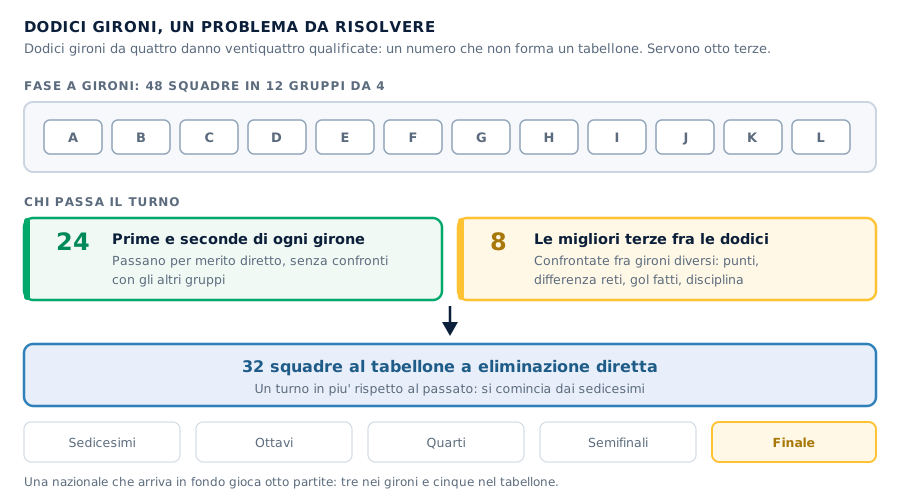
Twelve groups of four produce twenty-four qualifiers if only the top two go through. Twenty-four is not a power of two: it cannot form a knockout bracket.
The chosen answer is to take the eight best third-placed teams, comparing results across different groups. That gives thirty-two teams and a regular bracket.
How the third-placed teams are ranked
| Order | Criterion | Note |
|---|---|---|
| 1 | Points won | Three for a win, one for a draw |
| 2 | Goal difference | Across the three group matches |
| 3 | Goals scored | Rewards the side that attacked more |
| 4 | Disciplinary record | Yellow and red cards received |
| 5 | Drawing of lots | Only if every earlier criterion matches |
The fourth criterion is the surprising one. A nation can go out on one card too many rather than on a result: it is rare, but the rules allow for it.
The bracket
The thirty-two qualifiers form a bracket beginning with the round of 32, one round more than before. Then come the round of 16, quarter-finals, semi-finals and final.
A team reaching the end plays eight matches: three in the group and five in the knockout stage. In knockout ties a level score means extra time and then penalties, following the logic described in the guide to how play-offs work.
Qualifying
Teams reach the final tournament through separate competitions, one per continental confederation. Places are distributed according to the number of member associations and the level of football in each area.
| Confederation | Area | Typical qualifying format |
|---|---|---|
| UEFA | Europe | Groups, then play-offs for the last places |
| CONMEBOL | South America | A single group of every nation, home and away |
| CAF | Africa | Groups and knockout rounds |
| AFC | Asia | Successive rounds with progressive elimination |
| CONCACAF | North and Central America | Preliminary rounds and a final group |
| OFC | Oceania | A short tournament, with few places available |
The South American single group is the hardest of all: everyone against everyone, home and away, with fewer places than there are strong nations. The Copa America page covers it too.
The intercontinental play-offs
Some places are not assigned to a single confederation but contested between nations from different areas, in a short tournament shortly before the final stage.
It is the mechanism that lets a team from Oceania or Central America win a place that would not otherwise exist.
Who qualifies without playing
The host country enters the final tournament automatically. When there is more than one host, as is increasingly common, the reserved places rise accordingly.
It is a debated rule, because it takes places from the qualifying competition of the confederation involved. The justification is practical: a country investing in staging the tournament needs certainty that it will take part.
Points in the groups
The ordinary three-point criterion applies, as described in the guide to the points system. With only three matches played, though, a draw weighs far more than it does across a thirty-eight-round league.
Posizioni e qualificazioni
| Group position | Consequence | Note |
|---|---|---|
| 1st | Round of 32 | In theory a kinder tie |
| 2nd | Round of 32 | Through on direct merit |
| 3rd among the best eight | Round of 32 | Taken through by comparing groups |
| 3rd outside the best eight | Elimination | Can come down to cards |
| 4th | Elimination | No route back |
Why finishing first is worth it
The bracket is drawn up in advance, so group position sets the road ahead. Winning a group normally means meeting a runner-up or a third-placed team rather than another group winner.
It is the same principle as the pre-set bracket described on the Coppa Italia page: the opponents are known round by round in advance.
What the winner takes
The tournament awards the title of world champion, held for four years. The winner also earns entry to certain FIFA competitions for national teams and clubs.
There are no consequences at the other end: no nation is relegated and none loses rights for playing badly. That is the main difference from the club competitions described on the Serie A page.
The world ranking
Results feed the FIFA ranking, which sets the seeding pots for later draws. A good run therefore brings advantages lasting beyond the tournament, on a logic similar to the UEFA ranking for clubs.
Premi
FIFA distributes part of the revenue the tournament generates to those taking part. The split follows two criteria, plus a third and less familiar channel.
The channels
| Channel | Who receives it | Criterion |
|---|---|---|
| Participation payment | Every qualified association | Equal for all |
| Performance payment | Associations, by round reached | Rises with each round passed |
| Club benefits | The clubs registering the called-up players | Proportional to days spent away |
The channel that concerns clubs
The third channel is the least known and the most interesting. Clubs that release their players to national teams receive a payment, calculated on the days the player spends with his association.
The reason is that during the tournament the club loses the player, keeps paying his wages and carries the injury risk. The payment covers part of that.
There is also insurance cover for injuries sustained on international duty, protecting clubs such as those described on the Juventus and Inter pages.
What it means for a smaller association
For an association with limited resources, qualification alone can be worth more than years of ordinary activity. It is one of the arguments that drove the expansion to forty-eight teams: more places mean more associations reaching that money.
What is not included
Player bonuses are not set by FIFA but by each association, negotiating with its own squad. The sums vary enormously from country to country and are not comparable.
Calciomercato
The World Cup has no transfer rules of its own, but it affects transfers more than any other competition.
The release obligation
International rules require clubs to release called-up players to national teams within set windows. It is not a courtesy: it is an obligation, and refusal brings sanctions.
The player stays under contract with his club, which keeps paying his wages. The subject is covered in the guide to clauses and contracts.
The shop-window effect
A good tournament can multiply a player’s valuation within weeks. It is the most visible effect, and it pushes many clubs to close deals before the final stage, while prices still reflect the season just gone.
There is a flip side: buying on the strength of one month’s form means buying on a statistically thin sample. The dynamics are described in the guide to how the transfer market works.
The transfer calendar
Session dates are set by associations within international limits, as the guide to transfer windows explains. When the tournament falls at an unusual time of year, the windows move accordingly.
Coming back
Players who reach the closing stages return to their clubs with only a few weeks off, often once pre-season has already begun. Clubs with many internationals therefore start the season with part of the squad behind on fitness.
It is one reason squads have to be deep, on the logic set out on the club pages and on the Champions League page.
Approfondisci
-
UEFA European Championship
The European championship for national teams: qualifiers, play-offs and finals
-
-
-
-