Individual awards recognise a single player or coach, as distinct from the trophies won by teams. Some come from a vote, some from a calculation on a numerical figure, others from a decision by the league that runs a competition. Understanding who awards a prize is the quickest way to understand what that prize actually measures.
In short#
- Awards are grouped by who decides them, not by prestige.
- The Ballon d’Or is voted by one hundred journalists, one per country.
- The FIFA award gathers votes from coaches, captains, press and public.
- The Golden Shoe is not voted: goals are multiplied by a coefficient.
- A league’s top scorer almost never wins the Golden Shoe.
- Every league has its own awards, valid only within that competition.
- No individual award brings coefficient points or European places.
What individual awards are#
An individual award recognises the performance of one person over a defined period, usually a season or a calendar year. It is not a sporting trophy: it is not won on the pitch in a match, but granted by an outside body under criteria set in advance.
The difference from team trophies is substantial. Winning a league depends on points accumulated, under the rules described in the guide to the points system. Winning an individual award depends instead on who grants it and on what that body chose to measure.
Here are the four main families, separated by how they are decided.
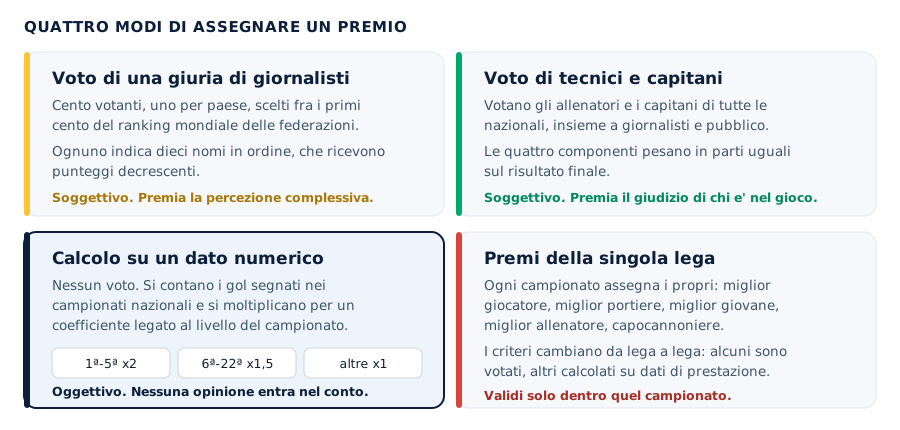
| Award | Decided by | How | What it measures |
|---|---|---|---|
| Ballon d’Or | A specialist magazine, with UEFA | Vote of one hundred journalists | Overall performance across the season |
| FIFA award | The world federation | Vote of coaches, captains, press and public | The judgement of those inside the game |
| Golden Shoe | The association of European leagues | Calculation, with no vote | Goals scored, weighted by league |
| League awards | Each individual league | Vote or performance data | Performance within that league |
Why there are so many awards#
The number of honours has grown a great deal in recent decades, for three reasons.
- Nobody holds the rights. There is no single body that awards the official prize for the best player. Magazines, federations and leagues each have their own, and they coexist.
- Different roles and categories. A forward and a goalkeeper cannot be judged by the same measure, and awards have multiplied to cover positions, age brackets and categories.
- Commercial value. An award generates attention, a ceremony and broadcasting rights. It is an editorial product as well as a recognition.
The consequence is that two awards can go to two different people in the same season without either being wrong. They measure different things, with different juries and different reference periods.
The voted awards#
The Ballon d’Or#
It is the best known. The jury is made up of one hundred specialist journalists, one for each of the first hundred countries in the world federation ranking. Each voter names ten players in order of merit, chosen from a shortlist of thirty published some weeks earlier.
The ten names receive descending point values, and the sum produces the final order. The reference period is the season, from August to August, rather than the calendar year. The change makes the award coincide with the span in which leagues and international competitions are actually played.
The structure of the vote explains why the award tends to favour those who won a lot and did so visibly. A journalist following a distant league judges mainly what has been seen, and the most widely watched matches are those of the Champions League and the national team tournaments.
The FIFA award#
The world federation grants its own recognition through a different mechanism. National team coaches, national team captains, a jury of journalists and the public through the official site all vote. The four components carry equal weight in the result.
Involving coaches and captains is the substantial difference. These are people who practise the game, and their judgement tends to value aspects less visible to an outside observer.
Why two awards can diverge#
It happens that the two main honours go to different people in the same year, and it is not an anomaly. The juries are composed differently, the reference periods do not always coincide, and the shortlists are drawn up by separate bodies.
Anyone looking for the definitive award will be disappointed: there is none. There are several answers to the same question, produced by mechanisms that measure different things.
The award that is not voted#
The Golden Shoe is the European recognition for the leading scorer, and it is the only major award with no vote at all. The winner is determined by calculation, which makes it the most predictable and the least disputed.
Goals scored in league matches are counted and multiplied by a coefficient tied to the standing of that league in the UEFA coefficient. Goals in domestic cups, European competitions and national team tournaments are not counted.
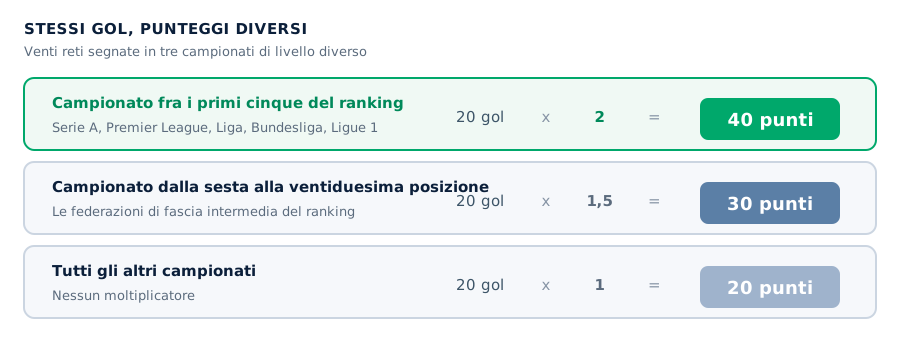
The coefficient is two for leagues among the top five of the ranking, one and a half for those between sixth and twenty-second, and one for all the others. The bands are updated every year along with the ranking, so a league can change multiplier from one season to the next.
Top scorer and Golden Shoe are not the same#
This is the most frequent misunderstanding. The top scorer is the leading marksman of a single league, determined by counting goals with no coefficient. The Golden Shoe compares scorers across every European league by applying the multiplier.
It follows that the top scorer of Serie A or the Premier League can win both. The top scorer of a lower-ranked league wins the first but has almost no chance at the second, even scoring considerably more.
Awards given by individual leagues#
Every league grants its own honours, valid only within it. Five categories recur.
- Player of the season. Usually voted, with juries that vary: coaches, captains, journalists or a combination.
- Goalkeeper of the season. Often decided on performance data, such as saves relative to shots faced.
- Young player of the season. Reserved for those within an age bracket set by the rules.
- Manager of the season. Assesses the result relative to expectations and to the club’s resources.
- Top scorer. The only one determined by a pure count, with no vote.
There are also monthly awards, goal of the season prizes and honours for individual positions. The picture changes from league to league: Serie A, the Premier League, LaLiga, the Bundesliga and Ligue 1 each have their own list, and the criteria are not comparable.
Lower divisions grant their own awards too. Serie B and Serie C name a player, goalkeeper and young player of the season, with juries and criteria set by their respective leagues. They are less visible but no less relevant to careers: they are often a player’s first public recognition before moving up.
Why league awards cannot be compared#
Two honours with the same name but granted by different leagues do not measure the same thing. The jury, the period, the criteria and the level of opposition all differ.
It is the commonest error when comparing players from different leagues. The best player of a league is the best relative to that context, not in absolute terms, and no league award is designed to be set against another’s.
Awards in national team tournaments#
Competitions between national teams also grant individual honours, with one important difference: the reference period is the single tournament, not a season.
The World Cup and the European Championship name a best player, best goalkeeper, best young player and top scorer of the tournament. The assessment therefore covers a handful of matches compressed into a month, which makes it far more exposed to chance than a seasonal award.
The same applies to the Copa América and the other continental tournaments, and to a lesser extent to the Nations League, which instead unfolds across several windows over two years.
The recurring criticisms#
Voted awards are debated every year, and the objections recur with regularity. They are worth knowing, because they clarify what an award can and cannot measure.
- The weight of visibility. A journalist judges mainly the matches seen, and the most watched are those of the international competitions. Playing in a less broadcast league is a disadvantage at equal performance.
- The advantage of forwards. Goals are the easiest unit to remember. Defenders and defensive midfielders rarely win the major awards, and not because they contribute less.
- The effect of team trophies. Those who win a lot with their club collect more votes, even when their personal performance was not superior to others’.
- The shortlist. It is drawn up by a private body, and anyone outside the thirty names cannot be voted for, however well they played.
Awards calculated on a numerical figure escape these objections but carry one of their own: they measure a single thing. The Golden Shoe records goals and nothing else, ignoring everything else a forward does on the pitch.
What awards do not carry#
It is worth clarifying what an individual award does not produce, because the confusion is common.
- No coefficient points. Awards do not affect the UEFA coefficient or the club ranking.
- No European place. Qualification for the European competitions depends only on team positions.
- No effect on the table. An award brings no league points and does not move the winner’s club by a single position.
- No automatic contractual effect. Many contracts do, however, include bonuses tied to individual honours, as described in contract clauses.
The most concrete practical effect is on the transfer market. An international honour raises a player’s valuation and bargaining power. The consequences show in the dealings described in how the transfer market works and in the transfer windows.
Frequently asked questions#
Who votes for the Ballon d’Or?#
A jury of one hundred specialist journalists, one for each of the first hundred countries in the world federation ranking. They are selected by the magazine that organises the award on the basis of their experience in international football.
Each voter names ten players in order of merit, chosen from a shortlist of thirty. The ten receive descending point values, and the sum of all votes produces the final order.
What period does the Ballon d’Or cover?#
The season, from August to August, rather than the calendar year. The change makes the award coincide with the span in which leagues and international competitions are actually played.
Before the change the award covered the calendar year, which meant combining the second half of one season with the first half of the next. The assessment was split across two different campaigns.
How does the Golden Shoe work?#
There is no vote: it is calculated. Goals scored in league matches are counted and multiplied by a coefficient tied to the standing of that league in the UEFA coefficient.
The multiplier is two for leagues among the top five, one and a half from sixth to twenty-second, and one for all the others. Goals in domestic cups, European competitions and national team fixtures are not counted.
Does the top scorer always win the Golden Shoe?#
No, and almost never when playing in a lower-ranked league. The top scorer is the leading marksman of a single competition, determined by counting goals with no coefficient.
The Golden Shoe compares every European league by applying the multiplier. Twenty goals in Serie A are worth forty points; the same twenty in a league with no multiplier are worth twenty.
Why do the FIFA award and the Ballon d’Or go to different people?#
Because they are granted by different bodies with differently composed juries. The Ballon d’Or is voted by one hundred journalists, while the FIFA award gathers votes from national team coaches and captains, the press and the public.
On top of that, the reference periods do not always coincide and the shortlists are compiled separately. There is no single official award: there are several answers to the same question.
Do individual awards bring points or European places?#
No. They do not affect the UEFA coefficient, bring no league points and grant no access to the European competitions, which depend only on team positions.
The full rules on earning a European place are in the guide to European qualification. The only concrete effect of awards is on a player’s market value and on the bonuses written into the contract.
Is there an award for the best goalkeeper?#
Yes, at several levels. The Ballon d’Or ceremony grants a dedicated one, FIFA has its own, and almost every league names the best goalkeeper of its competition.
The criteria vary widely. Some are voted like the other honours, others rest on performance data such as saves relative to shots faced or matches completed without conceding.
Do national team tournament awards follow the same rules?#
No. The reference period is the single tournament rather than a whole season, so the assessment covers a handful of matches compressed into a month.
The World Cup and the European Championship name a best player, best goalkeeper, best young player and top scorer of the tournament. The small sample makes these honours more exposed to chance than seasonal ones.