
Play-offs are a knockout mini-tournament played at the end of the regular season. They decide a place that the league table alone does not award, almost always promotion to the division above. Only clubs inside a range of positions set by the competition rules take part.
In short#
- A knockout mini-tournament played after the regular season.
- Only the clubs just below the automatic promotion places take part.
- The bracket is not drawn: it is built from the final league table.
- Clubs finishing higher skip a round, host the second leg and go through if the tie is level.
- Three formats: a single match, two legs, or a final at a neutral venue.
- The rules vary widely: six clubs in Serie B, twenty-eight in Serie C, four in England, two in Germany.
- Winning grants the sporting title, not automatic promotion: entry criteria still apply.
What a football play-off is#
A play-off is a series of knockout matches played once the regular season is over, that is once every club has faced all the others. It decides a place the table leaves unsettled: usually the last promotion available, and in some leagues a place in the continental competitions.
What separates it from the league is that a single defeat ends the run. What separates it from a domestic cup is that the ties are not drawn at random. They follow the final table, and the clubs that finished higher start with an advantage.
Here is how the rules differ across the four most consulted leagues.
| League | Who takes part | Format | Advantages of finishing higher | Level on aggregate | Matches to go up |
|---|---|---|---|---|---|
| English second tier | 3rd to 6th | Two-legged semi-finals, final at a neutral venue | Hosting the second leg only | Extra time and penalties | 3 |
| Serie B | 3rd to 8th | Single-match preliminary, two-legged semi-finals and final | Bye, second leg at home, parity in their favour | Better-placed club goes through | 4 or 5 |
| Serie C | 28 clubs from three groups | Group phase and national phase, then semi-finals and final | Bye, second leg at home, parity in their favour | Better-placed club goes through | Up to 10 |
| Bundesliga | 16th in the top flight, 3rd in the second tier | Two legs | Second leg hosted by the second-tier club | Extra time and penalties | 2 |
Why play-offs exist#
A single round-robin league produces a ranked table. If the number of promotion places always matched the number of clubs that deserved them, play-offs would serve no purpose. The problem appears when there are fewer places, or when awarding them automatically would drain the final third of the season of any meaning.
Federations adopt them for three reasons.
- Sporting fairness. Between third and eighth in a second division the gap is often a handful of points, accumulated across forty matches shaped by injuries, fixture congestion and individual incidents. Settling that place head to head is considered fairer than handing it to whoever finished one point ahead. How points accumulate, and which criteria separate clubs level on points, is covered in the guide to the Points system.
- Revenue. Play-offs extend the season by three or four weeks and generate knockout matches, worth far more in broadcasting rights and gate receipts than a league fixture with nothing at stake.
- Public interest. If automatic promotion were the only prize, clubs outside the top places would have nothing left to play for by midseason. The play-off range keeps ten or twelve clubs in contention until the final round.
The drawback is well known: a club can lead the chasing pack for nine months, finish third and still not go up. That is why the rules include the safeguards described below. Some leagues do without play-offs entirely, such as Serie A and most European top flights, because the title and the European places are already settled by the table.
Who qualifies and how the bracket is seeded#
The width of the range depends on how many places remain and how many clubs the league contains. Where two go up automatically and one place is left, the range starts at third. Where a single promotion place is shared between three regional groups, as in Serie C, the range widens to dozens of clubs.
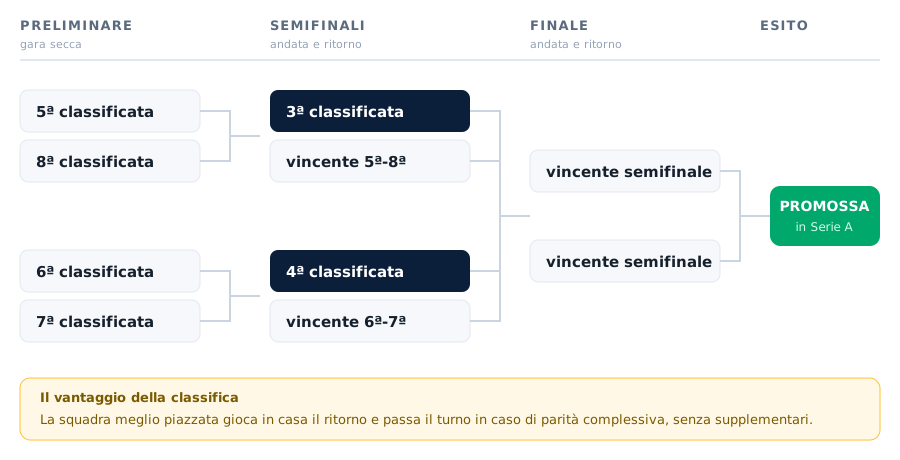
The bracket is not drawn at random. Ties are built from the regular season table, on the principle that the higher a club finished, the lower the opponent it faces. In Serie B, which uses the six-team model, fifth plays eighth and sixth plays seventh, while third and fourth skip the opening round.
The three advantages of finishing higher#
A play-off without safeguards would be unjust. Thirty-eight rounds of football would count for no more than a single match. Competition rules therefore reward the clubs that finished higher, using three devices that recur almost everywhere.
- A bye into a later round. Clubs at the top of the range skip the preliminary tie: two matches fewer and more recovery days.
- Hosting the second leg. Over two matches the better-placed club plays the return in front of its own supporters, facing the closing minutes knowing exactly how many goals are needed.
- Parity in their favour. If the two legs finish level overall, the club that finished higher goes through without extra time.
The third is the heaviest safeguard, because it turns a draw into a win. Not every league applies all three: the combination chosen reveals how far that federation wants to protect the outcome of the regular season.
The route, stage by stage#
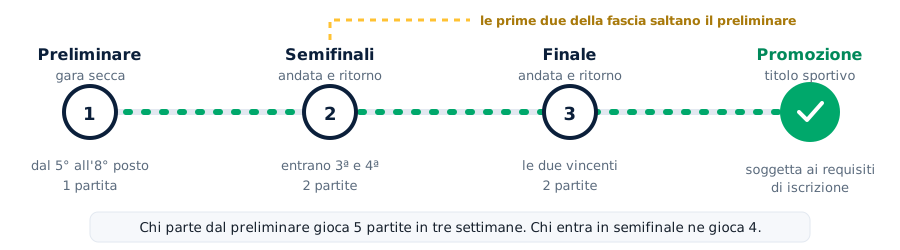
The path from the end of the league to promotion always has the same shape, whatever the number of clubs involved. What changes is the number of rounds, not the logic.
The three match formats#
Three formats cover almost every play-off in world football, and the choice between them is never accidental.
Single match#
Played once, at the ground of the better-placed club. It suits competitions with many participants and a tight calendar, because it halves the number of matches required. If the score is level after ninety minutes some rules call for extra time and penalties, while others send the higher-placed club through automatically. This is the format in which league position counts for most.
Two legs#
The scores of the two matches are added together. The away goals rule used to break aggregate ties in favour of the club that had scored more away from home. It has been abolished in the major competitions, because it discouraged the home side in the second leg. The same abolition applies in the continental competitions, as explained on the Champions League and Europa League pages. Aggregate ties are now settled by extra time, by penalties, or by league position.
Final at a neutral venue#
Played at a ground chosen in advance and neutral to both clubs. It removes home advantage and turns the match into a single event, with far greater capacity and revenue. It does require a large stadium and dedicated organisation, so it is reserved almost exclusively for the match that decides promotion.
The four main models#
The four-team model#
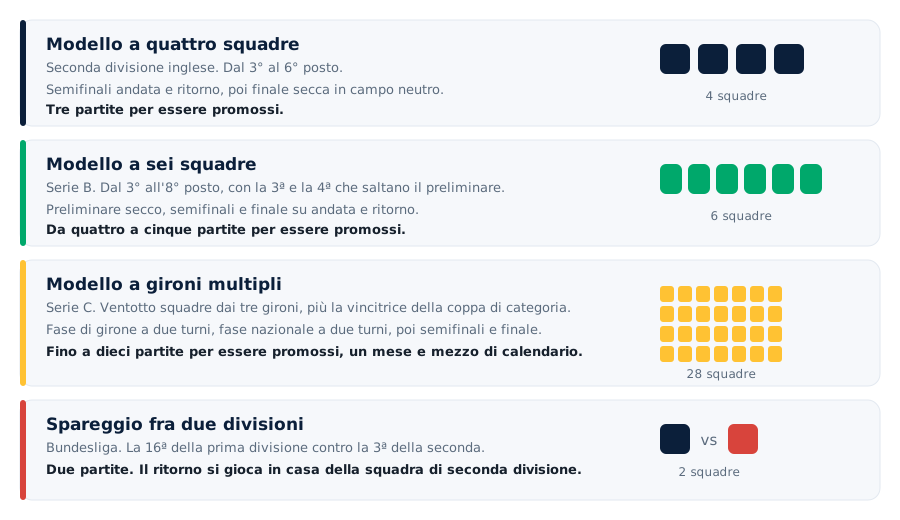
In the English second tier the top two are promoted to the Premier League. Third to sixth contest the remaining place. The semi-finals are played over two legs, with the better-placed club hosting the return. If the aggregate score is level the tie goes to extra time and penalties: league position does not decide it. The final is a single match at a neutral venue.
Three matches in total to win promotion. It is the most widely copied model in Europe. It compresses the play-off into two weeks and produces a final worth as much on its own as an entire season of revenue. Similar formats are used in the second tiers of most countries listed under Other European Leagues.
The six-team model#
In Serie B the top two go up automatically to Serie A. The third available place is decided by a play-off between the clubs finishing third to eighth. The preliminary round is a single match, the semi-finals and the final are played over two legs, and third and fourth enter at the semi-final stage.
A club starting from the preliminary round must win four or five matches in three weeks. A club entering at the semi-finals plays four, having rested through two rounds. The difference is deliberate: it makes third place considerably more valuable than eighth. The full promotion and relegation picture for that league is on the Serie B page.
The multi-group model#
Serie C is the extreme case. The league is split into three regional groups, the winner of each is promoted automatically, and a single place remains for everyone else. The play-off involves twenty-eight clubs across two phases.
- Group phase. Restricted to the clubs of each regional section, over two rounds.
- National phase. The three runners-up and the winner of the divisional cup join in, having rested in the meantime. Also over two rounds.
- Semi-finals and final. Two legs each, between the four remaining clubs.
A club entering at the first round can end up playing ten matches in little over a month for one promotion place. It is the format most criticised for fixture congestion, and also the one that most often rewards a club that started a long way back.
The play-off between two divisions#
Some leagues do not stage a play-off between clubs of the same division at all. Instead they place the two clubs either side of the dividing line against each other. In the Bundesliga the club finishing sixteenth in the top flight faces the club finishing third in the second tier over two legs. The winner plays in the top division the following season.
The second leg is hosted by the second-division club: a deliberate concession to the challenger, offsetting the gap in squad quality and experience. If the tie is level, extra time and penalties decide it, with no advantage granted for divisional status.
This format is a relegation play-off rather than a promotion one, and the general mechanism is described in the guide to How relegation works.
When the play-off is not played at all#
Many competition rules set a points threshold above which the play-off lapses. In Serie B the threshold is fourteen points. If the third-placed club finishes more than fourteen points clear of fourth, it is promoted directly to Serie A and the play-off is contested only for the remaining positions.
The reasoning is one of sporting fairness. A fourteen-point gap built over an entire season should not be overturned in two matches. It would mean that forty rounds of football count for less than a hundred and eighty minutes. The threshold is set by the league and can be revised from one season to the next, so it should be checked against the official rules in force.
The same principle applies, with lower thresholds, to individual ties. Where the rules provide for it, an excessive gap between the two clubs in a round sends the better-placed one through without the match being played.
Play-offs, play-outs and deciders#
The three terms are used interchangeably but mean different things, and the confusion is the most common source of misunderstanding.
- Play-off. Awards an additional place upwards: promotion, or in some leagues a European qualification. The criteria for earning a place in the continental competitions are set out in the guide to European qualification.
- Play-out. Decides which club is relegated among those level at the bottom. The format is similar but the stakes are reversed, and so are the safeguards: if the tie is level the better-placed club survives, so it plays not to lose. The full mechanism is in how relegation works.
- Decider. A single match between two clubs level on points, used when the table cannot separate them and the place at stake is decisive. Not a mini-tournament but one match, usually at a neutral venue.
What happens after winning#
Winning the play-off does not automatically mean being promoted. Victory confers the sporting title, that is the right to apply for entry to the division above. Entry itself requires financial criteria, guarantees and minimum stadium standards, all verified by the federation by a fixed deadline.
A club that wins on the pitch but fails those checks is not admitted. The place is then reallocated. Depending on the rules it goes to the losing finalist or to the best-placed of the clubs left out. It may also stay vacant, leaving the division above one club short.
If a club is excluded once the play-off has already begun, the bracket is redrawn. Some federations void the matches played and restart the round, while others insert the next club in line into the vacant position.
Frequently asked questions#
Who qualifies for the play-offs?#
The clubs inside the range of positions set by the competition rules, immediately below those promoted automatically. The number varies by league: four in the English second tier, six in Serie B, twenty-eight in Serie C.
The range depends on position alone, not on points. A club finishing eighth with a modest total still qualifies, while a club finishing ninth one point behind does not. The only exception concerns the gap thresholds, which can cancel the play-off entirely.
Who goes through if the two legs finish level?#
It depends on the league, and this is the difference that causes the most confusion. In Serie B and Serie C the club that finished higher in the regular season goes through without extra time: an aggregate draw counts as a win for them.
In the English second tier and in the Bundesliga play-off the tie goes to extra time and, if needed, penalties. The away goals rule no longer applies in either format, nor in the continental competitions.
Why does the third-placed club skip the first round?#
It is one of the three advantages reserved for the clubs that finished higher in the regular season. Skipping the preliminary round means two matches fewer and more recovery days before the semi-finals.
The other two advantages are hosting the second leg and progressing on aggregate parity. Together they stop an entire season counting for no more than a single match, which is the main criticism levelled at the format.
Can the play-off be cancelled?#
Yes. When the gap in the table between the clubs concerned exceeds the threshold set by the rules, the place goes straight to the better-placed club. In Serie B the threshold is fourteen points between third and fourth.
The threshold is decided by the league and can change from one season to the next. It is worth checking against the official rules listed at the foot of this page.
Is the play-off winner certain to be promoted?#
No. Victory confers the sporting title, that is the right to apply for entry to the division above. Entry also depends on financial criteria, guarantees and stadium standards, verified by the federation by a set deadline.
If those criteria are not met the place is reallocated to the losing finalist or to the best of the clubs left out. It may also stay vacant, leaving the division above one club short.
What is the difference between a play-off and a play-out?#
A play-off awards promotion or an additional place upwards. A play-out determines which club is relegated among those at the bottom of the table, and is explained in the guide to how relegation works.
The format is nearly identical but the safeguards are reversed: in a play-out the better-placed club survives an aggregate draw, so it only needs to avoid defeat.
How many matches does it take to win promotion?#
Between two and ten, depending on the league and on where a club enters. Two in the Bundesliga play-off, three in the English second tier, four or five in Serie B according to whether the club enters at the semi-finals or the preliminary round.
In Serie C a club starting from the first round can reach ten matches in little over a month. That is the main reason the format is criticised.
Are there play-offs for European places?#
In some leagues, yes. Several European federations decide the final Conference League place with a mini play-off between the clubs finishing just below the European zone, rather than awarding it on league position alone.
The number of places available to each country is not fixed: it depends on the UEFA ranking and on how that country’s clubs performed in previous seasons. The full criteria are set out in the guide to European qualification.