- 20 Clubs
- 38 Rounds
- 3 Relegated
- Aug-May Season
Regolamento
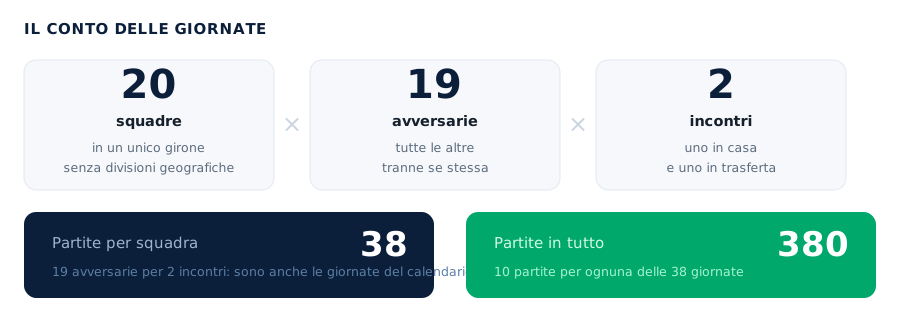
Serie A is the top division of Italian football. Twenty clubs take part, playing in a single group with no regional divisions, across thirty-eight rounds.
The format
Each club meets every other twice, once at home and once away. The calendar therefore splits into two mirrored halves, of nineteen rounds each.
The season runs from August to May, with a winter break and pauses for national team fixtures. Matches are spread across several days of the round, and clubs competing in Europe also play midweek.
The points system
A win is worth three points, a draw one, a defeat none. It is the worldwide standard, and the reasons it replaced the older two-point system are set out in the guide to the points system.
How ties are broken
When two or more clubs finish level on points, Serie A applies different criteria depending on what is at stake. It is a feature that sets the Italian league apart from those using a single sequence throughout.
| Position at stake | How it is decided | Format |
|---|---|---|
| First place | Play-off match | Single match at the better-placed club |
| Relegation | Play-off match | Two legs, then penalties |
| European places | Sequence of criteria | Head-to-head, then goal difference |
For positions awarding a European place the sequence is fixed. It applies in this order: head-to-head points, head-to-head goal difference, overall goal difference, goals scored, drawing of lots. The first criterion that separates the clubs decides, and the rest are not considered.
When more than two clubs are level a reduced table is built from the matches played among them alone. The mechanism is described in the guide to the points system, which also compares the Italian approach with that of the Premier League and the Bundesliga.
Who can enter the league
Finishing high enough is not sufficient. To be admitted, a club must obtain the national licence, which the federation grants after checking four groups of requirements.
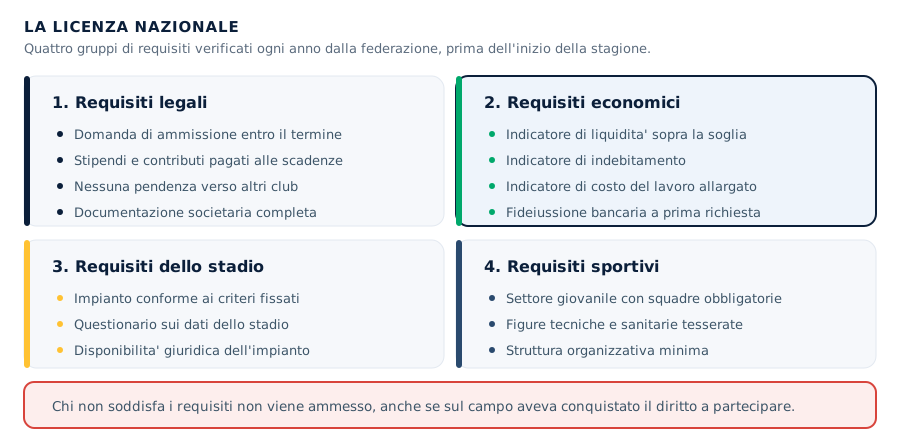
The legal requirements concern the application for admission, filed by the deadline. They include payment of wages, withholdings and social contributions by the dates set during the season, and the absence of debts towards other clubs.
The financial requirements rest on three indicators calculated from the club’s accounts: the liquidity indicator, the debt indicator and the extended labour cost indicator. The liquidity indicator is the ratio of current assets to current liabilities and must exceed a minimum threshold set in the licensing manual.
A first-demand bank guarantee must also be lodged, that is a security the federation can call in without dispute if the club defaults. The amount is set each year by the licensing manual and should be checked against the document in force.
The infrastructure requirements concern the stadium: compliance with the criteria, legal availability of the ground and filing of the stadium data questionnaire. The sporting requirements impose a youth academy with a minimum number of teams and the registration of technical and medical staff.
A club failing these requirements is not admitted, even if it earned the right on the pitch. It is one of the routes described in how relegation works for dropping a division without finishing last.
How the squad is built
Each club files a list of twenty-five players for the league. Anyone left off the list stays under contract and trains with the squad, but cannot be selected until the market reopens.
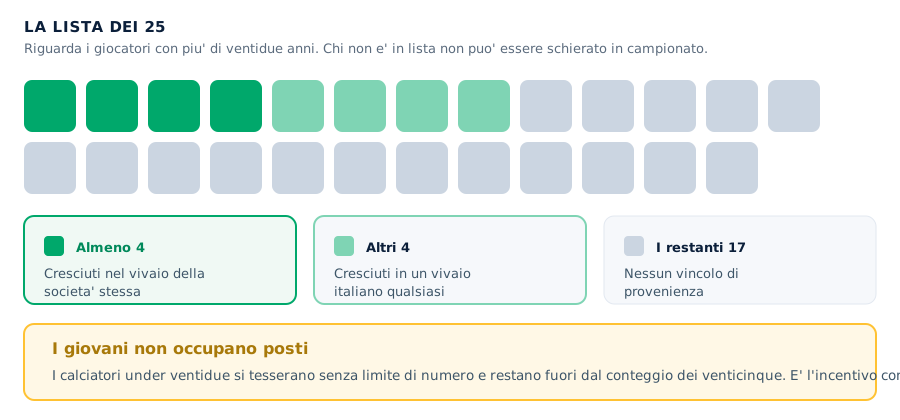
The list covers players over twenty-two, and carries restrictions on where they were developed.
- At least four must have been developed at the club itself.
- Another four must have been developed at any Italian club.
- The remaining seventeen carry no restriction.
A player counts as academy-developed once he has been registered permanently for at least three full seasons in Italy. The period that counts runs from the season he turned fifteen to the season he turned twenty-one, and the status holds even if he was loaned out in between.
Players under twenty-two take up no places on the list and can be registered without limit. It is how the rules reward clubs that field young players, and why many squads carry more youngsters than they will actually use.
The federation also caps how many players from outside the European area a club may register in a season. The quotas differ depending on whether the player is already in Italy or is being signed from abroad.
Posizioni e qualificazioni
| Position | Consequence | Notes |
|---|---|---|
| 1st | Title and Champions League | Direct entry to the league phase |
| 2nd — 4th | Champions League | Direct entry, no qualifying rounds |
| 5th | Europa League | Alongside the Coppa Italia winner |
| 6th | Conference League | Usually through a qualifying round |
| 7th — 17th | No consequence | Stay in Serie A |
| 18th — 20th | Relegation to Serie B | Automatic, with no play-out |
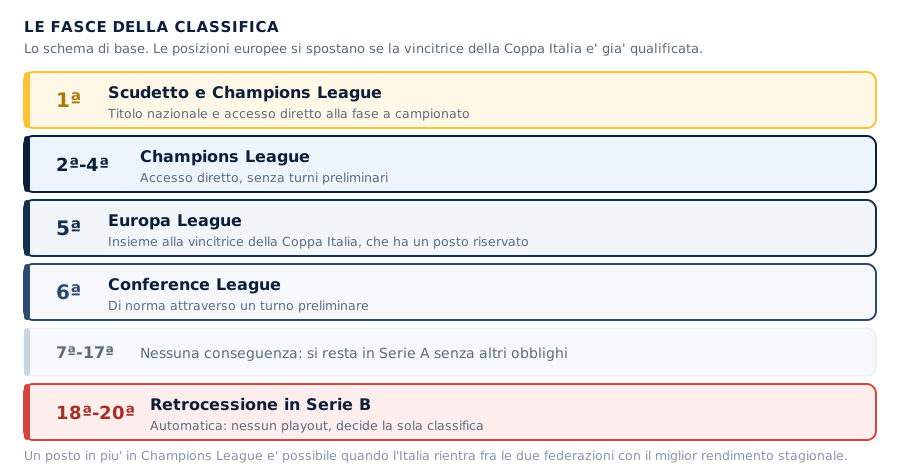
What each consequence means
First place awards the national title and a place in the Champions League. The three positions below give access to the same competition, entering the league phase directly with no qualifying rounds to survive.
Fifth place leads to the Europa League, where it is joined by the winner of the Coppa Italia, who holds a reserved place regardless of league position.
Sixth place is worth a place in the Conference League, usually through a summer qualifying round.
The bottom three are relegated to Serie B. Relegation is automatic and decided by the table alone: Serie A has no play-out, unlike the division below. The general mechanism is described in how relegation works.
When the positions shift
The table above is the starting point, but it changes in two recurring cases.
The first concerns the Coppa Italia winner. If it has already earned a European place through the league, the cup place is not lost: it passes to the club finishing immediately below the last one already qualified. The effect propagates downwards, and at the end of the chain a club expecting nothing finds itself in the Conference League.
The second concerns the winners of the European competitions. Whoever wins the Champions or Europa League enters the next Champions League even without a qualifying league position, which can alter the picture for the Italian places.
The extra place
The number of Italian clubs in the Champions League is not fixed at four. The two federations with the best performance in the season just ended receive an additional place, awarded to the club finishing immediately below those already qualified.
For Italy that means fifth place can lead to the Champions League rather than the Europa League. The calculation depends on how every Italian club performs across all three competitions, and is explained in the guide to the UEFA coefficient. The full allocation of places is in European qualification.
Premi
Serie A’s main source of revenue is broadcasting rights, sold collectively by the league and then shared among the clubs under criteria set in law.
What the champion earns
There is no separate cheque for winning the title. The reward arrives through three distinct channels, and adding them up is the only way to see what the title is really worth.
| Channel | What it involves | Order of magnitude |
|---|---|---|
| Merit share of broadcasting revenue | The largest slice of the 30% tied to results | Around twenty million |
| Champions League | Participation payment plus performance bonuses | Tens of millions |
| Commercial revenue | Sponsorship, ticketing, merchandising | Varies by club |
The figures are indicative and change with every broadcasting rights cycle: they should be checked against the league’s official documents, listed among the sources at the foot of this page. The proportions of the split, by contrast, are stable because they are set in legislation.
The third channel is the least predictable and often the largest. A title raises the value of sponsorship contracts at their next renewal, season ticket demand and international following, with effects spread across several seasons.
The biggest financial step is not between first and second place but between fourth and fifth. That is where the Champions League boundary falls, as explained in European qualification.
How broadcasting revenue is shared
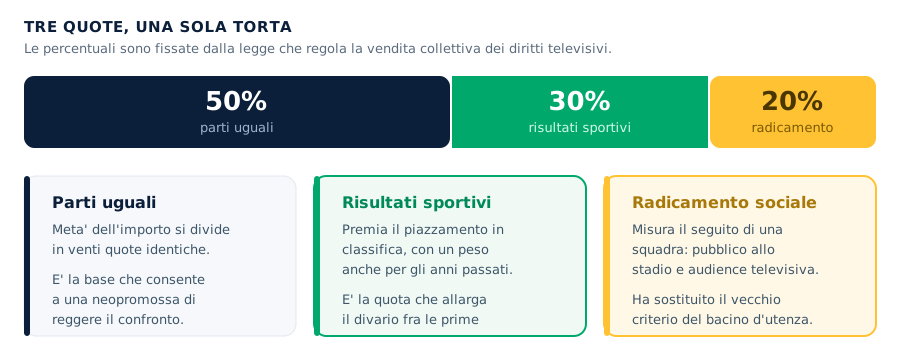
There are three proportions, set by the legislation governing the collective sale of audiovisual rights.
- Fifty per cent divided equally. Half the amount is split into twenty identical shares, one per club.
- Thirty per cent for sporting results. It rewards the final position, with some weight also given to results in previous years.
- Twenty per cent for a club’s following. It measures support through stadium attendance and television audience. It replaced the older catchment area criterion.
The overall amounts change with every rights cycle and should be checked against the league’s official documents, listed among the sources at the foot of this page. The proportions themselves are stable, because they are set in legislation.
Other revenue
Alongside broadcasting income come sponsorship, ticketing and commercial revenue, which each club negotiates for itself. Qualified clubs then add European participation, which brings a fixed share plus performance bonuses.
The gap between reaching the Champions League and missing out is the widest financial difference in the whole table. It shapes the decisions described in how the transfer market works.
Trophies and individual awards
The winning club receives the league trophy. The league also names the best player, best goalkeeper, best young player, best coach and top scorer, that is the player with the most league goals.
The Serie A top scorer also competes for the European Golden Shoe, where goals are multiplied by a coefficient tied to the standing of the league. The mechanism, and the reason the two awards do not coincide, is explained in individual awards.
Calciomercato
Transfer business for Serie A clubs follows the calendar set by the Italian federation, within the maximum limits laid down by the international regulations.
The windows
There are two windows. The summer one opens at the end of the previous season and closes in the first days of September, with the league already two or three rounds old. The winter one lasts a few weeks and falls in January.
Outside the windows the squad is frozen, and only players without a contract can be registered. The exact dates change every year and are announced before the season: the full picture is in the guide to transfer windows.
The formats most used
Deals are concluded under different formats, and the difference is not one of wording. What changes is who holds the contract at the end and whether the player can return.
- Permanent transfer. The contract moves for good, usually with the fee paid in instalments.
- Loan. A temporary move, with the contract staying at the original club.
- Loan with an option or an obligation to buy. With an option the choice stays open; with an obligation the purchase is already decided and merely deferred.
- Free transfer. A player out of contract moves with no fee at all.
The full picture, with the differences between the six main formats, is in the guide to types of transfer.
The constraints
Beyond the dates other limits apply. The federation sets a maximum number of registered players and caps how many players from outside the European area a club may register in a season.
The international regulations also cap loans in and out, a limit reduced progressively in recent years. Financial sustainability rules tie total spending to a percentage of revenue, and clubs exceeding the threshold face sanctions. The clauses governing what happens to wages and contracts on relegation are described in contract clauses.