- 36 Clubs
- 8 Matches each
- 1 Single table
- Jul-May Season
Regolamento
The Champions League is Europe’s leading club competition. Its structure has changed fundamentally: the four-team groups are gone, replaced by a single table holding every participant.
The format in one sentence
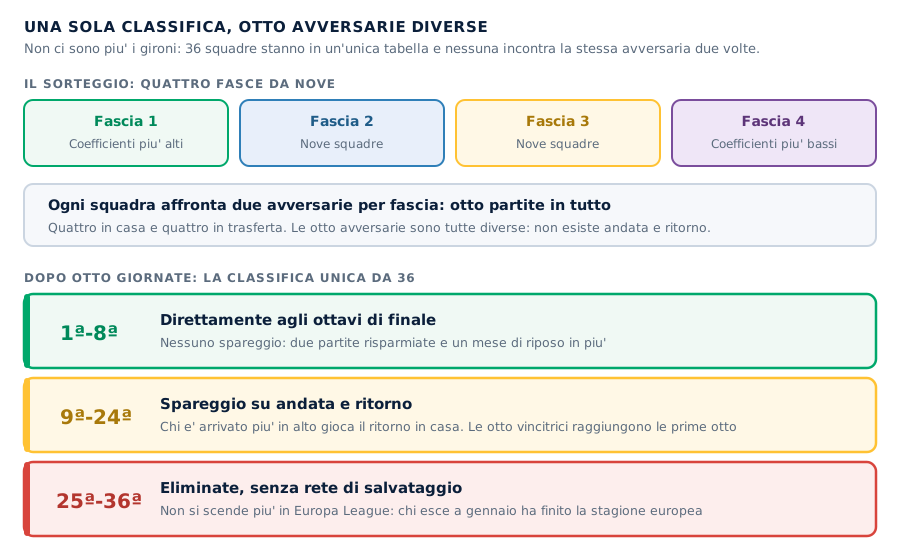
Thirty-six clubs sit in one table. Each plays eight matches against eight different opponents, four at home and four away. No club meets the same opponent twice.
How the fixtures are drawn
The thirty-six entrants are split into four pots of nine, ordered by the club coefficient explained in the guide to the UEFA ranking. Each club faces two opponents from each pot: one at home and one away.
The result is that two clubs from the same pot can end up with very differently demanding schedules. That is the main criticism of the format, and the reason the draw is run by software rather than with balls.
What the table decides
| Position | Consequence | Advantage |
|---|---|---|
| 1st — 8th | Straight to the round of sixteen | Two fewer matches and a month’s rest |
| 9th — 24th | Two-legged play-off | The higher-placed club hosts the second leg |
| 25th — 36th | Elimination | None: the European season is over |
The most important change is the last row. Under the old format, third-placed group teams dropped into the Europa League: that no longer happens. A club out in January is finished, which makes every league-phase match heavier.
The shape of a European season
- July First and second qualifying rounds: the champions of smaller countries meet while many domestic seasons have not yet started.
- August Third qualifying round and play-offs. Losing does not mean going home: beaten clubs are redirected into the other competitions.
- September The draw and the opening league-phase rounds.
- September to January The eight matchdays, spread over five months and woven through the domestic calendars.
- February Play-offs between ninth and twenty-fourth, over two legs.
- March to April Round of sixteen, quarter-finals and semi-finals, all two-legged.
- Late May or early June The final, a single match at a neutral venue chosen years in advance.
How clubs get in
Most places go to the leading clubs of the highest-ranked leagues, under the mechanism described in the guide to European qualification. A few places are reserved for other routes.
| Route | Who benefits | Note |
|---|---|---|
| League position | The leading clubs of the best-ranked leagues | Up to four clubs per country |
| European title | The Champions and Europa League winners | The place is additional, not taken from the league |
| Country performance | The two countries with the best collective results | One extra place each, based on the previous season |
| Qualifying rounds | Champions of the smaller countries | A long road, with elimination possible from July |
The rules on the pitch
In two-legged ties the away goals rule no longer applies. Level on aggregate means extra time and then penalties, regardless of how the goals were distributed.
Player lists follow UEFA criteria distinct from domestic ones, as set out on the league pages: a player eligible in Serie A may not be eligible in Europe.
Posizioni e qualificazioni
| Outcome | Consequence | Note |
|---|---|---|
| Winning the competition | A place in the following edition | Additional to the country’s own places |
| Winning the competition | Entry to the UEFA Super Cup | Against the Europa League winner |
| Any round won | Coefficient points | They feed the country’s future places |
| Out of the league phase | European season over | There is no longer a drop to the Europa League |
What the winner takes
The trophy carries a place in the following edition. If the winner has already qualified through its league, the place is not lost: it passes to the next eligible club from that country.
The winner also enters the UEFA Super Cup, a single match against the Europa League winner.
The effect on the coefficient
Every round won produces points for the country coefficient. That figure decides how many European places will be available in later years, under the UEFA ranking calculation.
It is a loop that closes on itself: more clubs competing means more points available, and so more places in future. The contrast shows when comparing the largest countries with Ligue 1 and the other European leagues.
Premi
The Champions League distributes more money than any other club competition in the world. The split follows four distinct criteria, and understanding them explains why some clubs chase qualification harder than their domestic title.
The four channels
| Channel | How it is calculated | Who it favours |
|---|---|---|
| Participation fee | Equal for every qualified club | Clubs from smaller countries |
| Results | A payment per win and per round reached | Clubs that go deep |
| League-phase position | One step for each place among the thirty-six | Clubs finishing the league phase high |
| Market value and coefficient | Size of the television market and the club’s European history | Clubs from the largest countries and histories |
The last channel is the most contested. It rewards the past and the size of the home market rather than what a team did on the pitch: two clubs with identical runs can receive very different sums.
Why merely taking part changes a balance sheet
The participation fee, equal for all, on its own exceeds the annual broadcasting income of many mid-sized clubs. That is why the race for fourth place in a domestic league is worth more than a national cup.
Added to it are gate receipts from home matches and the value of commercial contracts, which rise with the European stage.
The solidarity share
Part of the revenue is distributed to clubs that did not qualify, including lower-division sides that trained players competing in the tournament. It is separate from the mechanism described in the guide to the transfer market, but it answers the same logic.
What does not pay
The title itself carries a modest payment compared with the road to it. Almost all the money accumulates along the way: a club can earn more reaching the semi-finals as a seed than by winning after coming through the qualifying rounds.
Calciomercato
European qualification changes how a club operates in the market, and the competition’s rules impose constraints the domestic league does not.
The UEFA list
Each club files a list of players eligible in Europe, with a numerical ceiling and places reserved for club-trained and association-trained players. Anyone off the list does not play, even while properly registered domestically.
The list can be changed only within limits after the league phase. It is one reason certain January deals close in a hurry, as described in the guide to transfer windows.
The rule that catches people out
A player who has already appeared for one club cannot play the competition for another in the same season. Narrow exceptions exist, and the bar applies across the different UEFA competitions too.
That constraint shapes the January market: a signing who has already played in Europe is unusable in the cup until the following year.
Bonuses in contracts
Qualification and rounds reached are among the most common bonuses in player and coach contracts, alongside appearances. How they work is explained in the guide to clauses and contracts.
The effect on negotiations
| Situation | Effect on the market |
|---|---|
| Qualification secured | More certain revenue and greater appeal to players |
| Qualification missed | Wage-reduction clauses and forced sales |
| Elimination in January | Revenue lost mid-season, with the squad already built |