The UEFA coefficient is the ranking that measures how federations and clubs have performed in European competition. It awards no trophy: it decides how many clubs each country can enter, which round they start from and who they are drawn against. It is why fifth place in one league can be worth the Champions League and in another worth nothing at all.
In short#
- There are two separate rankings: one for associations and one for clubs.
- Points are earned by winning and drawing matches in European competition.
- Bonus points are added for every round reached.
- A country’s coefficient is the average of the points earned by its clubs.
- The total covers the last five seasons, on a rolling basis.
- It determines the number of places, the entry round and the seeding pot.
- Effects always arrive late: a single season counts for one fifth.
What the UEFA coefficient is#
The UEFA coefficient is a points system that ranks federations and clubs on the results they achieved in continental competition. It is not a sporting table in the usual sense: nobody wins it, and it produces no trophy.
It answers an administrative question. If the places available in the competitions are limited, which countries should have more of them? UEFA chose a measurable criterion: those who achieved more in previous years receive more places.
There are two rankings, and they should be kept apart because they do different jobs.
| Ranking | Applies to | Determines | Period |
|---|---|---|---|
| Association coefficient | The country | Number of places and entry round | Five seasons |
| Club coefficient | The individual club | Seeding pot and top seeds | Five seasons |
Why a ranking of this kind exists#
Without an objective measure, the distribution of European places would be a political negotiation between federations. The coefficient replaces that negotiation with a number, and produces three effects worth separating.
- Proportionality. Countries whose clubs go far in the competitions receive more places, those whose clubs go out early receive fewer. The measure is the result, not the size of the television market.
- Predictability. Clubs know in advance how many places their league will have, and can plan budgets and transfers accordingly.
- Stability. Calculating over five years stops a single poor campaign wiping out a place earned over half a decade.
The drawback is that the system feeds itself. Those with more places send more clubs, so accumulate more points, so keep more places. It is the main criticism levelled at the mechanism, and the reason UEFA introduced the corrective described further down.
How it is calculated#
The count starts from individual matches and rises to the country total, in three steps.
Points from matches#
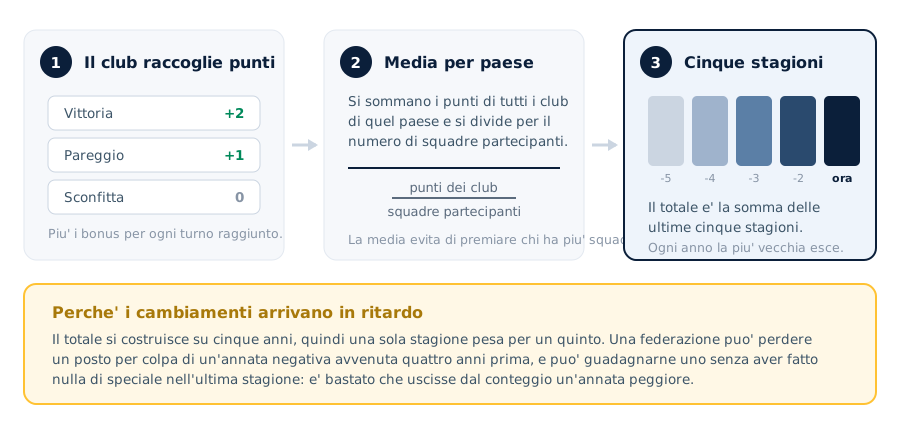
Each club earns points in European matches: two for a win, one for a draw, none for a defeat. Bonus points are added for every round reached, rewarding those who progress in the tournament.
The exact bonus values are set by UEFA regulations and are revised whenever the format of the competitions changes. They should therefore be checked against the document in force rather than assumed.
The average per country#
The points earned by all the clubs of a federation are added together and divided by the number of clubs that country entered. The result is the association’s coefficient for that season.
The division is the most important step and the least known. Without it a country with seven clubs in Europe would always accumulate more points than one with three, regardless of results. The average measures typical performance instead, and lets a small federation with two strong clubs climb the ranking.
The five-season window#
The total coefficient is the sum of the five most recent seasonal coefficients. Each year the campaign just ended comes in and the oldest drops out.
It is why effects always arrive late. A federation can lose a place because of a poor campaign four years earlier. It can also gain one without having done anything special, simply because a worse season fell out of the count.
What it decides#
The number of places#
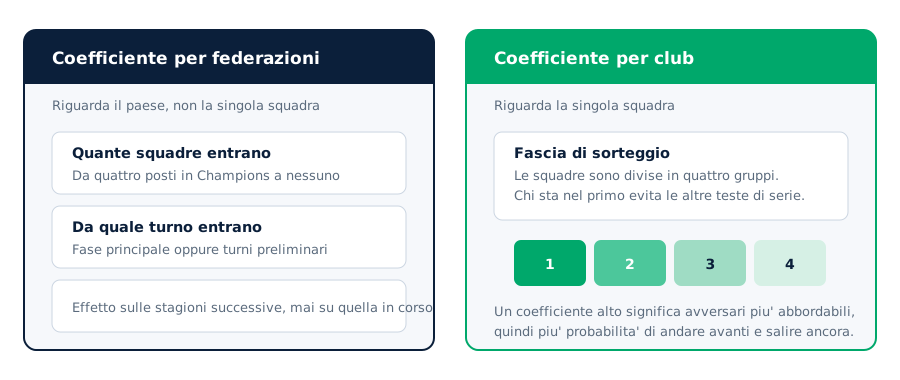
This is the most visible effect. Countries at the top of the ranking get four clubs in the Champions League, those lower down two, one, or only a place in the qualifying rounds. The full pattern of how those places are spread down the table is in the guide to European qualification.
The entry round#
Clubs from the best-ranked leagues enter the main phase directly. That applies to Serie A, the Premier League, LaLiga, the Bundesliga and Ligue 1. Clubs from lower federations must come through qualifying rounds in July and August, with pre-season barely begun and squads often incomplete.
The difference weighs more than it appears. Going out in qualifying means losing the entire European season, and with it the points that would have fed the following year’s coefficient.
The seeding pot#
Here the club coefficient comes in, which is personal and does not depend on the country. Clubs admitted to the main phase are split into four pots according to their own coefficient, and the draw pairs them across pots.
Being in the first pot means avoiding the other top seeds and facing weaker opponents on average. The advantage feeds itself: the further a club goes, the more points it earns, the more likely it stays in the first pot the year after. The same criterion applies in the Europa League and the Conference League.
The extra place for seasonal performance#
The five-year coefficient is slow by design, which penalises those improving quickly. UEFA therefore introduced a corrective that looks only at the current season.
The two federations with the best performance in the campaign just ended receive an extra Champions League place. The multi-year ranking does not count: what counts is how that country’s clubs performed that season, across all three competitions.
The place goes to the club finishing immediately below those already qualified. For a country with four base places that means fifth also enters the Champions League, a jump from the Europa League it would otherwise have had.
Who rises and who falls#
The coefficient is not a fixed photograph. Positions shift over the years, and the movements follow recurring patterns worth recognising.
- The rising federation. One or two clubs repeatedly reach the later rounds, the average climbs, the country gains a place. With an extra place it sends an extra club, which brings further points: the movement feeds itself.
- The falling federation. Clubs go out early for two or three consecutive seasons, the average drops and the place is lost. With one place fewer it becomes harder to win it back.
- The small country climbing. A single very strong club can lift the average of a federation with few entrants, because the divisor is low.
- The large country stagnating. Many clubs going out in the early rounds drag the average down even if one reaches the final stages.
This explains why the countries at the very top and the very bottom of the ranking rarely change, while movement in the middle band is constant. The federations behind the leagues listed under Other European Leagues compete every year for the places that separate direct entry from qualifying rounds.
What the coefficient does not measure#
It helps to know what stays outside the calculation, because it explains several apparent anomalies.
- Domestic leagues. Winning Serie A or the Premier League brings no points at all: only European matches count.
- Domestic cups. Winning the Coppa Italia grants a European place, but no coefficient points.
- National teams. Performance at the European Championship or the World Cup does not affect the club ranking, which is a separate table.
- Squad value. The coefficient records results, not spending: an expensive club going out early collects fewer points than a modest one that progresses.
There is also a national team ranking, used for the draws of qualifying groups and tournament groups, including the Nations League. It is a different system with its own rules and should not be confused with the club one. The same goes for the world ranking used in the draws for the Copa América and the other continental tournaments.
How to read a coefficient table#
The tables published by UEFA and reproduced by sports sites all follow the same layout, and knowing it avoids the most common misreadings.
- The season columns. Five columns, one per campaign, each with that year’s coefficient. These are the figures that enter and leave the rolling window.
- The total column. The sum of the five, and the number that determines places. It is the only column that really counts.
- The clubs column. How many that country entered, used as the divisor. A high number here makes it harder to keep the average up.
- The position. That of the current year, which determines places two seasons later rather than the immediately following one.
That last point is the most frequent source of confusion. The coefficient updated today does not change places for next season, which are already fixed: it acts on the one after. Clubs fighting for a European position in Serie A or LaLiga are therefore competing for places decided by results achieved years earlier.
The coefficient and the transfer market#
The link between the ranking and the transfer market is closer than it looks, and it works in both directions.
An extra place in the Champions League means guaranteed revenue for one more club in that league. That club can afford signings it could not before, and the decisions taken in the transfer windows change accordingly.
In the other direction, a club that misses European qualification sees its power to keep its best players shrink. Contract clauses often provide for adjustments tied to European participation, and the general mechanism is described in how the transfer market works.
It is why the coefficient is followed closely even out of season, when the European matches are over but the financial consequences are about to appear.
Frequently asked questions#
What is the UEFA coefficient in plain terms?#
It is a ranking that measures how well each country’s clubs have done in European competition over the last five years. Those higher up receive more places in the competitions.
It awards no trophy and has nothing to do with the domestic league table. It is an administrative tool that lets UEFA distribute places in proportion to results.
How are coefficient points earned?#
By winning and drawing matches in the European competitions: two points for a win, one for a draw. Bonus points for each round reached are added on top.
The exact bonus values are set by UEFA regulations and change when the competition format changes. They should be checked against the document in force, listed among the sources at the foot of this page.
Why divide by the number of clubs?#
Because without that division a country with seven clubs in Europe would always accumulate more points than one with three, regardless of results. The average measures typical performance instead.
It is the step that allows a small federation with two strong clubs to overtake a large one with many mediocre clubs. Without it the ranking would reward quantity alone.
Why can Italy have five clubs in the Champions League?#
Because on top of the four places awarded by the five-year coefficient there are two extra places, reserved for the federations with the best performance in the season just ended.
If Serie A is among those two, the place goes to the fifth-placed club, which enters the Champions League rather than the Europa League. The full pattern is in European qualification.
What is a seeding pot?#
It is the group a club is placed in before the draw, according to its own club coefficient. There are four pots, and the draw pairs clubs from different pots.
Being in the first pot means avoiding the other top seeds and facing weaker opponents on average. The advantage tends to last, because clubs that progress earn points and stay in the first pot the following year too.
Does winning the league earn ranking points?#
No. The coefficient records only matches played in European competition. Winning Serie A, the Premier League or any other domestic league brings no points.
The domestic title does grant entry to the Champions League, and it is the matches played there that produce points. The league therefore counts indirectly, by opening the door.
Why did my country lose a place for no apparent reason?#
Almost certainly because a good season from five years ago dropped out of the count, replaced by a more recent and worse one. The total updates every year through this rolling mechanism.
It is the same reason a country can gain a place without having done anything special in the latest season. The delay with which the ranking reacts is a feature of the system, not a fault.
Is the club ranking the same as the association ranking?#
No, they are two separate tables. The association ranking applies to the country and sets how many clubs enter and from which round. The club ranking applies to the individual club and sets the seeding pot.
A club can therefore have a high coefficient while playing in a country with few places, and the reverse. The two figures influence each other but remain distinct.