The transfer market is the set of dealings through which clubs exchange players. Nobody buys a person: what changes hands are the rights arising from an employment contract, and the player has to agree. Deals are permitted only in two periods of the year, and every transfer needs three separate agreements, all of which must close before the deadline.
In short#
- You do not buy a player: you acquire the contract.
- Three agreements are needed: between clubs, with the player, and registration.
- Deals are allowed only within two windows a year.
- The fee does not all reach the selling club.
- A share goes to the clubs that trained the player.
- A player out of contract moves for no fee at all.
- Financial rules cap how much a club can spend.
What the transfer market is#
The transfer market is the mechanism by which a player moves from one club to another before the natural end of the contract. The phrase misleads: there is no market in which people are bought, and no club owns a player.
What passes from one company to another is the employment contract. A professional footballer is an employee of the club, on an agreement of fixed duration. If another club wants him before that date, it has to persuade the current club to end the relationship, and pays a fee to do so.
The distinction is not formal. It explains why a player at the end of his contract moves for nothing. It also explains why nobody can be forced to change clubs, and why deals stall when the player is not convinced.
Why rules exist#
A completely free market would produce effects no federation considers acceptable. The rules answer three problems.
- Competitive balance. With no time limits a club could strengthen late in the season, after already facing its rivals. Hence the transfer windows.
- Protection of the player. A contract is an employment relationship, and the rules stop it being broken unilaterally without consequence.
- Club sustainability. Financial rules cap spending relative to revenue, to stop debt overwhelming the system.
To these is added the protection of youth development. A club that trains a player as a boy would receive nothing when another club later sells him, and without a corrective the academies would be pure cost.
Who takes part in a deal#
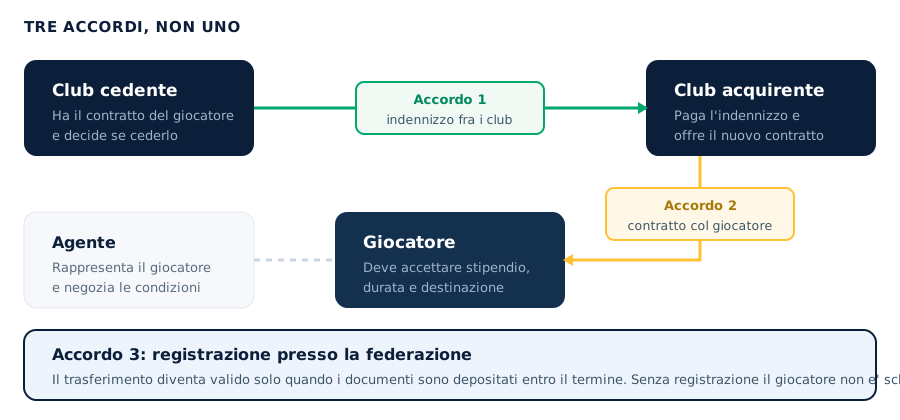
A negotiation over a contracted player is not an agreement between two parties but three, plus an administrative step.
The two clubs#
The selling and buying clubs negotiate the fee and how it is paid. The sum is almost never paid at once: it is split into instalments across several seasons, and part is often tied to future targets.
The player#
He has to accept the new contract: wages, length, role and destination. No deal closes without his consent, however firmly the two clubs agree. It is why negotiations already settled between clubs can stall for weeks.
The agent#
Represents the player in negotiating personal terms. He receives a fee, usually calculated as a percentage of the deal or of the wages, and the rules capping it have been revised several times in recent years.
The federation#
A transfer only becomes valid once the paperwork is filed before the window closes. Until then the player cannot be selected, however far he has travelled and however complete his medical.
Where the money goes#
The fee paid by the buying club does not reach the selling club in full, and the difference is often significant.
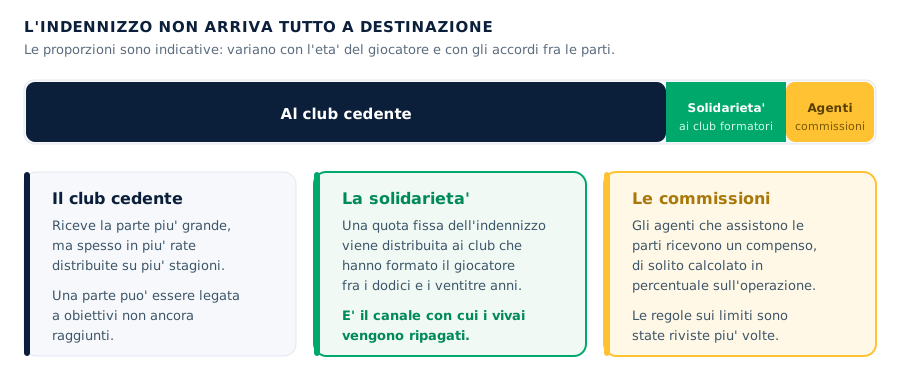
The solidarity mechanism is the least known part. A share of the fee is distributed to the clubs where the player was trained during his development years, in proportion to the time spent at each. It is the channel through which a small club is repaid for having raised a player later sold elsewhere.
There is also training compensation, due when a young player signs a first professional contract or changes club before a certain age. The two have different rules and can both apply to the same deal.
The formats a deal can take#
Not all transfers are alike. The main formats are six, and they differ in who holds the contract at the end and whether a return is possible.
- Permanent transfer. The contract passes permanently to the buying club.
- Loan. A temporary move, with the contract staying at the original club.
- Loan with an option to buy. The receiving club may purchase at an agreed figure.
- Loan with an obligation. The purchase happens anyway, or once a condition is met.
- Free transfer. A player out of contract chooses freely, with no fee.
- Swap. Two separate deals concluded at the same time.
| Format | Fee | Who holds the contract at the end | Return possible |
|---|---|---|---|
| Permanent transfer | Yes, one-off | The buying club | No |
| Straight loan | Sometimes, reduced | The original club | Yes |
| Loan with option to buy | Yes, in two stages | Depends on the choice | Yes, if not taken up |
| Loan with obligation | Yes, deferred | The buying club | No |
| Free transfer | None | The new club | No |
| Swap | Offset | Each club the other player | No |
Each carries different accounting and sporting implications, set out in detail in the guide to types of transfer.
When clubs can deal#
Transfers are permitted only in two periods of the year, called windows. The first falls between summer and the opening days of September, the second in January and is much shorter.
Outside the windows the squad is frozen. The only exception concerns players without a contract, who can sign at any time because no club has to authorise their release. The full picture, including the exceptions for goalkeepers, is in the guide to transfer windows.
The exact dates are not the same everywhere: each federation announces them before the season, within the maximum limits set by the international regulations. That applies to Serie A as much as to the Premier League and any other affiliated league.
The limits nobody talks about#
Beyond the windows there are less visible constraints, which explain why certain deals do not happen even when everyone agrees.
- Number of loans. The international regulations cap how many players a club can loan out and take in during the same season. The limit was phased in and is still being reduced: it should be checked against the document in force.
- Squad lists. Many leagues impose a maximum number of registered players, often with quotas reserved for academy graduates. One extra signing means another player left out.
- Financial rules. Spending on wages and transfers is tied to a percentage of revenue. Clubs exceeding the threshold face sanctions up to exclusion from competitions.
- Non-domestic quotas. Federations limit how many players from outside their area a club may register in a season.
Youth transfers are restricted further still. International moves are barred before eighteen, with narrow exceptions, and the rule applies equally in Serie B, Serie C and every affiliated league.
A further constraint concerns deals between clubs under the same ownership, which are monitored because the price may not reflect real value. The same principle stops two commonly owned clubs entering the same European competition, as explained in European qualification.
The four stages of a negotiation#
Deals do not begin on the day they are announced. The typical path runs through four stages, and knowing them helps in reading the news that circulates during a window.
- Identification. The club watches the player for months or years, often from when he plays in a lower division such as Serie B or Serie C. Nothing leaks at this stage.
- Approach. The club checks whether the contract holder is willing and whether the player is interested. This is when the first reports appear, often prematurely.
- Negotiation. Fee, instalments, bonuses and personal terms are agreed. The two negotiations run in parallel and can stall on a single item.
- Completion. Medical, signature and filing of the paperwork with the federation before the window closes.
The gap between the second stage and the fourth can be months. It is why the same deal is reported as done several times before it either happens or collapses.
What links the market to the pitch#
Transfer decisions do not arise in a vacuum. They depend on how the previous season went and on what the club expects from the next.
European qualification weighs most. Reaching the Champions League means guaranteed revenue and the ability to keep the best players. Missing out produces the opposite effect, and the entry criteria are described in the guide to European qualification.
At the other end, relegation forces a rebuild. The collapse in revenue makes contracts signed for the division above unsustainable, and contract clauses exist precisely to cushion that fall.
The calendar matters too. A club competing on three fronts needs a deeper squad, while one playing only the league can afford a smaller group and more concentrated wages. Clubs in the Europa League or the Conference League face the same problem on a smaller scale.
In leagues with several clubs in Europe, such as the Premier League, LaLiga, the Bundesliga and Ligue 1, competition for the same players is higher and prices rise. It is one of the indirect effects of the UEFA coefficient, which determines how many clubs in each country have that kind of revenue.
The market in the other direction#
Signings get the coverage, but for most clubs the harder part is selling. Moving a player on requires that somebody wants him, that he accepts the destination, and that his wages are affordable for the buyer.
A player on high wages with little playing time is the recurring problem. The club would like to move him on, but nobody offers the same terms and he has no reason to accept worse ones. The situation resolves in three ways. The club subsidises his wages at the new club, accepts a free transfer, or agrees to terminate the contract early.
This is also why the loan is so common. It lightens the wage bill without giving the player up permanently, and it is often the only workable option for a club with too large a squad.
Selling also has to fit the calendar. A club can be left with a gap it cannot fill if it sells abroad after its own window has shut, a situation described in transfer windows. Squad list rules add another constraint, since a signing may force somebody else out of the domestic cup or European lists.
Frequently asked questions#
What is actually bought in a transfer?#
Not the player, but the rights arising from his employment contract. The selling club gives up the existing relationship, and receives a fee from the buying club for doing so.
The distinction explains why a player at the end of his contract moves for nothing: there is no relationship left to end, so there is nothing to compensate.
Can a player refuse a transfer?#
Yes, always. No deal closes without his agreement to the new contract, however completely the two clubs have settled everything else.
It is why transfers reported as done stall for weeks. The agreement between clubs is only the first of the three steps required.
Why is a fee paid over several years?#
For accounting reasons. Spreading the outlay across seasons eases the pressure on the current year’s books and lets the buying club operate within its spending limits.
Part is often tied to future targets as well: appearances, goals, European qualification. Those sums fall due only if the condition is met.
What is the solidarity mechanism?#
It is the distribution of a share of the fee to the clubs where the player was trained during his development years, in proportion to the time spent at each.
It exists to repay youth academies. Without it, a club that raises a boy later sold elsewhere would receive nothing from the subsequent deals, and academies would be pure cost.
Why do some deals collapse at the last moment?#
Because three agreements and a registration are needed, and it takes only one of them failing to close before the deadline. A medical can go badly, the player can change his mind, the paperwork can arrive late.
A transfer becomes valid only on filing with the federation. Until then the player cannot be selected, even if he has already arrived and completed every formality.
How many players can a club take on loan?#
The international regulations cap loans in and out during the same season, with exemptions for younger players and for those developed at the club.
The limit was phased in and is being reduced progressively, so the precise number changes from year to year. It should be checked against the document in force, listed among the sources at the foot of this page.
Do financial rules stop clubs from buying?#
They do not stop it, they constrain it. Spending on wages, fees and commissions cannot exceed a percentage of the club’s revenue, calculated under criteria set by the federations.
Clubs exceeding the threshold face sanctions ranging from transfer restrictions to exclusion from the European competitions. It is why some clubs have to sell before they can buy.
Is the transfer market the same in every country?#
The international rules are common, but each federation sets its own dates, its own squad limits and its own quotas on players from outside its area.
The economic context differs too. The same deal weighs differently in Serie A, in the Premier League or in a league among the other European leagues, because broadcasting revenue differs.