Relegation means dropping to the division below after finishing the season in the bottom places. It is the mechanism that keeps the system open. No club has a guaranteed place, and every year a set number go down while as many come up from the tier beneath. How many clubs are relegated, and how they are identified, varies from league to league.
In short#
- Clubs finishing in the bottom places of the table are relegated.
- The number is fixed and set before the season starts.
- As many clubs go down as come up: the league size stays the same.
- In some leagues the last place is decided by a play-out or a relegation decider.
- Serie A and the Premier League relegate three clubs on league position alone.
- The Bundesliga relegates two and puts the third against the second tier.
- A club can go down without finishing last: points deductions and exclusions count.
What relegation is#
Relegation is the move of a club from its current division to the one immediately below, decided by its final league position. It is the opposite of promotion, and the two are linked: the clubs going down free the places taken by those coming up.
The principle is called an open system. It separates European football from the North American leagues, where the franchises are always the same and none can lose its place. In an open system sporting results decide who stays, and a historic club can find itself in the third tier within a few seasons.
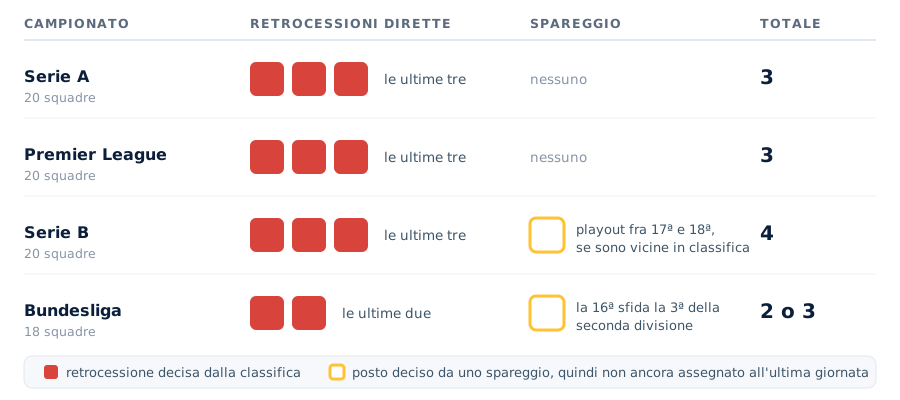
The rules are not the same everywhere. Here is how they differ across the four most consulted leagues.
| League | Clubs | Automatic relegation | Decider | Total |
|---|---|---|---|---|
| Serie A | 20 | Bottom three | None | 3 |
| Premier League | 20 | Bottom three | None | 3 |
| Serie B | 20 | Bottom three | Play-out between 17th and 18th | 4 |
| Bundesliga | 18 | Bottom two | 16th against 3rd in the second tier | 2 or 3 |
Why relegation exists#
A league without relegation would be a closed tournament: the same clubs every year, with no consequence for finishing last. European federations chose the opposite, for three reasons.
- Sporting merit. A place in the division above is earned on the pitch and lost on the pitch. No club owns it, however great its history.
- Interest until the final round. Without relegation, clubs at the bottom would have nothing left to play for by midseason. The survival fight is often followed more closely than the title race, because it involves more clubs.
- Access from below. An open system lets a club climb the divisions all the way to the top flight. It is the same ladder, descended, by those who go down.
The open system is the norm across Europe. It applies to the leagues listed under Other European Leagues and to every level of the pyramid, down to amateur competitions. It also governs entry to the domestic cup, which depends on the division a club plays in.
The cost of the model is its financial brutality. Going down means losing most of the broadcasting revenue at a stroke, with player contracts signed on the earnings of the division above. That is why almost every league provides a transition payment to the clubs just relegated, described further down.
Who goes down and how to read the table#
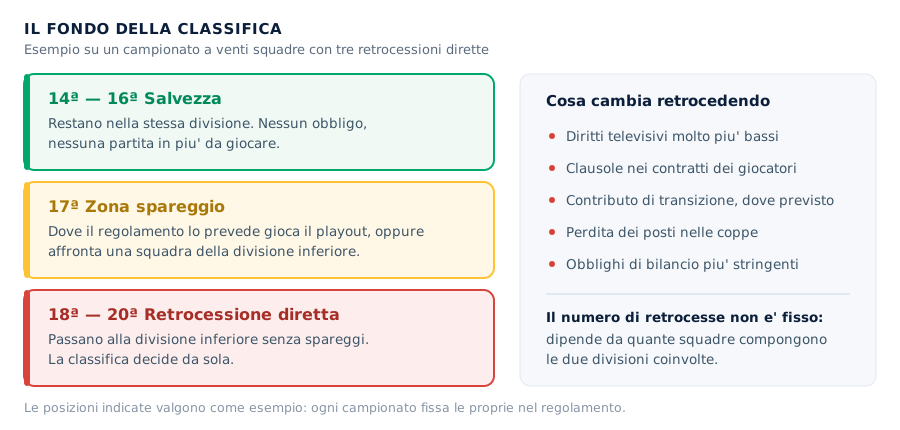
The number of relegation places is fixed by the competition rules before the season starts and does not change mid-season. It depends on how many clubs make up the division and how many make up the one below: the two league sizes have to stay stable year on year.
Three bands therefore form at the bottom of the table, and they are worth telling apart because they carry different consequences.
When two clubs finish level on points in a decisive position, the rules state which criterion separates them. Those criteria vary widely and are covered in the guide to the Points system: Serie A starts from head-to-head results, the Premier League from goal difference.
The exchange with the division below#
Relegation and promotion are two sides of the same movement. Each division sends down as many clubs as it receives from above, and receives from below as many as it sends up.
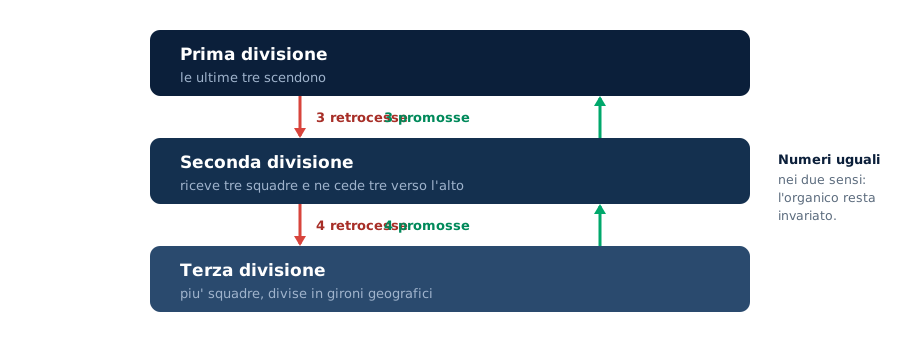
When a league decides to change the number of participants, the exchange is unbalanced for one season only. If a division goes from twenty clubs to eighteen, that year there are more relegations than promotions. It is a rare move, announced well in advance because it alters the financial planning of every club involved.
The four main models#
Relegation on league position alone#
This is the most common model. The bottom three go down, with no extra matches. It is used by Serie A, the Premier League, LaLiga and Ligue 1.
The advantage is clarity: everything is known at the final whistle, and every club knows at any moment how many points it needs. The drawback is that a club can go down by a single point accumulated over nine months, with no second chance.
Relegation with a play-out#
Serie B relegates the bottom three automatically, but the last place is decided by a play-out between the clubs finishing seventeenth and eighteenth. The play-out is a two-legged tie: the loser of the aggregate goes down.
The tie is only played if the two clubs are close in the table. If seventeenth finishes more than four points clear of eighteenth, the play-out is not held and the lower-placed club is relegated directly. The threshold exists to stop a gap built over forty rounds being erased in two matches.
In the tie the lower-placed club hosts the first leg, and if the aggregate is level the better-placed club survives. These are the same safeguards used in promotion play-offs, applied in reverse: the club that did better in the league plays not to lose. How these mini-tournaments work in general is covered in how play-offs work.
A decider between two divisions#
The Bundesliga relegates only the bottom two automatically. The sixteenth-placed club faces the third-placed club of the second tier over two legs, and the winner plays in the top division the following season.
The second leg is hosted by the second-tier club, an explicit concession to the challenger. If the tie is level it goes to extra time and penalties, with no advantage for divisional status. It is the format that gives the most chances to those coming up and the fewest certainties to those already there.
Relegation from divisions split into groups#
Serie C is divided into three regional groups, which complicates the count. Each group relegates a set number of clubs, but positions are not comparable across groups. The bottom club of a strong group may have more points than the fourth-bottom of a weaker one.
The rules therefore provide for play-outs within each group and, in some cases, a comparison between the worst-placed clubs of all three. It is the most intricate model and also the one that changes most often from season to season.
The run-in#
The survival fight concentrates in the closing rounds, when gaps become unbridgeable and every point counts double. It is the period in which the rules show their effect. Where a play-out exists the race continues past the final round; where it does not, it ends at the final whistle.
Clubs in the danger zone also face a second deadline, that of the transfer market. Likely relegation changes decisions on expiring contracts and loans, because deals signed for the division above become unsustainable in the one below.
Going down without finishing last#
The table is not the only route to a lower division, and this is the part that most surprises anyone new to the game.
- Points deduction. A club breaching financial or administrative rules can be docked points. If the penalty lands mid-season, the club can end up in the relegation zone despite having earned enough points on the pitch.
- Failure to register. A club that does not file the paperwork or the financial guarantees by the deadline is not admitted to the following season, whatever its final position.
- Disciplinary exclusion. The gravest breaches carry exclusion from the competition, either immediately or from the following season.
- Insolvency. When a club ceases to exist, its sporting title is extinguished. A new company can restart from the lower tiers, but it is a different legal entity.
In all these cases the vacant place is reallocated. Depending on the rules it goes to the best of the clubs relegated on the pitch, which is reinstated, or to the best of those that missed out on promotion. If neither route is available, the division starts one club short.
What relegation costs#
The sporting consequences are immediate, the financial ones follow at once and weigh more.
The fall in broadcasting revenue is the main item, and the gap between first and second tier is almost always an order of magnitude. Player contracts are signed on the earnings of the division above, and without safeguards a relegated club would be left with an unsustainable wage bill.
Two instruments soften the blow. The first are relegation clauses in contracts, which automatically cut wages when a club goes down: the mechanism is described in the guide to contract clauses. The second is the transition payment, also called a parachute payment, made by the league for one or more seasons to clubs just relegated.
A relegated club also loses any place in the continental competitions earned on the pitch, whether in the Champions League, the Europa League or the Conference League. The entry criteria are covered in the guide to European qualification, and require the club to play in its federation’s reference division.
Frequently asked questions#
How many clubs are relegated from Serie A?#
Three. They are the bottom three at the end of the season, identified by the table alone: there are no play-outs or deciders.
If two clubs finish level on points in the decisive position, Serie A rules provide for a two-legged decider to establish who goes down. It is rare but foreseen, and differs from what happens for European places, where a separate set of criteria applies.
What is a play-out and how does it differ from a play-off?#
A play-out is a two-legged tie between two clubs at the bottom of the table to decide which of them is relegated. A play-off, by contrast, awards promotion and is explained in how play-offs work.
The format is nearly identical but the safeguards are reversed. In a play-out the better-placed club survives an aggregate draw, so it only needs to avoid defeat. In a play-off the same advantage serves to win something instead.
Why does the Bundesliga relegate only two clubs?#
Because the league has eighteen clubs rather than twenty, and the number of relegation places is proportionate to the league size. The third is not automatic: the sixteenth-placed club plays a decider against the third-placed club of the second tier.
That tie can end two ways. If the Bundesliga club wins there are only two relegations, if the challenger wins there are three. It is why the number is not fixed as it is elsewhere.
Can a club be relegated by a points deduction?#
Yes. A deduction for financial or disciplinary breaches applies to the table like any other result. It can therefore push into the relegation zone a club that had stayed up on the pitch.
Penalties imposed after the season ends take effect on the following campaign, so they do not change relegations already decided. Those imposed during the season do, and can overturn the table with only a few rounds left.
What happens if a relegated club goes bust?#
The sporting title is extinguished with the company. The place in the lower division does not pass to any automatic heir. The federation reallocates it under its own rules, usually to the best of the clubs relegated on the pitch, which is reinstated.
A new company can restart from the amateur tiers with the same name and the same colours. It is nevertheless a different legal entity, and inherits neither the place nor the earlier results.
How much does relegation cost?#
The main item is the collapse in broadcasting revenue, which between first and second tier is almost always an order of magnitude. The figures are indicative and change with every rights cycle: they should be checked against the league’s official documents.
Two instruments soften the blow: wage reduction clauses in contracts, described in contract clauses, and the transition payment made by the league for one or more seasons.
Does a relegated club lose its European place?#
Yes. Entry to the continental competitions requires the club to compete in its federation’s reference division, so relegation voids a place earned on the pitch.
The vacant place passes to the club finishing immediately below, in the order set by the rules. The full criteria are in the guide to European qualification, which also explains how the number of places per country depends on the UEFA coefficient.
Are there leagues without relegation?#
Yes, but not in Europe. The North American leagues are closed systems: the participating franchises are always the same and none can lose its place, whatever the results.
The European model is the open one, in which a place is earned and lost on the pitch. It is why in Europe a historic club can end up in the third tier, something impossible in a closed competition.