In football the referee punishes misconduct with two cards: a yellow card is a caution, a red card a sending-off. A yellow card has no immediate effect, but two yellows in the same match become a red. A red card forces the player off the pitch and brings at least a one-match ban. Off the pitch, cautions also add up: past a threshold that varies by competition, the player misses a match.
In short#
- A yellow card is a caution, a red card a sending-off: the offences behind them are listed in Law 12.
- Two yellows in the same match equal a red, and the team plays on with ten.
- A sending-off always brings at least a one-match ban, which the disciplinary body can extend.
- Cautions add up over the season and, past a threshold, trigger a suspension.
- In Serie A the first ban for accumulated cautions comes at the fifth booking; a player one booking away is on a warning.
- In UEFA competitions three yellows are enough, but the count is wiped after the quarter-finals.
- Bans are served in the competition set by the rules: a red card in a cup is normally served in that cup.
What cards are#
Cards are the referee’s way of announcing a disciplinary sanction. A yellow card means a caution, a formal warning. A red card means a sending-off: the player must leave the pitch and the area around the bench, and cannot be replaced.
The offences that lead to cards are written in Law 12 of the Laws of the Game, set by The IFAB for every national association. The Law separates a foul, punished with a free kick, from misconduct, punished with a card. The two can coincide, but not always.
A foul committed carelessly is just a foul: the free kick is given and that is all. A foul committed recklessly, with disregard for the danger to the opponent, earns a yellow. A foul committed with excessive force, endangering the opponent, earns a red.
The referee can take disciplinary action from the pre-match inspection of the pitch. That power lasts until the referee leaves the pitch after the match, including any penalty shoot-out. If a player commits a sending-off offence before kick-off, that player cannot take part in the match.
The table sums up the main differences between the two cards.
| Aspect | Yellow card | Red card |
|---|---|---|
| Meaning | Caution | Sending-off |
| Effect on the pitch | None, the player stays on | The player leaves, the team is a player down |
| Substitution | Possible | Not possible |
| Suspension | Only through accumulated cautions | Always, at least one match |
| Can be shown to someone on the bench | Yes | Yes |
| Reviewable by VAR | Only for mistaken identity or a wrong second yellow | Yes, if a direct red |
Why cards exist#
Coloured cards arrived at the 1970 World Cup. Before that, referees announced cautions and sendings-off only verbally, and language barriers between referees and players caused confusion. Colour solved the problem: it is a signal everyone understands, on the pitch and in the stands.
- Protecting players. Safety is the main purpose. The red card for serious foul play exists to discourage challenges that can cause serious injury.
- Defending the spirit of the game. Simulation, time-wasting and tactical fouls are punished because they take something away from the match, even without endangering anyone.
- Giving the referee visible authority. A card shown in front of everyone ends the argument and makes it clear to all what has happened.
- Grading the sanction. A yellow is a warning, a red a punishment. The system separates behaviour that needs correcting from behaviour that must stop at once.
- Linking the pitch to the disciplinary system. Every card goes into the match report and becomes the basis of the disciplinary body’s decisions.
There is also a reason of continuity. Without progressive sanctions, a player could commit tactical fouls repeatedly and pay only a free kick each time. Accumulated cautions make even behaviour that looks worthwhile in a single match costly over time.
The downside is subjectivity. The line between a yellow-card foul and a red-card foul depends on the referee’s judgement, and two referees can see the same challenge differently. VAR has reduced errors on direct red cards, but it cannot intervene on most cautions.
How yellow and red work on the pitch#
Each card has its own procedure and precise consequences for the match.
Cautionable offences#
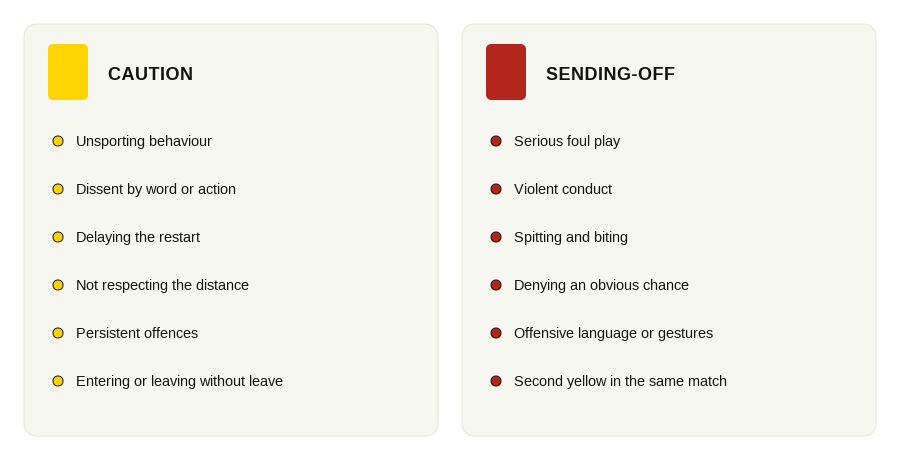
Law 12 lists the behaviour that leads to a caution. The most common are listed here.
- Unsporting behaviour, which includes simulation, reckless fouls and fouls that stop a promising attack.
- Dissent by word or action.
- Delaying the restart of play.
- Failing to respect the required distance at free kicks, corners and throw-ins.
- Persistent offences, with no set number defining them.
- Entering or leaving the pitch without permission.
- Entering the referee review area and excessive use of the TV signal.
Celebrations can also earn a yellow. Removing the shirt, covering the head, wearing a mask or climbing a fence dangerously all lead to a caution, even if the goal is later disallowed.
Sending-off offences#
A direct red card is reserved for the most serious offences, listed here.
- Serious foul play, meaning a challenge for the ball with excessive force or that endangers the opponent.
- Violent conduct, even away from the ball and even without contact.
- Spitting and biting.
- Denying an obvious goal-scoring opportunity with a foul or a handball.
- Offensive, insulting or abusive language or gestures.
- A second caution in the same match.
- Entering the video operation room.
The obvious goal-scoring opportunity#
The most debated case is denying an obvious goal-scoring opportunity, often shortened to DOGSO. To decide, the referee considers the distance to goal, the direction of play, the likelihood of controlling the ball and the number of defenders. “Last man” is a common expression, but it is not a term in the Law: the opportunity counts, not the defender’s position.
Inside the penalty area the Law is more lenient. If the defender denies the opportunity while attempting to play the ball, the referee awards a penalty and shows a yellow. If the defender holds, pushes or has no chance of playing the ball, the red card stands.
Advantage and cards#
If the referee plays advantage, the card is shown at the next stoppage. There are some exceptions. If advantage is played after a promising attack was stopped, there is no caution. If it is played after an obvious goal-scoring opportunity was denied and the team scores, the foul goes unpunished by a card.
Coaches and staff#
Since 2019, cards can also be shown to coaches and bench staff. Dissent, repeatedly leaving the technical area and gesturing for a card lead to a yellow. Throwing objects, entering the pitch to confront officials or using offensive language lead to a red. If the referee cannot identify the offender, the senior coach receives the sanction.
Accumulated cautions#
Off the pitch, every caution is recorded. Past a certain threshold, the player is banned for one match even without ever being sent off. The thresholds are not set by The IFAB: they are set by national associations and by the organiser of each competition.
In Serie A#
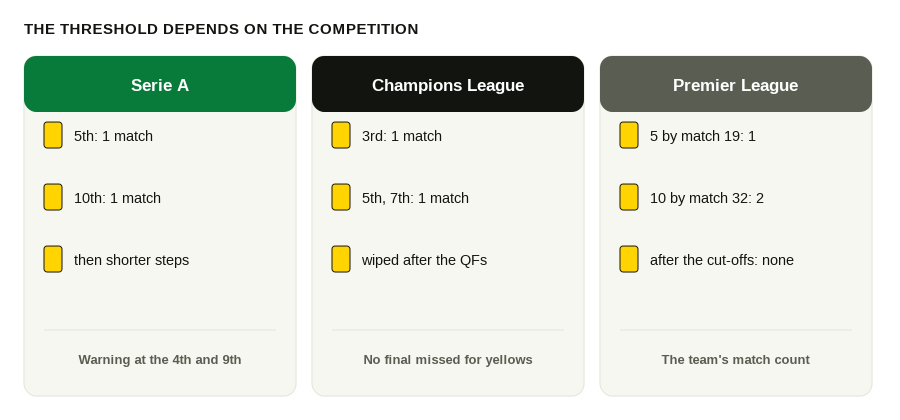
In Serie A the first ban for accumulated cautions comes at the fifth booking, the second at the tenth. After that, the thresholds get shorter. A player with only one booking to spare, at four and then at nine, is “diffidato”, on a warning: one more yellow means missing the next match.
The warning is a typically Italian term. It appears in the disciplinary judge’s statements, next to the player’s name. For a coach it is important information: fielding a player on a warning before a decisive match is a calculated risk.
In the other Italian divisions#
The Italian football federation’s disciplinary code sets different thresholds for professional and amateur leagues. Serie B follows rules similar to Serie A. In lower divisions, such as Serie C and the amateur leagues, the first threshold is lower.
The Coppa Italia has a separate count: one match ban for every two cautions, served in the cup itself. In professional play-offs and play-outs, league cautions do not count, and a second caution during those ties brings a ban.
In UEFA competitions#
In the Champions League, Europa League and Conference League, three cautions bring a one-match ban. Further bans follow at the fifth, the seventh and every subsequent odd-numbered caution. Cautions that led to a sending-off in the same match do not count.
The special feature is the reset. All cautions are wiped at the end of the quarter-finals. That way a player cannot miss the final for a yellow received in the semi-final, unless sent off.
In the Premier League#
In the Premier League the system is tied to the fixture list. Five cautions by the team’s nineteenth league match bring a one-match ban. Ten cautions by the thirty-second bring a two-match ban. Once those matches have been played, the corresponding threshold no longer applies.
In La Liga, the Bundesliga and Ligue 1, as in the other European leagues, thresholds are set by each federation and league. The numbers differ, but the principle is the same: a ban for accumulated cautions only applies to the competition in which the yellows were received.
What happens after a sending-off#
A red card has immediate consequences and others that follow in the days after the match.
On the pitch#
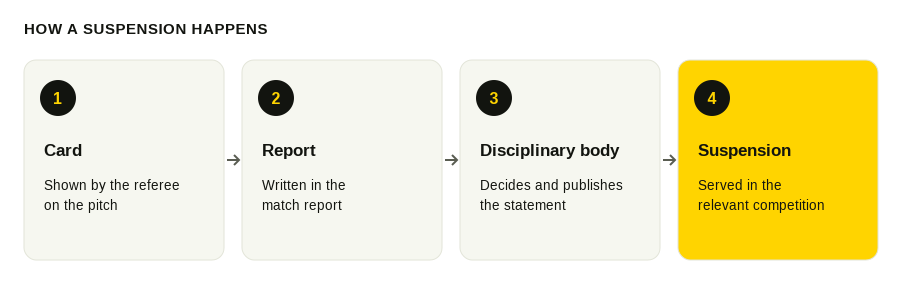
The player sent off must leave the pitch and the bench area. The team plays on a player down, because a sent-off player cannot be replaced. If a team is reduced to fewer than seven players, the match cannot continue.
The report and the disciplinary body#
After the match the referee writes the report, describing every caution and sending-off. The disciplinary body reads it and publishes its decisions in an official statement, usually in the days after the round. In Italy a player who is sent off automatically receives at least a one-match ban.
Bans for sendings-off apply to players in every league, from Italian football to European football. The disciplinary body can extend the ban according to the seriousness of the offence. Violent conduct, insulting the referee or behaviour after the sending-off lead to longer bans. The captain may receive a heavier sanction, because of the responsibility the role carries.
Where the ban is served#
In Italy a ban received in the league is served in the league. One received in the Coppa Italia is served in the Coppa Italia. Domestic cups run by different leagues are treated as separate competitions. Bans received in European cups are served in UEFA competitions, and in the most serious cases UEFA can extend them to other competitions. This also applies to the UEFA Super Cup.
Cautions that have not yet turned into a ban are cancelled at the end of the season. In professional leagues they are also cancelled when a player moves to a different league during the season.
Edge cases and exceptions#
The rules on cards have some grey areas. They generate the most questions after matches, and almost all of them have a precise answer in Law 12 or in disciplinary rules.
Two offences at once#
A player can commit two separate cautionable offences, even seconds apart. In that case the player receives two cautions and is therefore sent off. If the two offences happen at the same moment, the referee punishes the more serious one.
A red card cancelled by VAR#
If VAR has a direct red card cancelled, the sending-off disappears and so does the automatic ban. Under the Laws in force from 1 July 2026, VAR can also intervene on a clearly wrong second yellow card. A first yellow, and a yellow not given, remain outside its scope.
Cards for players not on the pitch#
Substitutes and players already substituted can also be cautioned or sent off. A red card to a player on the bench does not reduce the number of players on the pitch, but it still leads to a ban.
Temporary dismissals#
In youth and grassroots football, The IFAB allows national associations to use temporary dismissals, known as sin bins. The player leaves the pitch for a few minutes instead of receiving a yellow, then returns. Sin bins are not used in professional football, where the yellow card remains the only minor sanction.
The penalty shoot-out#
Disciplinary action still applies during a penalty shoot-out that decides a knockout match. A player sent off at that stage can no longer take a kick. Misconduct during the shoot-out can therefore have a direct effect on the result.
Terms that get confused#
- Caution and warning. The caution is the yellow card. The warning, the Italian “diffida”, is the status of a player one caution away from a ban.
- Sending-off and suspension. The sending-off happens on the pitch and applies to that match. The suspension is decided by the disciplinary body and applies to the following matches.
- Two yellows and a straight red. Two yellows usually lead to a single-match ban. A straight red can lead to several matches, depending on the seriousness.
- Last man and DOGSO. The first is a media expression. The Law only refers to denying an obvious goal-scoring opportunity, judged on several criteria.
- Suspension and ban from office. A suspension applies to players and coaches and is counted in matches. A ban from office applies mainly to club officials and is counted in days or months.
- Disciplinary body and referee. The referee decides on the pitch. The disciplinary body decides sanctions after the match, based on the report.
The weight of cards over a season#
A sending-off changes a match: playing with ten for a whole half sharply reduces the chances of winning. Suspensions change a season, because they remove players from the following matches. In the final stages they affect the title race, the fight against relegation and qualification for Europe.
Suspensions also affect transfer decisions. A team with several players banned or on a warning in the same position needs a deeper squad, which shows in the winter transfer windows. That is why clubs manage players on a warning carefully. A player one booking from a ban may be rested in a less important match, to be available for the next one.
There are less visible effects too. Some competitions use the number of cards as a criterion in fair play rankings, which in the past even awarded places in European competitions. Tie-breaking criteria are explained in the guide to the points system.
Finally, conduct on the pitch matters for national teams too. In major tournaments such as the World Cup, the European Championship, the Nations League and the Copa América, bans for accumulated cautions follow their own rules, set by each tournament’s organiser.
Frequently asked questions#
How many yellow cards lead to a ban in Serie A?#
In Serie A the first ban for accumulated cautions comes at the fifth yellow, the second at the tenth. After that, the thresholds get shorter and a ban comes with fewer cautions.
A player one yellow away from the threshold is on a warning. Cautions received in the Coppa Italia do not add to league cautions: the cup has its own count.
What does it mean to be one booking from a ban?#
It means having one caution to spare before a suspension. If that player receives another yellow, they miss the next match in the same competition.
In Italy this status, called “diffida”, is shown in the disciplinary judge’s statements. It is not a sanction: it is only a notice about the player’s situation.
Is a second yellow the same as a straight red?#
On the pitch, yes: the player is sent off and the team plays with ten. Off the pitch, usually not: two yellows generally lead to a single-match ban.
A straight red, on the other hand, can lead to several matches depending on the seriousness. Violent conduct or insulting the referee weigh far more than a tactical foul.
Are yellow cards reset halfway through the season?#
In Serie A, no: the count runs for the whole season and is only reset at the end. Cautions that have not produced a ban are cancelled when the season ends.
In UEFA competitions, all yellows are wiped after the quarter-finals. In the Premier League the thresholds are tied to the number of matches the team has played.
Is a ban received in a cup served in the league?#
As a rule, no. In Italy bans received in the Coppa Italia are served in the Coppa Italia, and those received in the league are served in the league.
Bans received in European cups are served in UEFA competitions. In the most serious cases UEFA can extend them to other competitions, but that is an exception.
How many yellows lead to a ban in the Champions League?#
Three are enough, as long as they did not lead to a sending-off in the same match. Further bans follow at the fifth, the seventh and every odd-numbered caution after that.
The count is wiped at the end of the quarter-finals. That way no player misses the final because of a yellow received in the semi-final.
Can a coach be sent off?#
Yes. Since 2019 referees can show yellow and red cards to coaches and bench staff. Dissent and leaving the technical area lead to a yellow, aggressive or offensive behaviour to a red.
Coaches also accumulate cautions and can be banned. A banned coach cannot sit on the bench or communicate with the team during the match.
Can VAR cancel a yellow card?#
Only in two cases: mistaken identity, when the yellow was shown to the wrong player, and a clearly wrong second yellow that led to a sending-off. The second case was introduced with the Laws in force from 1 July 2026.
A debatable first yellow stands, even if the footage shows it was harsh. The full process is explained in our guide on how VAR works.
Can a player be sent off after the final whistle?#
Yes. The referee can take disciplinary action until the players leave the pitch after the match, including a penalty shoot-out. An insult or a fight after the final whistle can cost a red card.
What happens later, for example in the tunnel, is not punished with a card. The referee records it in the report, and the disciplinary body decides the sanction.