- 1897 Founded
- 41,507 Capacity
- 2011 Stadium opened
- Turin Based in
Il club
- Fondazione
- 1897
- Citta
- Turin
- Colori sociali
- Black and white vertical stripes
- Soprannome
- The Old Lady
Lo stadio
- Impianto
- Allianz Stadium
- Comune
- Turin
- Capienza omologata
- 41,507 seats
- Inaugurazione
- 2011
- Proprieta
- Juventus Football Club
La capienza indicata e' quella omologata, non la presenza media: cambia solo dopo lavori o nuove prescrizioni di sicurezza.
Identita
Juventus is a football club from Turin, founded in 1897. It is among the oldest Italian clubs still in existence, and its history overlaps closely with that of Italian professional football.
The name and the colours
The name comes from Latin and means “youth”: the club was started by a group of Turin students. The first shirts were pink. The black and white stripes arrived a few years later, borrowed from an English side.
That detail gives the club its most common nickname, the bianconeri. The other, “the Old Lady”, came much later as a play on the meaning of the name.
The relationship with the city
Turin is home to two professional clubs, and the city rivalry is among the oldest in the league. Juventus, however, draws a following that reaches well beyond the city boundary and is spread across the whole country.
That matters in concrete terms. In the broadcasting revenue split described on the Serie A page, one share is allocated precisely on the basis of following. It is not a prestige figure: it is a line in the accounts.
Why a club profile lists no players
You will not find a squad list on this page, and that is deliberate. Names change twice a year, in the sessions described in the guide to transfer windows.
A page listing them would be out of date by the following summer. What stays true instead are the rules: how a squad is put together, who works inside a club, how a youth academy operates. Those are what this page covers.
Lo stadio
The Allianz Stadium, opened in 2011, stands in the northern part of Turin. It was built on the site of the city’s previous ground, demolished to make room for it.
The detail that really counts
The club owns the ground. In Italy that is rare: the great majority of clubs play in municipally owned stadiums held under a concession, against payment of a fee.
The difference is not a formality. A club that owns its ground collects match-day revenue directly, runs the commercial spaces and schedules works without agreeing every step with an owner. A club holding a concession does the opposite.
The ground is also among the requirements checked on admission to the league, as explained on the Serie A page. The criterion concerns the suitability of the structure, though, not who holds title to it.
The capacity
The capacity shown is the licensed one, meaning the maximum number of spectators the competent authority allows in. It is not the average attendance, which changes from match to match.
The figure moves only after structural work or new safety requirements. That is why it can be published in a profile: it stays stable for years.
What you will not find here
Television viewing figures do not appear on this page. They are broadcast audience data, they depend on the broadcaster and the kick-off time, and they change with every single match.
Andare allo stadio
This section answers the practical questions of anyone going to the ground for the first time. The information changes rarely, because it depends on the structure of the stadium rather than on the fixture list.
Getting there
The Allianz Stadium sits in the northern part of Turin, outside the city centre. The public transport lines serving it and the available car parks are listed on the club’s official site, together with the traffic restrictions applied on match days.
On match days the area around the ground is subject to closures decided by the local authority. It is worth checking them before setting off: they vary with the risk level assigned to the fixture.
How the sections are laid out
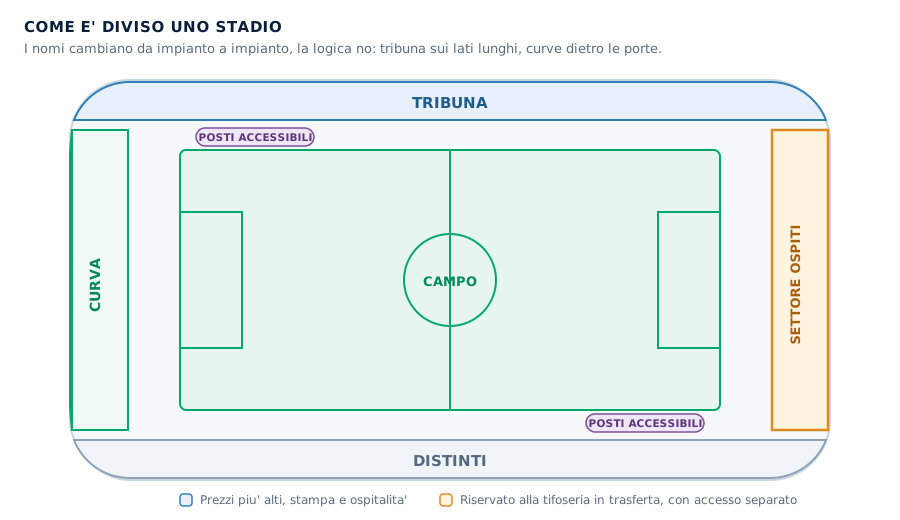
The layout holds for almost every Italian ground. The long sides carry the main stand and the side stand, with the best view and the highest prices. The short sides, behind the goals, carry the ends, where the organised support gathers.
| Section | Where it is | What to expect |
|---|---|---|
| Main stand | Long side, level with the halfway line | Best view, highest prices, press positions |
| Side stand | Opposite long side or the corners | A fair balance between view and price |
| The ends | Behind the goals | Organised support, lower prices, end-on view |
| Away section | A corner kept apart from the rest | Separate entry and facilities, restricted sale |
The away section
The away section is the area set aside for supporters of the visiting club. It has its own entrances, its own facilities, and is physically separated from the other sections.
Those tickets are sold under different rules from the rest. The competent authority can restrict the sale to residents of one province, or tie it to holding a supporter card. It can also ban it outright when a fixture is classed as high risk.
Those decisions are taken a few days before the match and published by both clubs. That is why no prices or procedures appear here: they would be out of date by the following round.
Accessibility
Every ground licensed for professional football must provide reserved places for people with disabilities. They sit at pitch level or on raised platforms, because a view from behind other spectators would be unusable for anyone who stays seated.
A reserved place normally carries the right to bring a companion, often at no extra cost. Booking goes through a dedicated channel rather than general sale, because the places are few and have to be allocated.
Many grounds also offer audio description for blind and partially sighted spectators. That is a service run by associations in agreement with the club, not something the rules require.
Albo d'oro
A club’s honours are among the few figures that do not age: titles already won stay won. Below are the international competitions, with the year of each success.
The UEFA competitions
| Competition | Years | Note |
|---|---|---|
| European Cup | 1985, 1996 | Now the Champions League |
| UEFA Cup | 1977, 1990, 1993 | Forerunner of the Europa League |
| Cup Winners’ Cup | 1984 | Competition later discontinued |
| UEFA Super Cup | 1984, 1996 | See the UEFA Super Cup |
In 1985 Juventus became the first club to win all three main European club competitions. At the time those were the European Cup, the Cup Winners’ Cup and the UEFA Cup.
That distinction is now mainly of historical interest, since other clubs have matched it since. The Cup Winners’ Cup no longer exists: its place in the continental order has been taken by the Conference League, as explained in the guide to European qualification.
The domestic titles
The domestic trophies are the Serie A title, the Coppa Italia and the Italian Supercoppa. The overall count is not given here, because it changes whenever the club wins another one. It should be checked against the official sources listed at the foot of the page.
It should be noted that two league titles awarded in the middle of the 2000s were the subject of sporting proceedings. The consequences of those decisions are still debated, so counts published by different sources may not agree.
Le rivalita
Rivalries are stable content: they come from historical or geographical facts and do not shift with results. What follows is where each one comes from, not a report on the latest meeting.
The Derby della Mole
This is the city derby against the other Turin club. It takes its name from the monument that symbolises the city. It is among the oldest derbies in Italy, and it exists for the simple reason that two professional clubs share the same municipality.
Like every city derby, it carries a weight beyond the three points described in the guide to the points system. For part of the support it counts for more than the final league position.
The Derby d’Italia
This is the fixture against Inter. The name has nothing to do with geography, since the two clubs are based in different cities. It comes instead from the fact that for decades they were the two clubs with the largest national following.
The rivalry with Napoli
This one is more recent and sporting in origin, rooted in the title races of the 1980s. Over time it has taken on a territorial dimension as well, between the north and the south of the country.
Why they matter
Beyond the folklore, derbies have concrete effects. They are the fixtures most often classed as high risk, the ones with the tightest restrictions on ticket sales, and the ones that generate the largest gate receipts. The following they draw also feeds into the revenue split described on the Serie A page.
Organigramma
This section describes the roles that make up a professional club, not the people who hold them. People change; the organisational structure is close to identical at every leading club.
The football side
| Role | How many | Responsible for |
|---|---|---|
| Head coach | 1 | Preparation, team selection, managing the group |
| Assistants and coaching staff | 2 – 4 | Opposition analysis, specific sessions, standing in for the head coach |
| Fitness coaches | 3 – 5 | Workloads, recovery, injury prevention |
| Goalkeeping coach | 1 – 2 | Work specific to that position, separate from the rest of the squad |
| Match analysts | 1 – 3 | Collecting and reading match and training data |
| Sporting director | 1 | Transfer business and dealings with agents |
The figures are indicative and describe a top-flight club. They vary from club to club and shrink sharply lower down: a Serie C side works with a far smaller staff.
The medical side
Every professional club must have a medical staff. Having a doctor is a regulatory obligation, not an organisational choice: without one the match is not played.
| Role | How many | Responsible for |
|---|---|---|
| Lead doctor | 1 – 2 | Medical clearance, clinical care, compulsory presence on match day |
| Physiotherapists | 4 – 6 | Daily treatment and recovery from injury |
| Nutritionist | 1 | Diet and body composition |
| Rehabilitation staff | 1 – 2 | Return-to-play programme after a long lay-off |
The executive side
Above the football side sits the corporate structure: board of directors, general management, finance and administration, commercial. It is this part that signs the contracts described in the guide to clauses and contracts.
It also answers for the financial indicators the league checks each year. The rules impose two further roles. The first is the safety officer, responsible for order inside the ground on match day. The second is the Supporter Liaison Officer, who handles relations with the fans.
| Area | How many | Responsible for |
|---|---|---|
| Board of directors | 5 – 11 | Strategic direction and accountability to shareholders |
| Finance and administration | 10 – 30 | Accounts, financial indicators, dealings with the league |
| Commercial and marketing | 20 – 60 | Sponsors, ticketing, licensing and stadium revenue |
| Safety officer | 1 | Compulsory role: public order on match day |
| Supporter Liaison Officer | 1 | Compulsory role: relations with the fans |
The total headcount at a top-flight club runs into the hundreds, against a few dozen at a third-division side. The difference is not only in the first team: it is in the structure.
Come si compone la rosa
This section explains how a squad is put together, not who is in it right now. These are rules, and they apply to any club in the same division.
The units
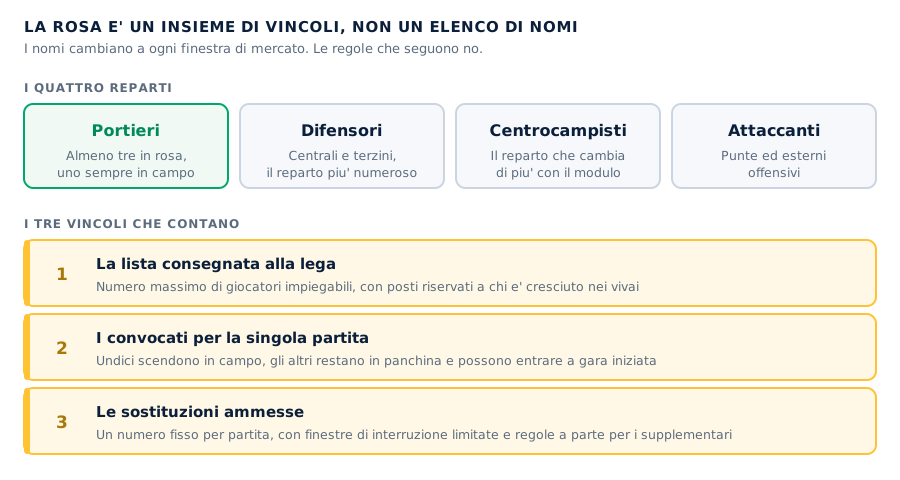
A squad is built around four units: goalkeepers, defenders, midfielders and forwards. How many players go in each is not set by regulation but follows practical need.
The tightest constraint concerns goalkeepers. One must always be on the pitch, and a club keeps at least three to cover injuries and suspensions. The other units are sized around the chosen system of play.
The list
Before the season starts each club files a list of eligible players with the league. The maximum number is set by the competition rules, and some places are reserved for players developed in Italian academies.
Anyone left off the list cannot play, even while remaining under contract. It is one of the reasons deals are closed before a session’s deadline, as described in the guide to types of transfer.
Match-day squad and bench
For a given match the coach picks a match-day squad from the list. Eleven start, the rest sit on the bench and can come on once the game is under way.
How many substitutions are allowed is set by the competition rules. The windows for making them are limited, to avoid constant stoppages, and extra time follows separate rules.
Shirt numbers
A shirt number is personal and fixed for the whole season. It is not tied to a position, with the traditional exception of the goalkeeper. A player arriving mid-season takes a free number.
Some clubs retire a number in memory of a former member: that number is never issued again. It is a club decision, not something the rules provide for.
Settore giovanile
A youth academy is an obligation, not a choice. Every professional club must enter a set number of youth teams to obtain its national licence.
Why it is compulsory
The requirement follows from a system-wide argument: without academies the game would produce no players, and clubs would depend entirely on buying them. The criterion is checked each year alongside the other requirements described on the Serie A page.
Second teams
Since 2018 Italian rules have allowed leading clubs to enter a second team in Serie C. Juventus was the first club to use that option.
The aim is to bridge the gap between youth football and the first team. A young player gets matches against professionals without changing club. The traditional alternative remains a temporary move to another club, described in the guide to how the transfer market works.
The financial return
A player developed in-house and entered on the list fills one of the places reserved for academy-trained players. If his value then grows, he generates a capital gain: the difference between what the club receives and what he cost.
There is also the solidarity mechanism: when a player moves for a fee, a share of the sum goes back to the clubs that trained him. How it works is explained in the guide to the transfer market.