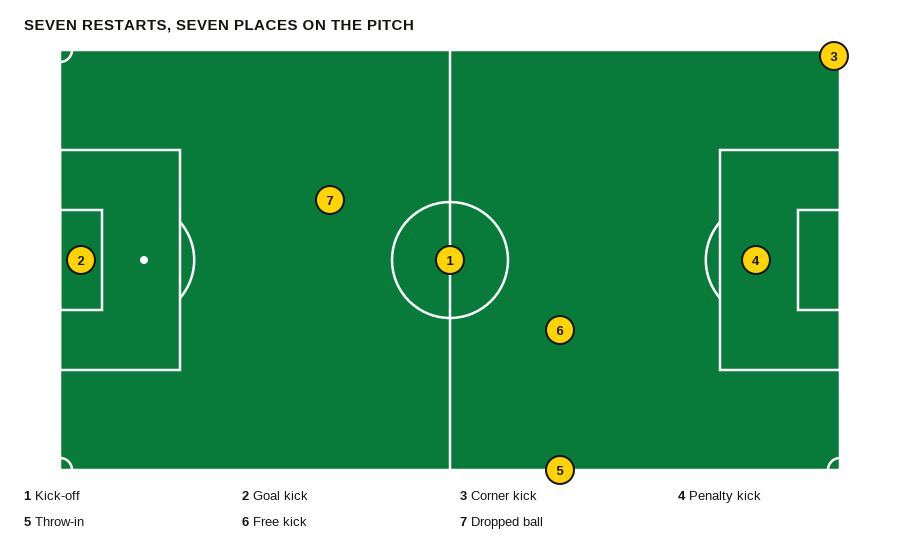
Set pieces are the restarts in which the ball is stationary: free kicks, the penalty kick, the corner kick, the goal kick and the kick-off. Together with the throw-in and the dropped ball they make up the seven restarts in the Laws of the Game. Each has a precise place from which it is taken, a distance opponents must respect and a rule on whether a goal can be scored directly. Knowing them explains most of the decisions seen in a match.
In short#
- There are seven restarts: kick-off, dropped ball, free kick, penalty kick, throw-in, goal kick and corner kick.
- A goal can be scored directly from a direct free kick; an indirect free kick needs a touch from a second player.
- At free kicks opponents stay 9.15 metres away, and attackers one metre from a wall of three or more defenders.
- A goal cannot be scored directly from a throw-in, and there is no offside from it.
- A goal can be scored directly from a corner, a goal kick or a kick-off, but only into the opponents’ goal.
- A goalkeeper who holds the ball for more than eight seconds concedes a corner.
- From 1 July 2026, delayed throw-ins and goal kicks are punished after a five-second countdown.
What set pieces are#
Every time play stops, it must restart in a way set out in the rules. The Laws of the Game, written by The IFAB for every national association, call these moments “restarts of play”. They are described in Law 8 and in Laws 13 to 17.
In everyday language people speak of “set pieces” or “dead balls” for restarts in which a stationary ball is kicked. The term does not appear in the Laws. It refers mainly to situations that can lead to a goal, such as free kicks, corners and penalties. The throw-in is taken with the hands and the dropped ball is not kicked, but they follow the same logic and this guide covers them together.
The first misconception to clear up concerns scoring directly. Not every restart allows it, and some only allow it into the opponents’ goal. Take a ball that goes directly into a team’s own goal from a corner or a goal kick. It is not an own goal: a corner is awarded to the opponents.
The table sums up the essential rules of each restart.
| Restart | When it is awarded | Direct goal | Offside | Opponents’ distance |
|---|---|---|---|---|
| Kick-off | Start of each half and after a goal | Yes, only against the opponents | No, everyone is in their own half | 9.15 m |
| Direct free kick | Fouls and handball | Yes, only against the opponents | Yes | 9.15 m |
| Indirect free kick | Technical offences, offside, dangerous play | No | Yes | 9.15 m |
| Penalty kick | Direct free kick offence in the penalty area | Yes | No, everyone is behind the ball at the kick | Outside the area, 9.15 m from the mark |
| Throw-in | Ball over the touchline | No | No | 2 m |
| Goal kick | Ball over the goal line, last touched by an attacker | Yes, only against the opponents | No | Outside the penalty area |
| Corner kick | Ball over the goal line, last touched by a defender | Yes, only against the opponents | No, when received directly | 9.15 m from the arc |
| Dropped ball | Play stopped without an offence | No, two touches are needed | Yes | 4 m |
Why the rules are so precise#
Restarts may look like details, but every rule has a concrete reason. Most of them exist to stop the offending team from benefiting from its offence.
- Giving the advantage back. A free kick returns the ball to the team that was fouled, away from the opponents. The 9.15-metre distance stops opponents from cancelling that advantage with a wall of players right next to the ball.
- Grading the punishment. A hard foul earns a direct free kick; a technical offence, such as dangerous play, only an indirect one. The penalty punishes a foul where it costs the most.
- Restarting quickly. Throw-ins and goal kicks are designed to restart play without wasting time. That is why the latest changes punish those who delay them.
- Preventing improper advantages. A goal cannot be scored directly from a throw-in because throwing with the hands is easier and more accurate than kicking.
- Keeping the dropped ball fair. When play stops through nobody’s fault, the ball goes back to the team that had it or would have won it.
The downside is that these situations have become huge tactical territory. Teams design routines for free kicks and corners, and a significant share of goals comes from dead balls. At the same time, restarts are the favourite moment for wasting time, and that is where the rules have changed most in recent years.
How free kicks work#
Free kicks are described in Law 13. They are awarded to the opponents of the person who committed the offence, whether a player on the pitch, a substitute or a member of the staff.
Direct or indirect#
A direct free kick is awarded for genuine fouls: tripping, pushing, holding, reckless challenges and handball. From a direct free kick a goal can be scored by shooting straight at goal.
An indirect free kick is awarded for technical offences: offside, dangerous play and impeding without contact. It also applies when the goalkeeper handles a ball deliberately kicked back by a team-mate. A goal only counts if the ball touches another player before going in.
To tell them apart, the referee keeps an arm raised above the head for an indirect free kick. The arm comes down when the ball touches another player, goes out of play or when it is clear that a goal cannot be scored directly. If the referee forgets the signal and the ball goes straight in, the kick is retaken.
The procedure#
The free kick is taken from where the offence occurred, with the ball stationary. The ball is in play once it is kicked and clearly moves. It no longer has to leave the area, even when a team is defending in its own penalty area. The kicker cannot touch it again until another player has touched it.
There is one exception on the spot. If the attacking team commits an indirect free kick offence inside the opponents’ goal area, the kick is not taken right on the goal line. It is taken from the nearest point on the goal area line parallel to the goal line.
The wall and the distance#
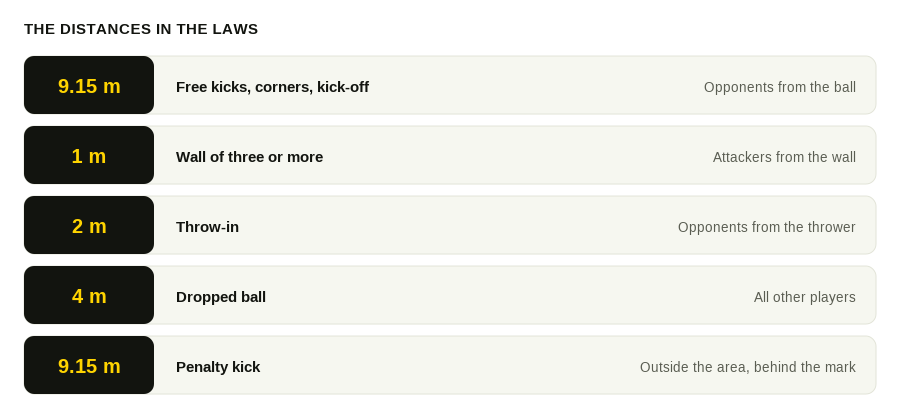
Opponents must stay at least 9.15 metres from the ball until it is in play. The only exception is a player standing on their own goal line, between the posts. That is why, at free kicks near the area, the referee paces out the distance and marks the line with vanishing spray.
When three or more defenders form a wall, attackers must stay at least one metre from it. Before this rule, attackers stood inside the wall to open it at the moment of the kick. An attacker closer than one metre is penalised with an indirect free kick to the opponents.
The kicker may lift the ball with one or both feet, and feints are allowed. A player may also deliberately kick the ball at an opponent to play it again, as long as it is not done recklessly or with excessive force.
The quick free kick#
The fouled team can take the kick at once, without waiting for opponents to get into position. If an opponent closer than 9.15 metres intercepts a quickly taken kick, play continues. If instead an opponent deliberately delays the restart by standing in front of the ball, they are cautioned, as explained in the guide on cards and suspensions.
How the penalty kick works#
The penalty kick, Law 14, is awarded when a player commits a direct free kick offence inside their own penalty area. It must not be confused with the shoot-out that decides a level match, explained in the guide on match length, extra time and penalties.
Kicker and goalkeeper#
The ball must be stationary and touching, or overhanging, the centre of the penalty mark. The kicker must be clearly identified and must kick the ball forward; a backheel is allowed, as long as the ball goes forward. Once the referee signals, the kick must be taken.
The goalkeeper stays on the goal line, between the posts, facing the kicker, until the ball is kicked. At the moment of the kick, at least part of one foot must touch the line, be in line with it or be behind it. The goalkeeper may not touch the posts, crossbar or net, nor distract the kicker.
All other players stay on the pitch, outside the penalty area, behind the penalty mark and at least 9.15 metres from it. The arc on the edge of the area exists precisely to measure that distance.
Feints and the run-up#
Feinting during the run-up is allowed. Feinting to kick once the run-up is complete is not. In that case the kicker is cautioned and play restarts with an indirect free kick for the defending team.
Passing a penalty to a team-mate#
The kicker does not have to shoot at goal. The ball can be passed forward to a team-mate who enters the area after the ball is in play. It cannot, however, be kicked backwards, and the kicker cannot touch it again before another player.
Entering the area too early#
Encroachment, entering the area too early, is only punished if it has a real effect. A kicker’s team-mate is penalised if they clearly affected the goalkeeper, or if they play the ball and then score, shoot or create a chance. A goalkeeper’s team-mate is penalised if they clearly affected the kicker, or if they intervene to prevent a goal or a chance.
If the goalkeeper offends and the ball goes in, the goal stands. If the ball does not go in, the kick is only retaken if the offence really affected it. The goalkeeper is warned for a first offence and cautioned for any further one.
How throw-ins and goal kicks work#
Throw-ins and goal kicks are the most frequent restarts in a match. They are also the ones the rules against time-wasting focus on.
The throw-in#
A throw-in is awarded when the whole ball crosses the touchline, on the ground or in the air, to the opponents of the player who touched it last. The thrower must face the field with part of each foot on the line or outside it. The ball is thrown with both hands, from behind and over the head, from the point where it left the field.
Opponents stand at least two metres away. The ball is in play as soon as it enters the field. If the throw is taken incorrectly, it goes to the opponents. If instead the ball touches the ground before entering the field, the same team retakes it.
A goal cannot be scored directly from a throw-in. If the ball goes into the opponents’ goal without another touch, a goal kick is awarded; if it goes into the thrower’s own goal, a corner. A player receiving the ball directly from a throw-in cannot be offside.
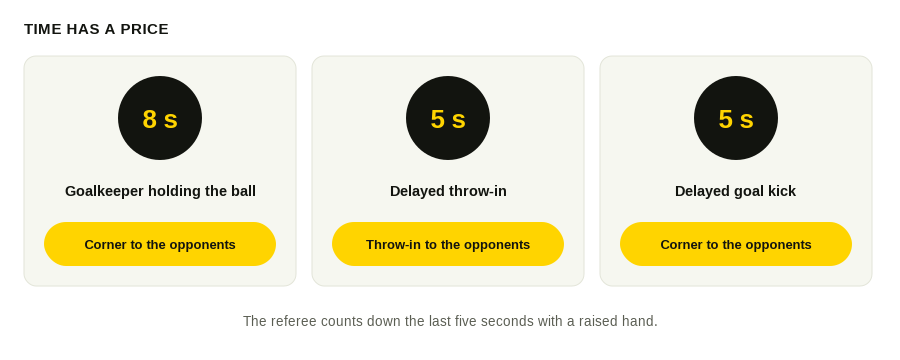
Under the Laws in force from 1 July 2026, if the referee considers a throw-in is being delayed, a visible five-second countdown starts with a raised hand. If the throw-in has not been taken when it ends, it goes to the opponents.
The goal kick#
A goal kick is awarded when the whole ball crosses the goal line, without a goal being scored, and was last touched by an attacker. It is taken from anywhere in the goal area, with the ball stationary. It is in play once it is kicked and clearly moves.
Opponents must stay outside the penalty area until the ball is in play. Team-mates, on the other hand, may receive it inside the area. This has changed how teams build from the back: defenders spread wide of the area and take short passes from the goalkeeper.
A goal can be scored directly from a goal kick, but only into the opponents’ goal. A team that delays a goal kick beyond the five-second countdown concedes a corner.
The goalkeeper’s eight seconds#
A related rule concerns a goalkeeper controlling the ball with the hands. Since 2025 the goalkeeper may hold it for no more than eight seconds, with the referee counting down the last five. Beyond that, the opponents are awarded a corner. Previously the sanction was an indirect free kick in the area, rarely applied.
Corner kick, kick-off and dropped ball#
The last three restarts have simpler rules, but with some details few people know.
The corner kick#
A corner is awarded when the whole ball crosses the goal line, without a goal being scored, and was last touched by a defender. It is also awarded in the two cases seen above: the goalkeeper exceeding eight seconds and a delayed goal kick.
The ball is placed in the corner area nearest where it went out. It is in play once it is kicked and moves, even without leaving the corner area. The corner flag may not be moved, and opponents stay at least 9.15 metres from the arc.
A goal can be scored directly from a corner into the opponents’ goal. A player receiving the ball directly from a corner cannot be offside. In some competitions VAR can correct a wrongly awarded corner, as long as the correction is immediate.
The kick-off#
The kick-off starts each half, including extra time, and restarts play after a goal. All players are in their own half, and opponents are at least 9.15 metres from the ball. The ball is in play once it is kicked and moves: it no longer has to go forward, and the first pass can go backwards.
A goal can be scored directly from a kick-off into the opponents’ goal. If the ball goes straight into the kicking team’s own goal, a corner is awarded to the opponents.
The dropped ball#
A dropped ball is used when the referee stops play without an offence. This happens for an injury, a ball hitting the referee and changing the play, or an object on the pitch. If play stops inside the penalty area, the ball is dropped for the defending goalkeeper.
Outside the area, the ball is dropped for a player of the team that had possession or would have gained it. Only if this cannot be determined does it go to the team that last touched the ball. Other players stay at least four metres away until the ball touches the ground.
A goal cannot be scored directly from a dropped ball: at least two different players must touch it. The rule stops a restart caused by a neutral event from gifting a goal.
Tactical variations#
The rules are the same everywhere, from Serie A to the Premier League, from La Liga to the Bundesliga and Ligue 1. What changes is how teams exploit them.
Free kick routines#
For free kicks near the area, teams prepare routines with several players over the ball, dummies and short passes to shift the wall. The one-metre rule has made it harder to disrupt the wall, and today routines rely mostly on speed and off-the-ball movement.
Short corners, inswingers and outswingers#
A corner can be played short, with a pass to a nearby team-mate, to change the angle of the cross. Or it can be an inswinger or an outswinger, curling towards the goal or away from it. Many clubs now employ coaches dedicated solely to set pieces.
The long throw#
Some players can throw the ball into the penalty area, turning a throw-in into a cross. A goal cannot be scored directly, but the long throw is a common weapon in lower divisions and physical leagues such as Serie B and Serie C.
Building from the back#
Today goal kicks and free kicks in a team’s own area can be played inside the area. That is why many teams restart with short passes instead of a long ball. Opponents respond with a high press, waiting for the first pass on the edge of the area.
Edge cases and exceptions#
Restarts have many special cases. They generate the most questions after a match, and almost all of them have a precise answer in the Laws.
An own goal from a set piece#
A ball that goes directly into a team’s own goal from a restart is not an own goal. This applies to free kicks, throw-ins, goal kicks, corners and kick-offs. A corner is awarded to the opponents instead. It is rare, but it happens with free kicks played back towards the goalkeeper.
An indirect free kick into the goal#
If an indirect free kick goes directly into the opponents’ goal, the goal does not count and a goal kick is awarded. The slightest touch by any player, even the goalkeeper, is enough to make the goal valid.
A double touch at a penalty#
The kicker may accidentally strike the ball with both feet, or touch it immediately with the standing foot. If the ball then goes in, the kick is retaken. If it does not, an indirect free kick is awarded to the opponents. A deliberate second touch is always punished with an indirect free kick.
A penalty at the end of a half#
If a penalty is awarded at the end of a half, the half is extended until the kick is completed. In that case the kick is complete when the ball is played by anyone other than the defending goalkeeper, not only when it stops.
The ball hitting the referee#
A ball that touches the referee sometimes changes the play: it starts a promising attack, changes possession or goes into the goal. In those cases play stops and restarts with a dropped ball. In all other cases play continues, as if the referee were part of the pitch.
Terms that get confused#
- Set piece and restart of play. Restart of play is the term used in the Laws and covers all seven situations. Set piece is a common expression for those in which a stationary ball is kicked.
- Direct and indirect free kick. A goal can be scored directly from the first; the second needs a touch from another player. The referee’s raised arm signals the second.
- Penalty kick and penalty shoot-out. The first punishes a foul in the area during the match. The second decides a level match.
- Goal kick and goalkeeper’s distribution. The goal kick is a restart with the ball stationary. A goalkeeper’s throw or volley happens while the ball is in play.
- Dropped ball and contested drop. A dropped ball used to be contested between two players. Today it is dropped for a single player, and the others stand four metres away.
- Wall and defensive line. The wall is the line of players 9.15 metres away at a free kick. The defensive line is how defenders are positioned in open play.
The weight of set pieces over a season#
A significant share of goals comes from dead balls, and in tight matches a set piece is often what decides them. A well-taken corner or a free kick from the edge of the area can be worth decisive points under the points system. Those points can separate a team from relegation or from qualifying for Europe.
In knockout matches the weight is even greater. It happens in play-offs, in the Coppa Italia and in the UEFA Super Cup. In the Champions League, Europa League and Conference League, as at the World Cup, the European Championship, the Nations League and the Copa América, many ties are decided this way. It happens above all late on, when teams are tired and the game closes up.
Set pieces also affect individual statistics. Players who take penalties and free kicks get more chances to score, which counts in the race for the top-scorer title and other individual awards. That is why the designated taker is often a debated choice within a team.
Finally, restarts are where most time is lost. The measures against delays in force from 1 July 2026 aim to cut those pauses and increase actual playing time. Their effect on stoppage time is explained in the guide on match length.
Frequently asked questions#
What is the difference between a direct and an indirect free kick?#
From a direct free kick a goal can be scored by shooting straight at goal. From an indirect free kick a goal only counts if the ball touches another player before going in. The direct kick punishes genuine fouls, the indirect one technical offences such as offside or dangerous play without contact.
To recognise it, watch the referee: for an indirect free kick the arm stays raised until the ball touches another player. If an indirect free kick goes straight into the opponents’ goal, a goal kick is awarded.
How far away must the wall be?#
At least 9.15 metres from the ball, which is ten yards, the historic English measurement. The only exception is a defender standing on their own goal line, between the posts, when the free kick is very close to goal.
If the wall has three or more defenders, attackers must stay at least one metre from it. An attacker who slips into the wall is penalised with an indirect free kick to the defending team.
Can you score directly from a corner?#
Yes, but only into the opponents’ goal. It is sometimes called an “Olympic goal”, rare but valid: the ball kicked from the corner goes in without any other touch.
If instead the ball goes straight into the kicking team’s own goal, the goal does not count and a corner is awarded to the opponents. A player receiving the ball directly from a corner cannot be offside.
Can you score directly from a throw-in?#
No. If the ball thrown with the hands goes into the opponents’ goal without another touch, a goal kick is awarded. If it goes into the thrower’s own goal, a corner is awarded to the opponents.
A touch from any player, even the opposing goalkeeper, is enough to make the goal valid. That is why long throws into the box are dangerous: a deflection is all it takes.
Can the goalkeeper move at a penalty?#
Yes, along the goal line. The goalkeeper cannot step forward before the kick: when the ball is kicked, at least part of one foot must be on the line, level with it or behind it.
If the goalkeeper moves off the line early and the ball goes in, the goal stands. If the kick is saved, it is only retaken if the offence really affected the kick. For a second offence in the same match the goalkeeper is cautioned.
Can a penalty be passed to a team-mate?#
Yes. The kicker can pass the ball forward to a team-mate who enters the area after the ball is in play. It cannot be passed backwards, and the kicker cannot touch it again before another player.
Feinting during the run-up is allowed. Feinting to kick once the run-up is complete is punished with a caution and an indirect free kick to the opponents.
What happens after a foul throw?#
The throw goes to the opponents. A throw is incorrect if the player does not use both hands, does not bring the ball from behind and over the head, or lifts both feet off the ground.
There is an exception: if the ball touches the ground before entering the field, the same team retakes the throw. And if the incorrect throw favours the opponents, the referee may play advantage.
What is the countdown on throw-ins and goal kicks?#
It is one of the changes in the Laws in force from 1 July 2026. When the referee considers a throw-in or a goal kick is being delayed, a visible five-second countdown starts with a raised hand.
If the throw-in is not taken in time, it goes to the opponents. If the goal kick is not taken in time, the opponents are awarded a corner. The player is only cautioned if they then also delay the opponents’ restart.
How long can the goalkeeper hold the ball?#
Eight seconds from when the ball is controlled with the hands. The referee counts down the last five with a raised hand. If the goalkeeper goes beyond that, the opponents are awarded a corner.
The rule has been in force since 2025 and replaced the old six-second limit, punished with an indirect free kick and almost never applied. If an opponent prevents the goalkeeper from releasing the ball, the indirect free kick goes to the goalkeeper’s team instead.
Does the ball have to go forward at kick-off?#
No, not any more. The ball is in play once it is kicked and clearly moves, in any direction. That is why the first pass from a kick-off is now almost always backwards.
All players must, however, be in their own half when the ball is kicked. A goal can also be scored directly from a kick-off, but only into the opponents’ goal.
Who gets the dropped ball?#
Inside the penalty area it always goes to the defending goalkeeper. Outside the area it goes to the team that had possession or would have gained it. Only if that cannot be determined does it go to the team that last touched the ball.
All other players, from both teams, stay at least four metres away until the ball touches the ground. A goal cannot be scored from a dropped ball unless at least two players have touched it.
Is there offside at set pieces?#
It depends on the restart. There is no offside for a player receiving the ball directly from a throw-in, a goal kick or a corner. There is offside at free kicks, direct and indirect, and at dropped balls. At a penalty, in practice, there cannot be: at the moment of the kick every player is behind the ball.
That is why, at wide free kicks, attackers line up with the last defender and only start their run when the ball is kicked. The full explanation is in the guide on the offside rule.