- 1926 Founded
- 54,726 Capacity
- 1959 Stadium opened
- Naples Based in
Il club
- Fondazione
- 1926
- Citta
- Naples
- Colori sociali
- Sky blue
- Soprannome
- I Partenopei
Lo stadio
- Impianto
- Stadio Diego Armando Maradona
- Comune
- Naples
- Capienza omologata
- 54,726 seats
- Inaugurazione
- 1959
- Proprieta
- City of Naples
La capienza indicata e' quella omologata, non la presenza media: cambia solo dopo lavori o nuove prescrizioni di sicurezza.
Identita
Associazione Calcio Napoli was founded in 1926, but football in the city is older. In the early 1900s clubs set up by British sailors and merchants calling at the port were already active.
Where the blue comes from
The club colour is sky blue, without stripes. Tradition ties it to the bay and the sea. That sets the club apart from most Italian sides, nearly all of which wear vertical stripes.
The most common nickname, I Partenopei, refers to Partenope, the Greek name of the settlement the city grew from.
A rare case in Italian football
Napoli is the only professional club in the city and in much of the surrounding region. That differs from Milan, Turin or Rome, where two clubs share one catchment.
The consequence shows in the following, which counts in the broadcasting revenue split described on the Serie A page. A club with no local competitor gathers all the support of its territory.
What you will find here
These sections hold stable information: the ground, the honours, the structure, the squad rules, the academy. There is no list of players, which changes twice a year in the sessions described in the guide to transfer windows.
Lo stadio
The ground stands in the Fuorigrotta district, in the western part of the city. It opened in 1959 as the Stadio del Sole, was renamed San Paolo, and in 2020 was named after Diego Armando Maradona.
A municipal ground
It is owned by the City of Naples, which grants its use to the club. That is the most common arrangement in Italy: the great majority of clubs play in public grounds rather than their own.
The difference from owning is concrete. The club pays a fee, has limited say over structural work and does not freely run the commercial spaces. The opposite model is Juventus, which owns its ground.
The running track
The ground was built as a multi-purpose venue and for decades had a running track around the pitch. Removing it during the refurbishment brought the stands closer to the playing surface.
That detail affects the experience more than it sounds: with a track the front rows sit tens of metres from the touchline, without one far less.
The capacity
The figure given is the licensed capacity after the works. It is not the average attendance, which varies match by match. It changes only after further work or different safety requirements.
Andare allo stadio
Fuorigrotta is a well-connected district, which makes the ground easier to reach than its position away from the centre would suggest.
Getting there
The district is served by the metro and by local rail lines, with stops a short walk from the ground. Up-to-date directions and match-day traffic restrictions are published by the club and by the city.
For the biggest fixtures the area is closed to private traffic well in advance. Driving is not advisable: parking is scarce relative to the number of spectators.
How the sections are laid out
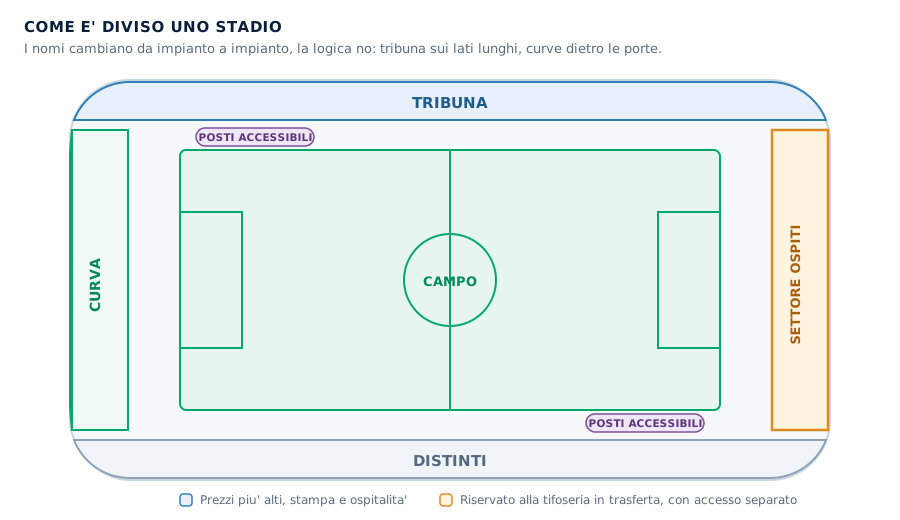
The structure follows the standard pattern. The long sides carry the main stand and the side stand, the short sides the two ends. The main stand is the most expensive section and also holds the press positions.
| Section | Position | What to expect |
|---|---|---|
| Main stand | Long side, level with halfway | Best view and highest prices |
| Side stand | Opposite long side | Good balance of price and view |
| The ends | Behind the goals | Organised support, moderate prices |
| Away section | Area kept apart from the rest | Dedicated entry, sale often restricted |
The away section
The area set aside for visiting supporters has its own entrances and facilities. Ticket sales follow their own rules, decided fixture by fixture by the competent authority.
Three restrictions are possible: reservation to residents of one province, a supporter card requirement, or an outright ban. That is why no prices or procedures appear here: they would change every round.
Accessibility
Places for people with disabilities are compulsory for the ground’s licence. They sit where the view is not blocked by those in front, and they include a place for a companion.
They are allocated on request through a dedicated channel, because the number is limited and they do not go through general sale.
Albo d'oro
The club’s honours list is shorter than those of the northern sides, but it includes a European trophy and league titles that shaped the competition’s history.
The UEFA competition
| Competition | Year | Note |
|---|---|---|
| UEFA Cup | 1989 | Forerunner of the Europa League |
The 1989 win remains the club’s only international trophy. It came during the spell when the side was consistently at the top, between the late 1980s and the start of the following decade.
The league title
The Serie A title came in 1987, 1990, 2023 and 2025. The first two ended a wait as long as the club’s history: until then no club from the south had ever won the championship.
That explains why those successes carry a symbolic weight beyond their number. The Italian league had until then been won only by clubs from the centre and north.
The domestic cups
The club has won the Coppa Italia and the Italian Supercoppa several times. Totals do not appear here because they rise with every success: read them from the official sources listed at the foot of the page.
Relegation and rebuilding
In the late 1990s and early 2000s the club went through a financial crisis that forced a restart from the lower divisions. It is a useful case for understanding the mechanisms in the guide to how relegation works, where not everything depends on the pitch.
Le rivalita
Napoli’s rivalries are sporting and territorial at once, and nearly all of them took shape in the same period.
The northern fixtures
The meeting with Juventus is the most keenly felt. It grew out of the title races of the 1980s and has taken on a dimension beyond the pitch, setting two parts of the country against each other.
The rivalry with Milan has the same origin, built on those same seasons at the top of the table.
Regional derbies
Fixtures against other clubs from the region and the south are rarer, because the sides seldom share a division. When they do meet, interest is very high: such matches are almost always classed as high risk.
What they involve
The most heated fixtures bring restrictions on away ticket sales and a reinforced security operation. They are also the matches with the season’s largest gate receipts.
Organigramma
As on the other profiles, what follows lists roles rather than people. A professional club’s structure is stable; those filling it change.
The training ground
The first team trains at Castel Volturno, in the province of Caserta, some forty kilometres from the city. The site takes in several pitches, accommodation and medical facilities.
The distance from the stadium is deliberate: within the urban fabric there would be no room for a complex of that size.
How many people work there
| Area | How many | Responsible for |
|---|---|---|
| Coaching staff | 6 – 10 | Head coach, assistants, fitness work, goalkeepers |
| Medical staff | 8 – 12 | Doctors, physiotherapists, rehabilitation, nutrition |
| Football management | 3 – 6 | Negotiations, scouting, registration handling |
| Corporate structure | Around a hundred | Administration, commercial, communications, ticketing |
The figures are indicative. Two roles are required of every professional club by the rules: the safety officer and the officer handling relations with supporters.
Come si compone la rosa
The rules governing a squad depend not on the club but on the competitions it enters. A club playing only the league faces one set; a club also in Europe faces two.
The domestic list
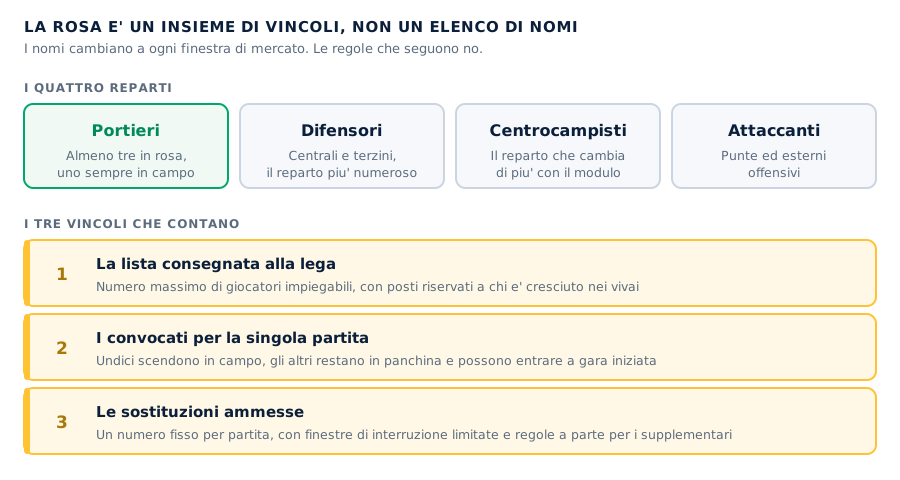
Before the season starts the club files with the league its list of eligible players. The ceiling is set by the rules, and some places are reserved for players trained in Italian academies.
Anyone missing from the list cannot be selected, even while under contract. That situation shapes the dealings described in the guide to types of transfer.
How many players per unit
The rules set no ratio between defenders, midfielders and forwards. The coach decides, according to the system of play. The one firm constraint concerns goalkeepers: one must be on the pitch, and every club registers at least three.
Selection and substitutions
The match-day squad is picked from the list. Eleven start, the others sit on the bench. How many changes are allowed, and the windows for making them, are set by each competition’s rules.
Shirt numbers
Each player has a personal number that stays his for the whole season. It does not follow the position, apart from the convention giving number one to the goalkeeper.
Settore giovanile
Entering youth teams is a condition for obtaining the national licence. It is not a choice the club makes.
The catchment area
Being the only professional club across a heavily populated area is an advantage for youth recruitment. The catchment is shared with no one, which cuts competition for local youngsters.
What an academy produces
A home-grown player fills one of the list places reserved for academy-trained players. If his value then grows, a sale produces an almost entirely clean gain, because he was never paid for.
Even if he leaves early, the solidarity mechanism gives the clubs that trained him a share of later transfers.
The step into the professional game
The most common route remains a temporary move to a lower-division club, where a young player gets real matches. The alternative is a second team in Serie C, which the rules allow leading clubs to enter.