A transfer can take very different forms, and the difference is not one of wording. What changes is who holds the contract when the deal is done, whether and when a fee is paid, and whether the player can return to where he started. Recognising the right format is the quickest way to understand what a transfer story actually means.
In short#
- A permanent transfer moves the contract for good.
- A loan moves it for a fixed period, after which the player returns.
- With an option to buy, the receiving club may purchase if it wants to.
- With an obligation the purchase happens anyway: it is a deferred signing.
- A free transfer involves a player out of contract, with no fee.
- A swap is formally two separate deals.
- Co-ownership no longer exists in Italian football.
What separates one format from another#
Every format answers the same question: who owns the player’s contract at the end of the deal, and on what terms. There are three variables.
The first is duration. A permanent transfer is final, a loan has an end date after which the player goes back. The second is the fee: how much is paid, when, and whether it is certain or conditional. The third is reversibility, that is whether a route back to the starting point exists.
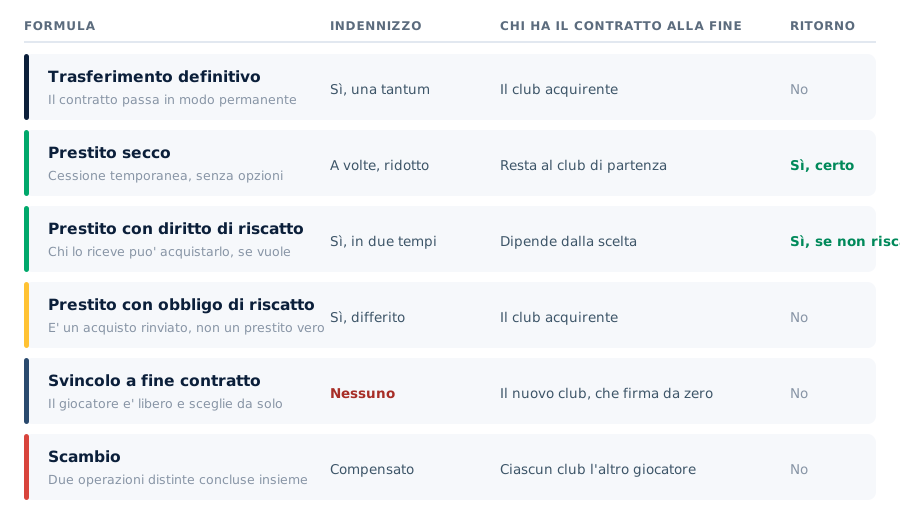
| Format | Fee | Contract at the end | Return | When it is used |
|---|---|---|---|---|
| Permanent | Yes, in instalments | Buying club | No | A planned, outright signing |
| Straight loan | Reduced or none | Original club | Yes | Developing a young player |
| With option to buy | In two stages | Depends on the choice | Yes, if not taken up | Trying before buying |
| With obligation to buy | Deferred | Buying club | No | Pushing the cost into next year |
| Free transfer | None | New club | No | Contract expired |
| Swap | Offset | Each the other player | No | A deal without cash outlay |
The permanent transfer#
The simplest format. The buying club pays a fee, the contract moves for good, and the player signs a new agreement with the new club. The selling club leaves the story for good, save for any sell-on percentage.
Payment is almost always spread across seasons. It distributes the cost in the accounts and helps respect the spending limits described in how the transfer market works.
Part of the sum can be conditional on targets: a number of appearances, goals scored, European qualification or survival in the division. Those sums are called bonuses and fall due only if the condition is met.
The loan#
A loan is a temporary move. The contract stays with the original club, the player goes elsewhere for a defined period, and returns at the end.
Why it suits all three parties#
- The lending club. It lightens the wage bill without giving the player up, and lets a young player develop by playing rather than sitting on a bench.
- The receiving club. It gains a reinforcement without paying a transfer fee, often with wages partly covered by the other club.
- The player. He plays regularly, which a crowded squad would not allow.
The limits#
The international regulations cap the loans a club can make and receive in the same season, and the number of players loaned at once to a single club. The cap was phased in and is being reduced progressively, so the precise number changes from year to year. The full set of constraints is in how the transfer market works, and the deadlines in transfer windows.
Exemptions apply to younger players and to those developed at the club. The stated reason for the cap is to stop a club stockpiling dozens of players spread across other teams, keeping them from rivals without ever selecting them.
Option and obligation to buy#
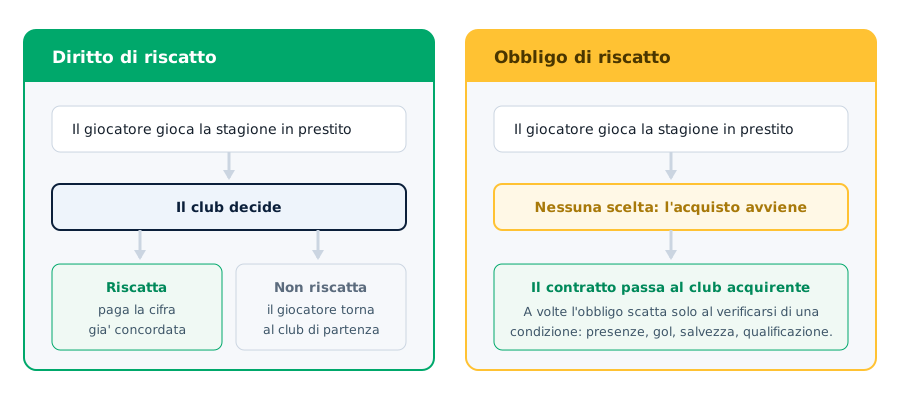
A pure loan, sometimes called a straight loan, carries no option: at the end the player returns. The two most common variants instead add a purchase route, and the difference between them is substantial.
The option to buy#
The receiving club has the right, not the duty, to purchase at the end of the loan. The figure is agreed in advance and stays fixed, whatever happens during the season.
The option has a value in itself. If the player performs, the club exercises it and buys at a price set months earlier. If he does not, it returns him having spent nothing beyond the loan.
There is also the buy-back: the original club’s right to take the player back after the purchase, at a figure also set in advance. It protects a club selling a young player who wants to keep the chance of recovering him.
The obligation to buy#
The purchase happens regardless, and the loan is merely the way to defer it. Formally a temporary move, in substance a permanent transfer with deferred payment.
The obligation is often not unconditional but tied to a condition: a number of appearances, survival, European qualification. The buy-out then triggers only if the condition is met, and the two clubs argue for months over how it is counted.
The reason for choosing this format is accounting. The cost shifts to the following year, which helps a club that has already reached its spending limits in the current one.
The free transfer#
The term describes a player who moves at the expiry of his contract, with the new club paying no fee. It is not strictly a transfer format: it is the absence of a transfer.
At the natural expiry the employment relationship ends and the player becomes free. No club has any claim on him, and he can sign where he prefers. The club losing him receives nothing.
The free transfer is now one of the main routes to strengthening without spending. Every window sees dozens of them, in Serie A as in the other European leagues.
The mechanism has reshaped the market. A player in the final year of his contract holds enormous bargaining power, because he can wait for expiry rather than accept a transfer. The club must choose between selling cheaply or losing him for nothing months later. The fall in value is illustrated in the guide to contract clauses.
Many federations also allow a pre-contract with a foreign club in the closing months. The player can therefore arrange his future before he is formally free.
The swap#
Two clubs each transfer a player to the other. It looks like one deal but is formally two, each with its own fee and its own contract.
The figures are often symmetrical, which is why swaps attract scrutiny. By assigning two players identical and high values, both clubs can book an accounting profit without money actually moving. The practice is monitored, and federations can challenge valuations with no basis.
Swaps can also be temporary, through two crossed loans, or asymmetric, with a player plus a cash balance. The format is common between clubs needing to meet the financial requirements for entry to the competitions described in European qualification.
Formats that no longer exist#
The vocabulary of the market still contains terms that no longer correspond to anything.
- Co-ownership. Two clubs each held half the rights to a player, and every year a procedure decided where he would go. It has been abolished in Italian football and replaced by loans with options.
- Third-party ownership. Funds or parties outside the clubs could hold a share of a player’s economic rights. It is banned by the international regulations.
- The lifetime tie. Until the 1970s a player stayed bound to his club even after his contract expired. It was ended by the reforms that established freedom at expiry.
Still current, by contrast, is the sell-on percentage: the selling club retains a share of any future sale. It is not a transfer format but a clause, described in contract clauses.
The lifetime tie was ended by a ruling that recognised a player’s freedom at the end of his contract. It is the same principle that makes free transfers possible today, and it shifted the balance of the market towards the players. The effects reach even the individual awards, since a free player can choose the club where he will be most visible.
Which format for which situation#
The choice of format is never neutral: it depends on what the club wants and on what it can spend this year.
- A young player to develop. A straight loan to a club in Serie B or Serie C, where he will play regularly. The contract stays at home and he returns with experience.
- A player there are doubts about. A loan with an option: try for a season and decide afterwards, at a price already fixed.
- A signing that cannot be booked this year. A loan with an obligation, which moves the cost into the next financial year without giving up the player.
- A heavy wage to clear. A loan with a wage contribution, or a consensual termination of the contract.
- A cost-free reinforcement. A free transfer, with the caveat that competition for free agents is fierce and their wage demands high.
Objectives change the picture. A club chasing the qualification described in European qualification looks for ready players and permanent deals. One fighting relegation prefers loans, which cost less and do not burden next season’s accounts if relegation does arrive.
How to read the format from a news story#
Transfer reporting uses elliptical language, and three questions are enough to see what has actually been written.
- Can the player come back? If yes it is a loan, in whatever form it is presented. If no it is a signing, even when the word loan appears in the headline.
- Is the fee certain? A conditional obligation is not an agreed figure but a possible one, dependent on what happens on the pitch.
- Who pays the wages? In loans the split varies, and a club covering most of the salary is effectively paying for its own player to play elsewhere.
A final caution concerns the figures. Reported amounts sometimes include bonuses and sometimes do not, and the same deal is told with different numbers depending on the source. They should be read as orders of magnitude, not as accounts.
The rules behind all this are the same in Serie A, the Premier League, LaLiga, the Bundesliga and Ligue 1, because they derive from the international regulations. What differs are the national limits on squad lists and registrations, described in how the transfer market works.
Frequently asked questions#
What is the difference between an option and an obligation to buy?#
With an option, the club holding the player on loan chooses whether to buy at the end. If it does not, the player returns to his original club with no further consequence.
With an obligation the purchase happens anyway, or once a condition set in the contract is met. It is a permanent transfer with deferred payment, not a true loan.
What does free transfer mean?#
It describes a player changing clubs at the natural expiry of his contract, with the new club paying no fee. The employment relationship has ended, so there is nothing to compensate.
The club losing him receives nothing. It is why renewals are negotiated two years ahead: a year from expiry the transfer value is already close to zero.
How long can a loan last?#
No longer than the current season. A multi-year loan is not permitted by the international regulations, although the parties can renew it at expiry with a fresh agreement.
The minimum can be six months or less, which makes possible the loans agreed in the January window and due to end when the league does.
Why use a loan with an obligation instead of buying?#
For accounting reasons. The cost is booked in the following financial year, which helps a club that has already reached its spending limits in the current one.
There is a cautious motive too when the obligation is conditional: the buying club commits only if the season goes as expected, for instance on survival or European qualification.
Does co-ownership still exist?#
No, it has been abolished in Italian football. It meant two clubs each holding half the rights to a player, with an annual procedure to decide where he would go.
Its place has been taken by loans with options and buy-backs, which achieve a similar effect without splitting ownership of the contract between two companies.
Why are swaps viewed with suspicion?#
Because by assigning two players identical and high values, both clubs can book an accounting profit without money actually moving.
The practice is monitored and federations can challenge valuations with no basis. A swap in itself is legitimate: the problem arises when the declared values have no grounding in the market.
Who pays the wages of a player on loan?#
It depends on the agreement. The receiving club can pay in full, the lending club can pay in full, or the two can split it in an agreed proportion.
When the original club covers most of the salary it is effectively paying for its own player to play elsewhere. It is a common choice with young players developing in Serie B or Serie C, and with those whose wages are out of scale for the destination.
The split is agreed in advance and written down, along with bonuses and any performance payments. The items making up such an agreement are the same as in a normal contract, described in contract clauses.
Can a player on loan face his parent club?#
It depends on the agreement between the two clubs. Many loan contracts include a clause preventing it, to stop the player affecting a match that matters to the club holding his contract.
Some federations have banned such clauses as damaging to the integrity of the competition. If a player is registered for a club, he should be selectable for all its matches, including the domestic cup and the Champions League.