
Clubs qualify for the European competitions by finishing near the top of their domestic league, or by winning a competition that carries a place. How many clubs each country can enter is not fixed: it depends on how its clubs performed in previous seasons. This is the part that causes the most confusion, because the same league position is worth different competitions depending on the country and the year.
In short#
- There are three European club competitions, ranked in order of standing.
- Each federation receives places in proportion to its UEFA coefficient.
- In the leading leagues the top four positions give the Champions League.
- The domestic cup winner gets a place regardless of league position.
- If a club qualifies by two routes, the spare place passes down the table.
- Winning the Champions or Europa League grants entry to the next Champions League.
- Two extra places go to the federations with the best performance that season.
What the European competitions are#
The European competitions are the club tournaments run by UEFA, the confederation that governs football on the continent. Clubs from different federations take part, selected on the results they achieved in their own domestic leagues.
There are three, and they form a hierarchy. It is not a division by tier as between a first and a second division. A club is not relegated from one competition to another for poor results: it enters according to where it finished at home.
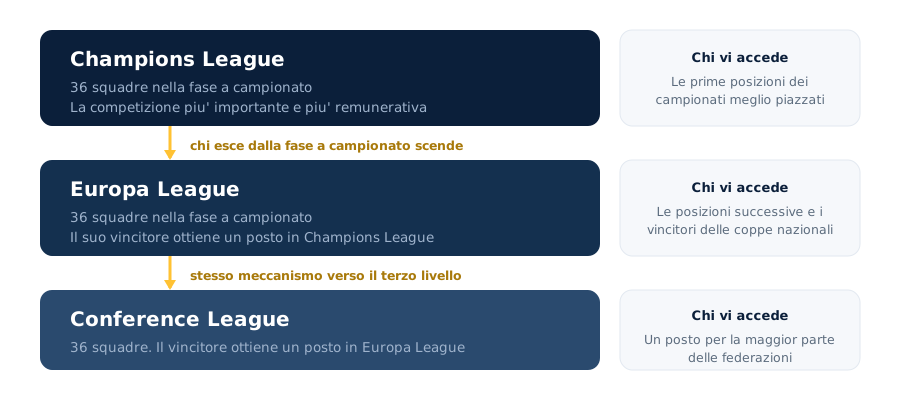
Here is what separates the three.
| Competition | Tier | Clubs in the opening phase | Prize for the winner |
|---|---|---|---|
| Champions League | First | 36 | A place in the next Champions League |
| Europa League | Second | 36 | A place in the Champions League |
| Conference League | Third | 36 | A place in the Europa League |
Why the number of places differs by country#
If every federation received the same number of places, the strongest leagues would be under-represented. The weaker ones would send clubs knocked out in the first round. UEFA therefore distributes places in proportion to the results achieved by each country’s clubs in European competition.
The measure is called the association coefficient and is calculated over five years. The full mechanism is explained in the guide to the UEFA coefficient, and it produces three practical effects.
- Number of places. The leading countries get four clubs in the Champions League, others two, one, or only a place in the qualifying rounds.
- Entry point. Clubs from the best-ranked leagues enter the main phase directly, while those from lower federations have to come through qualifying rounds.
- Delayed effect. The coefficient is built over five seasons: a good year does not add places at once, and a bad one does not remove them immediately.
The practical consequence is that the same league position is worth different competitions in different countries. Fifth place in Serie A or the Premier League leads to the Europa League, while in a lower-ranked league it may lead nowhere at all.
Who qualifies and for which competition#
In a league near the top of the rankings the places are spread down the table in a regular pattern. That is the starting point, before the exceptions.
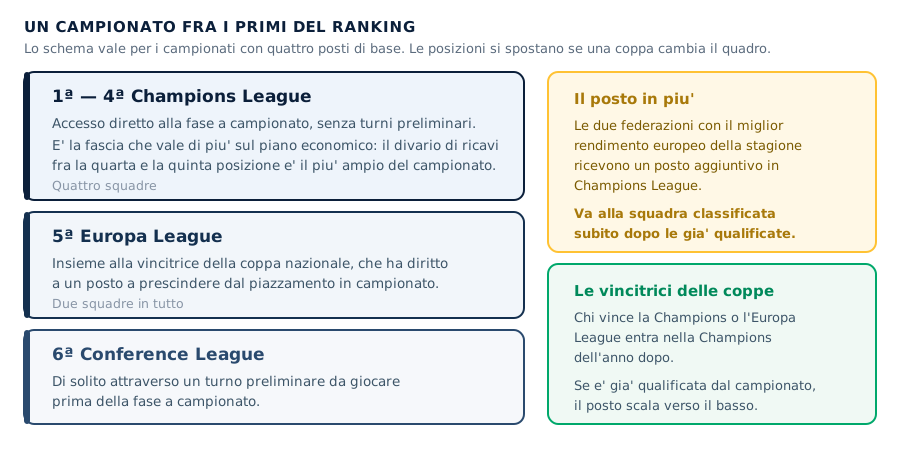
Fourth place is the most contested threshold of the whole season, and not for sporting reasons. The revenue gap between the Champions League and the other two competitions is such that being in or out changes a club’s accounts. The effects on transfer decisions are described in how the transfer market works.
The routes to qualification#
The league#
This is the main route. Final league positions award most of the places, under the pattern set out above. When two clubs finish level on points in a decisive position, the rules state which criterion separates them. Those criteria differ by country, and the full sequence is in the guide to the points system.
Domestic cups#
The winner of the domestic cup earns a European place regardless of league position. In Italy the place awarded to the Coppa Italia winner is in the Europa League, and it applies even if the club finished mid-table.
It is the mechanism that makes the domestic cup worth pursuing for clubs not competing for the top places. Winning it is often the only realistic route into Europe, and it changes how mid-table clubs approach the competition.
Winning a European competition#
The winner of the Champions League is admitted to the same competition the following season. The winner of the Europa League earns a Champions League place, and the winner of the Conference League earns a Europa League place.
The rule places the continental result above the domestic one. A club that wins the Europa League without qualifying through its league still enters the Champions League. That place is either taken from its country’s allocation or added to it, depending on the rules in force.
Qualifying rounds#
Not every qualified club enters the main phase directly. Federations lower in the rankings receive places that pass through one or more qualifying rounds, played between July and August.
The difference is substantial. A club entering by right knows its European calendar months in advance. A club coming through qualifying plays decisive matches with pre-season barely begun, often with signings not yet registered, and risks going out before the domestic league has started.
There is also a separate path reserved for the national champions of smaller federations. It exists to make sure a number of domestic champions reach the main phase, rather than being knocked out immediately by clubs from the strongest leagues.
What happens when a club qualifies twice#
This is the situation that confuses most readers, and it comes up almost every year.
When the domestic cup winner has already qualified for Europe through the league, the cup place is not lost. It passes to the club finishing immediately below the last one already qualified, in the same competition or in the one below, depending on how the national rules are written.
The same applies when a club wins the Europa League and also finishes in the top four at home. In that case the Champions League place is due through the league anyway, and the one earned with the cup is freed.
- Knock-on effect. Every freed place moves one position down, and at the end of the chain a club expecting nothing finds itself in Europe.
- Effect on the Conference League. It is the competition that most often receives the surplus places, being last in the chain.
- Effect on the total. The overall number of clubs per country can therefore rise by one above the base allocation.
The extra place for performance#
On top of the allocation calculated over five years, UEFA awards two extra Champions League places. They go to the two federations with the best performance in the season just ended. The criterion looks only at the current campaign, not at the multi-year ranking.
The place goes to the club finishing immediately below those already qualified. For a country with four base places that means fifth also enters the Champions League, a jump in competition from the Europa League it would otherwise have had.
It is the mechanism that most often overturns pre-season expectations. The outcome depends on how every club from that country performs, across all three competitions.
What qualifying changes#
Reaching Europe is not only a sporting milestone: it changes the calendar, the squad and the finances of the following season.
- Calendar. Continental matches are played midweek and add to the league and the domestic cup. A club in the Champions League can reach around sixty matches in a season.
- Squad. More players of comparable level are needed, because nobody can play three competitions week in week out. It is why European qualification changes decisions in the transfer windows.
- Revenue. Participation brings a fixed share, performance bonuses and a portion linked to the country’s television market. The figures are indicative and change with every cycle: they should be checked against the official documents.
- Coefficient. The results achieved feed both the club’s and the country’s ranking, which will determine places in later years.
The drawback is well known. A club with a thin squad that reaches Europe often pays for the overload in the league, and it happens that the qualification is not repeated the year after. In leagues with several clubs involved, such as Serie A and the Premier League, the effect shows in the mid-table positions.
Missing out despite the league position#
League position is not enough: the administrative criteria matter too, and that part stays invisible until it produces an exclusion.
- UEFA licence. Every club must obtain one from its own federation, demonstrating financial, stadium and youth-sector requirements.
- Financial rules. Serious breaches can lead to exclusion from the competitions for one or more seasons.
- Common ownership. Two clubs controlled by the same party cannot enter the same competition: one is excluded or moved to the one below.
- Relegation. A club dropping a division loses its European place, as explained in how relegation works.
In all these cases the place is reallocated to the next club in line. The decision often arrives in summer, with the league already finished, and can change the planning of two or three clubs at once.
National team tournaments are separate#
One frequent misunderstanding is worth clearing up. The European club competitions have nothing to do with tournaments between national teams, which follow entirely different qualification rules.
The European Championship and the World Cup are contested by national sides, selected through qualifying groups between federations. There is no link with club performance: a country can have four clubs in the Champions League and fail to qualify for the national tournament, or the reverse.
The Nations League also follows its own path, with promotion and relegation between leagues of different levels, and in some cases it feeds into the qualifying groups for the major tournaments. The calendars of the two families do interlock, which is why the domestic season pauses during the year.
Frequently asked questions#
How many Italian clubs enter the Champions League?#
Four, because Serie A is among the best-ranked leagues in the association coefficient. The number is not set in stone: it depends on the coefficient, which is updated every year.
It can become five if Italy is among the two federations with the best seasonal performance, in which case the place goes to the fifth-placed club. The full calculation is in the guide to the UEFA coefficient.
Which competition does fifth place lead to?#
In leagues with four Champions League places, fifth normally leads to the Europa League. It is the position most exposed to shifts, because a cup winner already qualified is enough to change the picture.
If the country earns the extra place for seasonal performance, fifth goes into the Champions League instead. It is the most profitable jump in competition a club can obtain without winning anything.
What happens if the cup winner has already qualified?#
The place is not lost. It passes to the club finishing immediately below those already qualified through the league, in the order set out in the national rules.
The effect propagates down the whole chain. At the end it is the Conference League that receives the surplus place, being the last competition in the sequence.
Does the Europa League winner enter the Champions League?#
Yes. Winning the Europa League grants a place in the following season’s Champions League, regardless of where the club finished in its own league.
It is the rule that places the continental result above the domestic one. In the same way the Conference League winner earns a Europa League place, and the Champions League winner is admitted to the next edition by right.
Why is fourth place worth so much?#
Because it marks the boundary between the Champions League and the other two competitions, and the revenue gap between those two situations is the widest in the whole table. It is not a difference of prestige but of accounts.
That gap shapes the following summer’s transfer decisions, contract renewals and the ability to keep the best players. The mechanism is described in how the transfer market works.
Can a club be excluded despite qualifying?#
Yes. A UEFA licence issued by the national federation and compliance with the financial rules are both required. Without them the club is not admitted, even if its position would entitle it.
There is also the common ownership restriction: two clubs controlled by the same party cannot enter the same competition. One of the two is excluded or moved to the competition below.
How does a club enter the main phase without qualifying rounds?#
It depends on the ranking of its country. Clubs from the best-ranked leagues enter the league phase directly, while those from lower federations must come through one or more qualifying rounds.
For a club from a smaller league that means starting the European season in July, with squads not yet complete, and risking elimination before the domestic league has even begun.
Can the number of places change from year to year?#
Yes, and it is normal. The coefficient is calculated over five seasons, so each year a new one enters and the oldest drops out. A country can gain or lose a place without anything having changed in the latest season.
On top of that come the two places awarded for seasonal performance, which depend only on the current campaign. The details of the calculation are in the guide to the UEFA coefficient.