A player is offside when a team-mate plays the ball and the player is ahead of both the ball and the second-last opponent. The player must also be in the opponents’ half. Being in that position, however, is not enough to be penalised. Offside is only called if the player becomes involved in active play: touching the ball, interfering with an opponent or gaining an advantage. The sanction is an indirect free kick for the defending team.
In short#
- Position is judged at the moment a team-mate plays or touches the ball, not when the player receives it.
- To be in an offside position a player must be in the opponents’ half and ahead of both the ball and the second-last opponent.
- A player level with the second-last opponent is onside.
- Hands and arms do not count: only the rest of the body does, for every player.
- Being in an offside position is not an offence on its own: the player must be involved in active play.
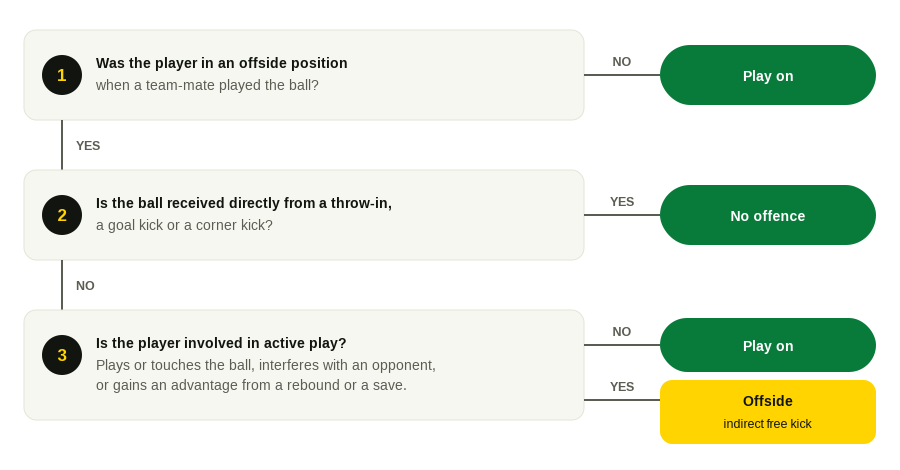
- There is no offside when the ball comes directly from a throw-in, a goal kick or a corner kick.
- The rule is the same in every league in the world: only the technology used to judge it changes.
What offside is#
Offside is governed by Law 11 of the Laws of the Game. The Laws are written by The IFAB, the international body that sets the rules of football for every national association. Law 11 separates two ideas that everyday language tends to mix up: the offside position and the offside offence.
An offside position is a matter of geometry. It occurs when any part of a player’s head, body or feet is in the opponents’ half. That part must also be nearer to the opponents’ goal line than both the ball and the second-last opponent. The halfway line itself is not part of the opponents’ half.
An offside offence is a matter of behaviour. A player in an offside position is only penalised if they become involved in active play. If they stay still and have no effect on the move, the referee lets play continue. That is why attackers are often seen beyond the defensive line without the flag going up.
The second-last opponent is the defending player who is second nearest to their own goal line. Usually the last one is the goalkeeper and the second-last is the deepest defender. It is not a fixed rule, though: if the goalkeeper has come out, the two reference players may both be outfield defenders.
The table sums up the match situations in which offside can be called and those in which it cannot.
| Where the ball comes from | Offside possible | Why |
|---|---|---|
| Pass from a team-mate in open play | Yes | The standard case covered by Law 11 |
| Free kick, direct or indirect | Yes | Free kicks are not among the exceptions |
| Throw-in | No | Explicit exception in the Law |
| Goal kick | No | Explicit exception in the Law |
| Corner kick | No | Explicit exception in the Law |
| Rebound off a post, the crossbar or a match official | Yes | The player in an offside position gains an advantage |
| Save by an opponent | Yes | A save does not reset the earlier position |
| Deliberate play by an opponent | No | Deliberate play resets the assessment |
Why the offside rule exists#
Without offside, football would be a different sport. The rule has existed for as long as there have been written rules. Its purposes also explain why it has been changed several times over the years.
- Stopping players from camping in front of goal. Without the rule, a striker could wait next to the goalkeeper for the whole match. The game would turn into long balls aimed at that one player.
- Keeping teams compact. Offside forces attackers to stay close to the defensive line. Teams therefore play in a shorter space, and midfield matters.
- Giving defending a purpose. Defenders can step up together to catch opponents offside. This is the origin of the high defensive line, one of a coach’s most important choices.
- Rewarding timing. The perfect run starts at the moment of the pass, not before. The rule turns a sprint into a technical skill.
- Balancing attack and defence. Every historic change has shifted that balance. When goals became too scarce, the rule was made more favourable to attackers.
History bears this out. In the first English rules of the nineteenth century, anyone ahead of the ball was offside, as in rugby. The threshold then became three opponents, cut to two in the 1920s. In 1990 came the change that still applies today: a player level with the second-last opponent is onside.
The downside is obvious to anyone who follows football. Offside is the most debated rule, because it is decided by a few centimetres and by moments that are hard to see with the naked eye. Technology has reduced errors, but it has created a new problem. Goals are now ruled out for a shoulder or the tip of a boot, and many fans feel this is far from the spirit of the rule.
How offside works, step by step#
The referee and the assistant referees judge offside by following three steps. The first concerns position, the second the exceptions, the third involvement in play. If any one of the three conditions is missing, there is no offence.
The moment that counts: the pass#
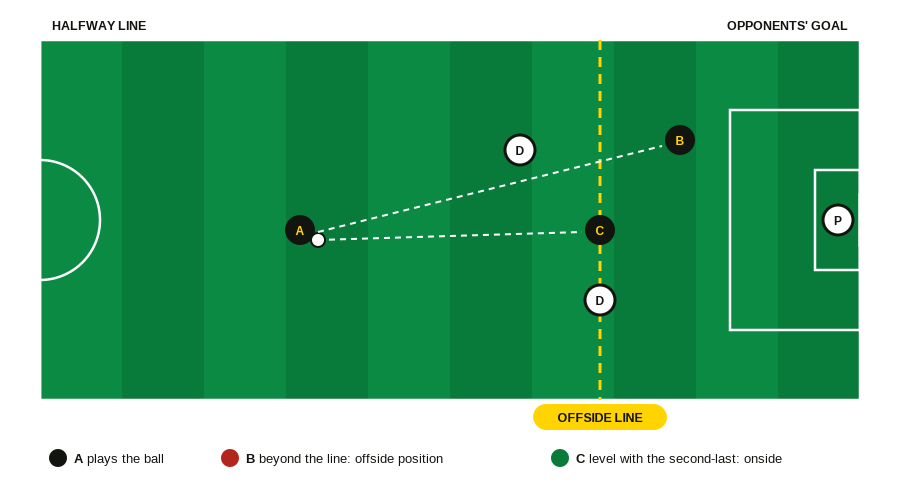
Position is judged at the moment a team-mate plays or touches the ball. Where the attacker is when receiving it does not matter. A player can therefore start from an onside position and collect the ball well beyond the defence without committing any offence.
To fix the exact moment, the first point of contact between the team-mate and the ball is used. There is one exception: when the goalkeeper throws the ball, the last point of contact is used, which is the moment the ball leaves their hands.
The three conditions of an offside position#
A player is in an offside position only if three conditions are true at the same moment.
- Part of the head, body or feet is in the opponents’ half.
- That part is nearer to the opponents’ goal line than the ball.
- That part is nearer to the opponents’ goal line than the second-last opponent.
Two useful consequences follow. A player receiving a backward pass cannot be offside, because they are behind the ball. A player who starts in their own half cannot be offside, whatever happens next.
The parts of the body that count#
Only the parts of the body with which a goal can legally be scored count for position. Hands and arms are excluded for every player, including the goalkeeper. The upper boundary of the arm is the bottom of the armpit.
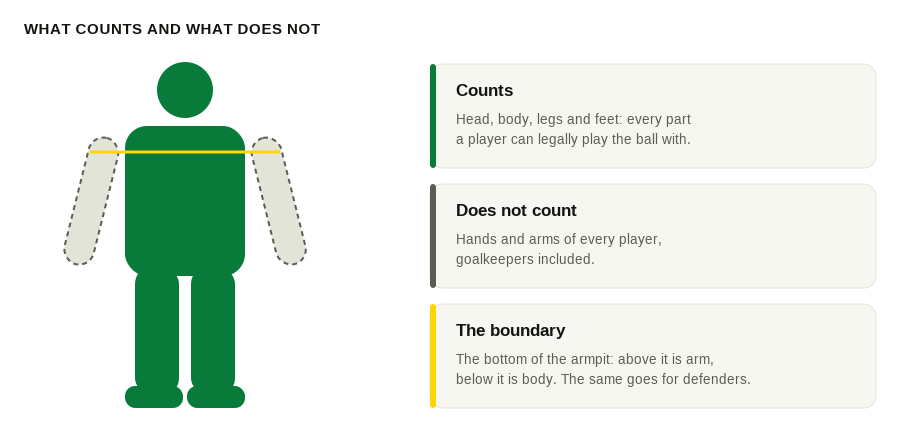
This level of detail has become decisive with technology. Slow-motion images often show goals disallowed for a shoulder or a knee beyond the line. Those decisions are correct under the Law, even when they look excessive.
Involvement in active play#
Once it is established that the player was in an offside position, the question is whether they took part in play. Law 11 lists three ways.
- Interfering with play: playing or touching a ball passed or touched by a team-mate.
- Interfering with an opponent: stopping them from playing the ball by blocking their line of vision or challenging them. Clearly trying to play a nearby ball, or an obvious action that affects them, also counts.
- Gaining an advantage: playing a ball that rebounds off a post, the crossbar, a match official or an opponent, or that comes from a save.
The most common case of interfering with an opponent is the attacker standing in front of the goalkeeper on a long-range shot. If the goalkeeper cannot see the shot because of that player, the goal is disallowed even if the attacker never touches the ball.
The sanction#
Offside is punished with an indirect free kick, taken where the offence occurred. That is not where the player stood when the ball was played, but where they became involved. It can even be in the player’s own half, if they had moved back in the meantime.
Offside does not bring a caution. It is a technical offence, not misconduct. A yellow card only follows in particular cases, such as deliberately leaving the pitch to avoid being caught, described further down.
The variations: one rule, different tools#
Law 11 is identical in every league affiliated to FIFA, from Italian football to European football and amateur competitions. National associations cannot change it. What changes from one competition to another is how it is judged: by eye, with VAR, or with a semi-automated system.
Semi-automated offside technology#
Semi-automated offside technology uses dedicated cameras that track dozens of points on every player’s body. A sensor in the ball, or image analysis, identifies the exact moment of the pass. The system flags the offside position to the VAR, who confirms it and passes it to the referee within seconds.
Its debut at a major tournament came at the 2022 World Cup. It is now also used in the Champions League, Europa League and Conference League, and in the top domestic leagues, including Serie A and the Premier League. The 3D animations shown on television are produced by this system.
VAR with manually drawn lines#
Where the semi-automated system is not available, the VAR draws the lines by hand on a frame chosen by the operator. The method is slower and depends on picking the right frame for the pass. The lines are placed on the most advanced point of the attacker and of the second-last defender, arms excluded.
Offside is a factual decision, not a matter of interpretation. For that reason the VAR does not apply the “clear and obvious error” test. If the position was offside and the player was involved, the goal is ruled out even by a few centimetres.
Football without VAR#
Most matches played around the world use no technology at all. The decision belongs to the assistant referee, who stands level with the second-last defender. In youth and grassroots football the assistants are often club volunteers, who only signal throw-ins and not offside.
Reading offside live is the hardest skill an assistant referee has to learn. National referees’ associations, such as Italy’s AIA, train their assistants on it with dedicated video sessions.
Edge cases and exceptions#
The least known part of Law 11 deals with unusual situations. They are the ones that fuel Monday-morning arguments, and almost all of them have a precise answer in the text.
Deliberate play and deflection#
If a defender deliberately plays the ball, the attacker’s position is reset. A player who was offside can receive that ball without being penalised. This applies even when the defender’s play goes wrong, such as a short back-pass or a miscued clearance.
If the ball instead bounces off the defender by accident, it is a deflection and the offside stands. To tell the two apart the referee looks at several factors.
- The distance between the defender and the ball.
- Whether the defender could see the ball coming.
- The speed of the ball and how predictable its path was.
- The time the defender had to coordinate their movement.
- Whether the ball was on the ground or in the air.
The save#
A save does not reset the position. If the goalkeeper parries a shot and the ball reaches an attacker who was offside when the shot was taken, the offence stands. The Law also counts as a save an outfield player blocking, with any part of the body except the arms, a ball going into or very close to the goal.
A defender who leaves the pitch#
A defender who leaves the field without permission still counts for offside. They are treated as standing on their own goal line or touchline. This applies until the next stoppage, or until the defence plays the ball towards the halfway line and it is outside their penalty area.
It prevents a trick: stepping off the pitch to put an attacker offside. If the departure was deliberate, the defender is cautioned at the next stoppage.
An attacker who leaves the pitch#
An attacker may step off the pitch to show they are not involved in play. If they come back on from the goal line and become involved before the next stoppage, they are treated as standing on the goal line. If they leave and return deliberately to gain an advantage, they are cautioned.
An attacker inside the goal#
If an attacker is standing still inside the goal, between the posts, when the ball goes in, the goal stands. The exception is when the player commits an offside offence, for example by blocking the goalkeeper’s view, or a foul.
A foul and offside in the same move#
When a foul and an offside occur in the same move, the order matters. If the foul comes first, the foul is penalised. If the offside comes first, the offside is penalised and the later foul is dealt with only from a disciplinary point of view.
The delayed flag#
In matches with VAR, assistant referees do not raise the flag immediately when the position is doubtful. They wait when the move could lead to a goal. Play is allowed to finish, then the decision is made. If play were stopped by mistake, there would be no way to restore a legitimate goal.
Terms that get confused#
- Offside position and offside. The first is a geometric condition that is not punished. The second is the offence, which also requires involvement in play.
- Active and passive offside. These are media expressions, not terms used in the Law. “Passive” describes a player in an offside position who takes no part in play, and is therefore not penalised.
- Second-last opponent and last defender. The Law talks about opponents, not defenders, and the goalkeeper is included. The reference is the second deepest player, whoever that is.
- Offside line and defensive line. The defensive line is a tactical choice. The offside line is the reference set by the Law, and it always runs through the second-last opponent or through the ball, if the ball is further forward.
- Deflection and deliberate play. A deflection is involuntary and does not reset offside. Deliberate play is voluntary, even if it goes wrong, and it does reset it.
- Semi-automated offside and VAR. The semi-automated system does not decide on its own: it flags a position, and the decision stays with the referee after the VAR check.
- Offside trap and offside tactic. They mean the same thing: the defenders step up together a moment before the pass, leaving the attacker beyond the line.
What happens after an offside#
The immediate consequence is an indirect free kick for the team that was defending. A goal cannot be scored directly from an indirect free kick: the ball must touch another player before going in. In practice, it is almost always the goalkeeper or a defender who restarts play with a long ball.
When the VAR spots an offside after a goal, the goal is disallowed and play restarts with an indirect free kick from the place of the offence. The time spent on the check is added on at the end of the half. In knockout phases, such as play-offs, a disallowed goal weighs exactly as much as in a league match.
There is also a statistical consequence few people think about. A goal ruled out for offside does not appear in the match record or in the scoring charts. It therefore affects individual awards such as the top scorer title, and in extreme cases the points table.
Tactically, a team that is often caught offside has a timing problem. Coaches work on when attackers start their runs and when the pass is released. Teams that defend with a high line, on the other hand, accept the risk of an error in exchange for a shorter pitch.
Finally, offside is not set in stone. The IFAB keeps testing alternative versions, including the idea of keeping an attacker onside as long as any scoring part of the body is level with the defender. These trials are limited to a few competitions. Until The IFAB approves them, the rule used in Serie B, La Liga or the Bundesliga remains the one described here.
Offside across competitions#
Anyone who follows several competitions notices differences in how long decisions take, not in the rules. In Serie A and the Premier League the semi-automated system makes checks quick. In UEFA club competitions, such as the Champions League and the UEFA Super Cup, the same kind of technology is used in every match of the main stages.
In national-team competitions, from the World Cup and the European Championship to the Copa América and the Nations League, it varies. The technology depends on the organiser and on the stage of the tournament. In lower divisions, such as Serie C, and in the early rounds of domestic cups like the Coppa Italia, the set-up may be more limited. In Ligue 1 and the other European leagues, each league makes its own choices.
The difference matters to anyone watching. Where technology is complete, a goal that has been celebrated can be ruled out a minute later. Where it is missing, the assistant’s decision on the pitch is final.
Frequently asked questions#
Can you be offside in your own half?#
No. An offside position only exists in the opponents’ half, and the halfway line is not part of it. A player who, at the moment of the pass, has no part of the body that counts beyond the halfway line is onside.
The indirect free kick can, however, be taken in the player’s own half. This happens when the player was in an offside position when the ball was played, then moved back and became involved there. The free kick is taken where the offence occurs, not where the player was.
Is it offside if I am level with the defender?#
No. Since 1990 the Law has treated a player level with the second-last opponent, or with the last two opponents, as onside. To be offside, a part of the body that counts must be further forward, even by a little.
With technology, “level” has become a measurement in centimetres. The semi-automated system compares the most advanced point of the attacker with that of the defender, arms excluded. The old principle of “benefit of the doubt to the attacker” now mostly applies in matches without VAR.
Can you be offside from a throw-in?#
No. The throw-in is one of the three exceptions in Law 11, together with the goal kick and the corner kick. A player who receives the ball directly from one of these restarts cannot be penalised for offside.
The exception only covers the first pass. If, after the throw-in, a team-mate touches the ball and passes it to a player in an offside position, the assessment starts again and offside can be called.
Can you be offside from a free kick?#
Yes. Free kicks, direct or indirect, are not among the exceptions. That is why, on wide free kicks, attackers line up with the defenders and only start their run when the ball is kicked.
The trickiest case is the quick free kick. Position is judged at the moment of the kick, and a player who has not had time to get back may be offside. Defences exploit this by stepping up suddenly just before the kick is taken.
Does the goalkeeper count for offside?#
Yes, like any other player. The Law talks about the second-last opponent, not the second-last defender. In most situations the goalkeeper is the last player, and the second-last is the deepest defender.
If the goalkeeper comes forward, for example for an attacking corner or to claim a high ball, the two reference players may become two outfield defenders. In that case an attacker can be offside even while behind the goalkeeper.
Can your arm make you offside?#
No. Hands and arms do not count when judging position, for any player. The boundary is the bottom of the armpit: the shoulder counts, the arm does not.
The same exclusion applies to the defender used as the reference. If a defender stretches an arm back towards their own goal, that arm does not play the attacker onside. The measurement uses the deepest point of the defender’s body, arms excluded.
Does a touch off a defender cancel offside?#
It depends on how the touch happened. An involuntary deflection changes nothing: the offside stands. Deliberate play by the defender, even a poor one, does reset the attacker’s position.
The distinction rests on how much control the defender had over the ball: distance, view, speed, path and reaction time. A save, meaning an attempt to stop a goal, never resets offside.
Why does the flag sometimes go up long after the pass?#
In matches with VAR, assistants delay the signal when the situation is doubtful and the move could end in a goal. That way any error can be corrected on video, instead of stopping a legitimate move that could not be restored.
The result is moves that end in a goal and are then disallowed, or goalkeepers who do not react because they expect an offside flag. Defenders are taught to keep playing until the whistle, without stopping to wait for the flag.
Does offside apply in youth and amateur football?#
Yes, in eleven-a-side football the rule is the same at every level. For the youngest age groups national associations may adapt some organisational rules, such as pitch size or match length. The substance of offside in eleven-a-side football does not change.
In futsal and in amateur seven-a-side football, offside does not normally apply. They have their own rulebooks, which differ from the Laws of the Game for eleven-a-side football.