- 1908 Founded
- 75,817 Capacity
- 1926 Stadium opened
- Milan Based in
Il club
- Fondazione
- 1908
- Citta
- Milan
- Colori sociali
- Black and blue vertical stripes
- Soprannome
- Il Biscione
Lo stadio
- Impianto
- Stadio Giuseppe Meazza
- Comune
- Milan
- Capienza omologata
- 75,817 seats
- Inaugurazione
- 1926
- Proprieta
- Inter and Milan
La capienza indicata e' quella omologata, non la presenza media: cambia solo dopo lavori o nuove prescrizioni di sicurezza.
Identita
Football Club Internazionale was founded in Milan on 9 March 1908. The date is exact because the founding document survives: an evening at a restaurant on the cathedral square.
Born from a split
The club did not appear from nowhere. It came out of a split. A group of members left the existing Milanese football club over one disagreement: the parent club wanted to register Italian players only, the dissenters did not.
Hence the chosen name, Internazionale, and the line in the founding document describing a club open to players of every nationality. That is not colour: it is the reason two clubs exist in Milan rather than one, and the root of the derby covered further down.
The colours
Black and blue were chosen by the founders, several of whom were painters. Blue for the sky, black for the night. The most common nickname, Il Biscione, comes from the serpent on the Visconti coat of arms, an old symbol of the city.
What this page holds
The information gathered here is what stays valid over time: the ground, the corporate structure, the constraints governing a squad, the academy. You will not find a list of players, which changes in the sessions described in the guide to transfer windows, nor the division the club currently plays in.
Lo stadio
The Stadio Giuseppe Meazza, known everywhere as San Siro after the district around it, is the largest ground in Italy. It opened in 1926.
One ground, two clubs
What sets it apart is that the ground hosts two clubs. Inter and Milan both play their home matches there, alternating from round to round. At this level it is a rare arrangement in Europe.
The practical result is a fixture list that has to interlock. The two clubs cannot play at home on the same day, and the pitch takes twice the matches of a normal ground. A company jointly controlled by the two owners looks after it.
Who owns it
For almost a century the ground belonged to the City of Milan, which granted its use to the two clubs. In November 2025 the two clubs took ownership of it, along with the surrounding area.
The change matters more than it appears. Whoever owns a ground collects match-day revenue directly and schedules work without agreeing it with a public body. It is the same difference set out on the Juventus page, a club that has owned its ground for far longer.
The project tied to the purchase provides for a new ground on the site and the near-complete demolition of the present one. Since the work is still being defined, timings and final shape should be checked against official sources.
The capacity
The figure given is the licensed capacity, the maximum the competent authority allows. It is not the average attendance, which varies from match to match. It changes only after structural work or new safety requirements.
Andare allo stadio
San Siro sits in the western part of Milan, in a residential district served by public transport. First-time visitors almost always ask the same questions.
Getting there
The ground is connected to the metro network and to surface tram lines. Stops and available car parks are listed on the club’s official site, which also publishes the traffic restrictions applied on match days.
Since the ground hosts two clubs, it is worth checking which of the two is at home: signage and recommended entry points change accordingly.
How the sections are laid out
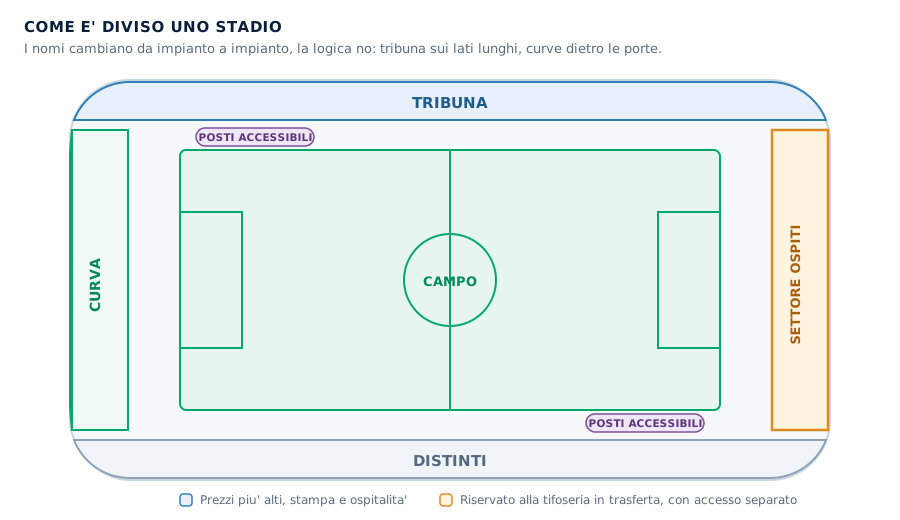
Against the general pattern, San Siro has a feature of its own: the stands are arranged over three stacked tiers. The tier number matters as much as the section, because it sets the height and therefore the distance from the pitch.
| Tier | Position | What to expect |
|---|---|---|
| First | Closest to the pitch | Maximum proximity, a flatter view of distant play |
| Second | Intermediate | The best balance between distance and reading the game |
| Third | The highest | A full overview, very far up, a demanding climb |
| Away section | A dedicated tier with separate entry | Sale restricted on a case-by-case basis |
The away section
Visiting supporters occupy an area with its own entrances and facilities, kept apart from the rest. Those tickets do not follow ordinary rules: the sale can be limited to residents of one province, or banned when the fixture is classed as high risk.
Decisions arrive a few days before the match. No prices or procedures appear here, then: they would need rewriting every round.
Accessibility
Reserved places for people with disabilities are a licensing requirement, not a courtesy from the club. At San Siro they sit at pitch level, where the view does not depend on whoever is seated in front.
A reserved place normally covers a companion, and booking goes through a dedicated channel rather than general sale.
Albo d'oro
Honours are the one club figure that never shrinks: what has been won stays won. Below are the international competitions with the year of each success.
The UEFA competitions
| Competition | Years | Note |
|---|---|---|
| European Cup | 1964, 1965 | The back-to-back wins of the 1960s |
| Champions League | 2010 | Same competition, new name: see the Champions League |
| UEFA Cup | 1991, 1994, 1998 | Forerunner of the Europa League |
The 2010 win carries a particular meaning: in the same season the club took the domestic cup, the league and the European competition. Very few clubs in Europe have managed it, because it demands holding up across three overlapping calendars into June.
The domestic trophies
Domestically the titles are the Serie A championship, the Coppa Italia and the Italian Supercoppa. The overall count is not given: it grows with every new win, and should be read from the official sources listed below.
It is worth recalling that some title awards from the middle of the 2000s followed sporting proceedings rather than results on the pitch. Counts published by different sources may therefore disagree, and that is why.
Le rivalita
Rivalries come from facts, not results, which is why they stay stable. Here is where each one comes from.
The Milan derby
The fixture against Milan is the only derby in the world played by two clubs in the same ground. There is no away trip: only which of the two is the host changes.
Its origin is the 1908 split described in the identity section. The two clubs grew from the same root, and that makes the contest closer than simple geographical proximity.
The Derby d’Italia
This is the fixture against Juventus. The name has no territorial origin, since the clubs are based in different cities. It comes from the fact that for decades they were the two clubs with the widest following in the country.
Why they carry real weight
Derbies produce the highest gate receipts of the season. They are also the fixtures most often classed as high risk, carrying the tightest restrictions on ticket sales.
A derby also swells the audience figures, and those figures carry weight in the way broadcasting money is shared out, as set out on the Serie A page.
Organigramma
What follows describes roles, not the people filling them. Names change; the organisational frame of a leading club almost never does.
Where the team trains
The first-team training ground is at Appiano Gentile, in the province of Como. It is known as the Pinetina after the pine wood around it, and has been in use since the 1960s.
Placing the training ground outside the city is common among leading clubs: it takes room for several pitches, accommodation and medical facilities, and in Milan that room does not exist.
How many people work there
| Area | How many | Responsible for |
|---|---|---|
| Coaching staff | 6 – 10 | Head coach, assistants, fitness and goalkeeping coaches |
| Medical staff | 8 – 12 | Doctors, physiotherapists, rehabilitation, nutrition |
| Football management | 3 – 6 | Sporting direction, scouting, contract handling |
| Corporate structure | Several hundred | Administration, commercial, communications, stadium |
The figures describe a top-flight club and are indicative. The rules also require two specific roles: the safety officer and the officer handling relations with supporters.
Come si compone la rosa
A club of this size works with two sets of constraints at once: those of the domestic league and those of the European competition, which do not match.
Two lists, not one
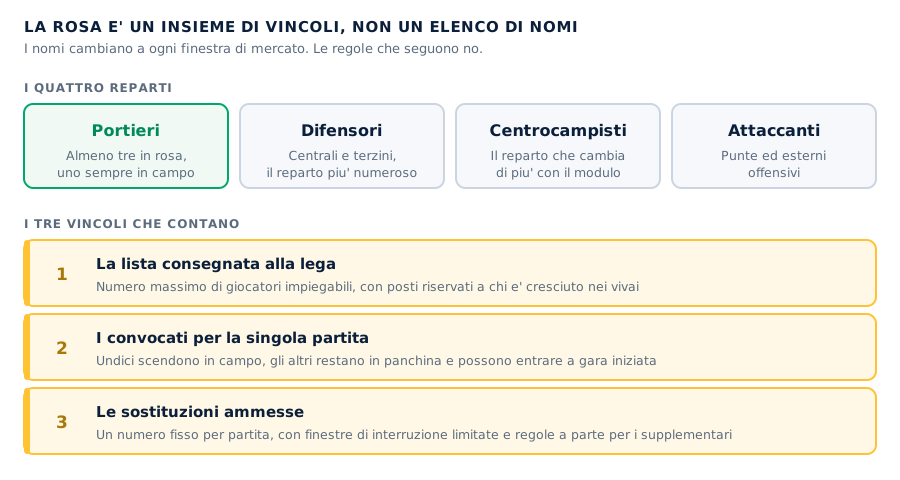
A list of eligible players is filed with the domestic league, with places reserved for players developed in Italian academies. A different list goes to UEFA, with its own criteria and its own maximum.
A player can therefore be eligible in the league and not in Europe, or the other way round. It is one reason certain deals close in a rush near the deadline described in the guide to types of transfer.
What the calendar does
A club in the European competitions plays up to twenty extra matches in a season. That changes how the squad is sized: it needs two dependable players per position, not one.
The number of substitutions allowed, and the windows for making them, are set by each competition’s rules and may differ between league and cup.
Shirt numbers
A number is personal and stays assigned for the whole season. It does not follow the position, beyond the goalkeeping convention. A player arriving mid-season is given one of the free numbers.
Settore giovanile
An academy is a requirement for obtaining the national licence: every professional club must enter a minimum number of youth teams.
Where the young players grow
The youth teams train at a dedicated site on the outskirts of Milan, separate from the first-team ground. The separation is deliberate: the two groups have different needs, hours and workloads.
What it produces
A player developed in-house fills one of the list places reserved for academy-trained players. That is an accounting advantage before a technical one, because the place would otherwise have to be bought.
If his value then grows he generates a capital gain, the difference between what the club receives and what he had cost. The solidarity mechanism described in the guide to the transfer market also returns a share to the clubs that trained him.
The route to the first team
The step from youth football to the professional game remains the hardest. There are two routes: a temporary move to a club in a lower division, or a second team entered in Serie C, an option Italian rules open to leading clubs.