- 18 Clubs
- 34 Rounds
- 2 Relegated
- Aug-May Season
Regolamento
The Bundesliga is the top division of German football. Eighteen clubs rather than twenty, thirty-four rounds rather than thirty-eight: it is the shortest of the major European leagues.
Why eighteen and not twenty
Fewer clubs mean four fewer matches a season. The choice frees calendar space for the cups and for a long winter break, which in Germany can run beyond a month.
The break is not an indulgence: January weather makes many pitches unplayable. The league restarts when conditions allow, which is why the German calendar compresses in the second half of the season.
The format
A single group, home and away, three points for a win. The final table settles the title and the European places without deciders. The difference from other leagues lies at the bottom.
The tie-break criterion
On equal points, goal difference comes first, then goals scored, then head-to-head. That is the English criterion, not the Italian one described on the Serie A page.
If two clubs finish level at the top, or on a decisive place, the rules provide for a decider at a neutral venue.
The 50+1 rule
This is the provision that makes German football unlike any other. The sporting club, which is an association of members, must retain the majority of voting rights in the company running the professional team.
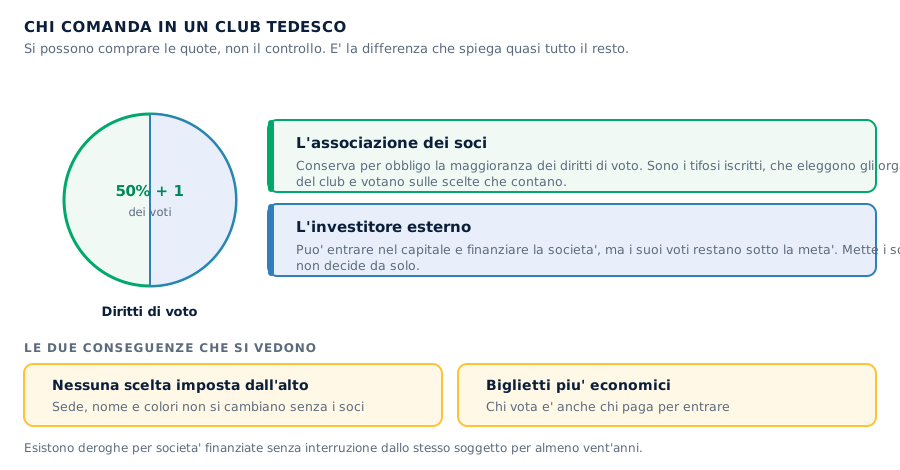
An investor can therefore fund a club and hold a substantial stake, but cannot decide alone. Home town, name and colours cannot be changed without the members’ consent.
Exemptions exist for clubs funded without interruption by the same party for at least twenty years. They are few and named, and each has a history of its own.
What you actually see
| Effect | Why it happens | Comparison |
|---|---|---|
| Cheaper tickets | The people voting are the people paying to get in | Far higher prices in England |
| High average attendance | Affordable prices and standing sections | Standing is banned elsewhere |
| Less debt | The licence forbids starting with a deficit | Control comes after the fact in England |
| Less capital available | No single owner to absorb losses | A disadvantage in the race for players |
Standing areas
German grounds keep sections with standing places, banned in the English top flight after the disasters of the 1980s. In Germany they are allowed domestically and converted to seats for European matches, where UEFA forbids them.
That is why a German ground’s capacity changes with the competition: the same stadium quotes two different numbers.
The licence and the squad
The league issues a licence each year after examining the accounts. A club that fails to obtain one is not admitted, whatever its league position, following the logic described in the guide to how relegation works.
Second teams are admitted to the lower divisions but cannot be promoted to the Bundesliga. The list also requires a minimum number of players trained in Germany.
Posizioni e qualificazioni
| Position | Consequence | Note |
|---|---|---|
| 1st | German champions | Settled by the table |
| 1st — 4th | Champions League league phase | A fifth place is possible on continental merit |
| 5th | Europa League | Can vary depending on the domestic cup |
| 6th | Possible Conference League | Depends on who wins the cup |
| 7th — 15th | No consequence | Stay in the Bundesliga |
| 16th | Play-off against the third-placed second-tier club | Two legs, home and away |
| 17th — 18th | Direct relegation | No deciders |
The play-off no other major league has
The sixteenth-placed club is neither relegated nor safe: it faces the third-placed club of the second division over two legs. The winner plays in the Bundesliga the following season.
It differs from the Italian play-out described in the guide to how play-offs work. Here it is not two clubs from the same division facing each other, but one from each.
Home advantage in the second leg goes to the Bundesliga club. There is no tie-break benefit, though: level on aggregate means extra time and penalties.
The two direct relegations
The bottom two go down without appeal, and the top two of the second division take their places. Three of the four places are therefore decided by the table alone, the fourth by the play-off.
The European places
The top four enter the league phase of the Champions League, with a fifth place possible on continental merit. The domestic cup awards a Europa League place, and if its winner has already qualified the place passes down the table.
How German clubs perform in Europe feeds the country coefficient, which sets the places available in later years under the UEFA ranking calculation.
Premi
The Bundesliga distributes less money than the Premier League but operates on sounder accounts. That follows directly from the rules described above.
How the rights are shared
| Component | Criterion | Who it favours |
|---|---|---|
| Multi-year performance | Final tables over recent seasons | Consistently strong clubs |
| Base share | Split among clubs in both professional divisions | Smaller clubs and the second tier |
| Youth development | Minutes played by players trained in Germany | Clubs that back their academies |
The last component is the most unusual. Paying clubs for minutes given to home-trained players is a choice no other major league has adopted with the same weight.
The economic model
Barring outside control limits the inflow of capital, but it also imposes discipline. A German club cannot rely on an owner to absorb losses, so it has to balance its books.
The result is a league with modest debt and some of the highest average attendances in the world. In exchange, its ability to compete on wages stays below that of the Premier League and La Liga.
What the title is worth
As elsewhere, the direct prize counts for little. The value lies in Champions League entry and in the multi-year component of the split, which keeps paying out in later seasons.
Where the money comes from
German clubs draw a larger share of their income from match day than their English or Spanish counterparts. Full grounds and affordable tickets add up across seventeen home matches.
Sponsorship also weighs more heavily, helped by an industrial base concentrated in the same regions as the clubs. The trade-off is a smaller share from broadcasting, which is the fastest-growing source elsewhere.
Calciomercato
The German market follows the international rules described in the guide to how the transfer market works. Its particularities come from the ownership model.
Contracts and player freedom
The maximum length of a professional contract is set by international rules. Germany has no compulsory release clause of the Spanish kind: clauses exist, but they are negotiated case by case, as explained in the guide to clauses and contracts.
The windows
There are two sessions, on dates set by the federation within international limits. The detail is in the guide to transfer windows.
The winter break straddles the reopening of the market. German clubs can therefore negotiate while the team is idle, and a new arrival settles in during pre-season work rather than between two matches.
Development as an economic model
The federation requires professional clubs to run academies meeting audited minimum standards. The system was introduced after a spell of poor national-team results, and it changed how clubs build their squads.
The return is twofold: ready-made players without signings, and the share of the revenue split tied to minutes given to home-trained players.
How it compares
| Aspect | Bundesliga | Other major leagues |
|---|---|---|
| Number of clubs | 18 | 20 in Italy, England and Spain |
| Ownership | Members keep control by rule | No such requirement elsewhere |
| Survival play-off | Between first and second division | Between clubs of the same tier in Italy |
| Standing areas | Allowed domestically | Banned in England and in Europe |