In football a win is worth three points, a draw one, a defeat none. The total decides a club’s position in the table, and from that position follow the title, European qualification and relegation. When two clubs finish level on points a sequence of criteria comes into play. That sequence differs from league to league, and it is where almost every misunderstanding begins.
In short#
- Three points for a win, one for a draw, none for a defeat: the same worldwide.
- The third point was introduced to make settling for a draw less profitable.
- Clubs level on points are separated by a sequence set in the competition rules.
- Serie A and LaLiga start from the head-to-head record between the tied clubs.
- The Premier League and the Bundesliga start from overall goal difference.
- The same results can therefore produce different orders in different leagues.
- For the title and for relegation some rules provide for a play-off match.
What the points system is#
The points system is the rule that converts match results into a table. Each club accumulates points round by round. At the end of the season the order of those points decides who wins the title, who reaches the continental competitions and who goes down.
It is not the only possible way to rank a competition. Some sports use win percentage, others reward goals scored. Football chose points because they make clubs comparable once they have played the same number of matches. They also allow the table to be read at any moment of the season.
The sequence applied when clubs are level is far from uniform. Here is how it differs across the main European leagues.
| League | First criterion | Second criterion | Third criterion | Play-off match |
|---|---|---|---|---|
| Serie A | Head-to-head points | Head-to-head goal difference | Overall goal difference | For title and relegation |
| LaLiga | Head-to-head points | Head-to-head goal difference | Overall goal difference | In extreme cases |
| Premier League | Overall goal difference | Goals scored | Head-to-head points | If the place is decisive |
| Bundesliga | Overall goal difference | Goals scored | Head-to-head points | Provided for in the rules |
Why a win is worth three points#
For most of the twentieth century a win was worth two points. The move to three was adopted first in domestic leagues and then in international competitions, until it became the worldwide standard.
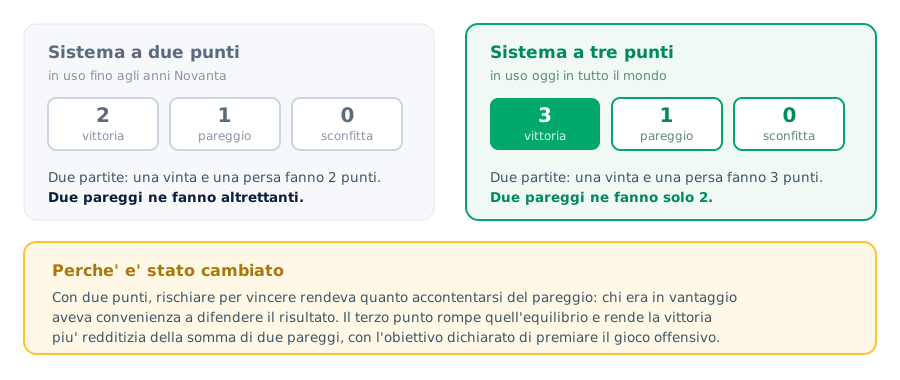
The reason for the change is arithmetic before it is sporting. Under two points, a club that won one match and lost another collected the same as a club that drew both. Going for the win was not rewarded, and defending a lead was the rational choice.
Three points breaks that balance. A win and a defeat are worth three points, two draws are worth two. A club that wins gains ground even if it loses the next match, and settling becomes less attractive.
- Intended effect. Reward attacking play and reduce the number of matches played out for a draw.
- Side effect. Gaps in the table widen, and a club that wins a lot and loses a lot can finish above a more consistent one.
- Effect on the survival fight. With three points available every round, a club at the bottom recovers faster. The race described in how relegation works stays open longer.
How to read a table#
The columns of a league table are nearly always the same. Knowing them helps in understanding what the rules will look at if clubs finish level.
- Points. The running total. It is the only figure that orders the table in the first instance.
- Played. Useful when a fixture has been postponed: two clubs level on points with a different number of matches are not in the same position.
- Won, drawn, lost. The breakdown from which the points derive.
- Goals for and against. The totals in both directions.
- Goal difference. Goals for minus goals against. It is the most widely used tie-breaker in European football.
Goal difference measures how convincingly a club has won its matches. It rewards those who dominate weaker opponents, which is why it is treated as an indicator of overall strength. A league that uses it as its first tie-breaker is declaring that the whole season counts, not the individual meeting.
The two schools for separating clubs level on points#
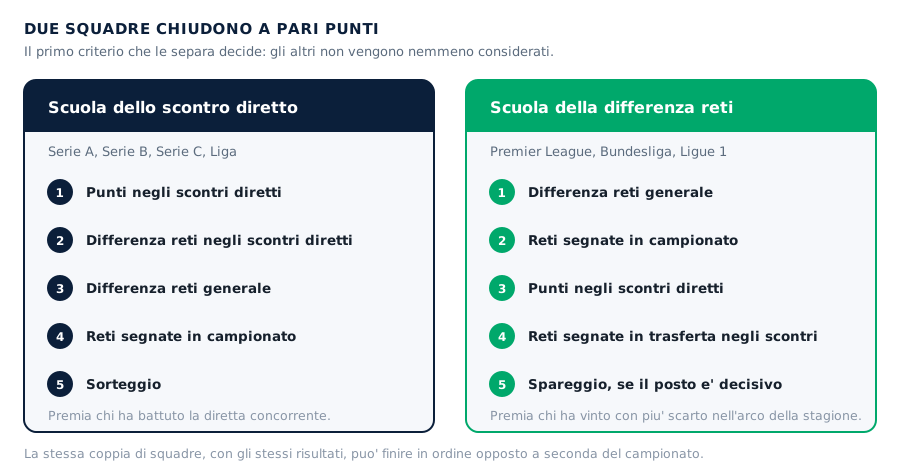
When two clubs finish on the same total, the rules set out a sequence of criteria. The first one that separates them decides, and the rest are never considered. The sequences used in Europe fall into two families.
The head-to-head school#
Used by Serie A, Serie B, Serie C and LaLiga. The first criterion is the points won in the matches between the tied clubs, then goal difference in those same matches, and only afterwards overall goal difference.
The principle is that a club which beat its direct rival has already settled the matter on the pitch. It is a measure of relative merit: what counts is the meeting between the two clubs, not their record against everyone else.
When more than two clubs are level, a mini-table is built from the matches played among them alone, then read with the same criteria. It is the step that causes the most confusion, because a club can be ahead in the main table and behind in the mini-table.
The goal difference school#
Used by the Premier League, the Bundesliga and Ligue 1, as well as most of the leagues listed under Other European Leagues. The first criterion is overall goal difference, then goals scored, and head-to-head results only at the end.
The opposite principle: what counts is how a club performed against everyone, not against one opponent. Two matches out of thirty-eight are considered too small a sample to decide a season.
The practical advantage is legibility. Goal difference is visible in the table from the first round, so any supporter knows at any moment who is ahead. Head-to-head records require remembering the results of two specific matches.
Why two schools and not one#
The divergence is neither accidental nor recent. It comes from two different ideas of sporting merit, and each federation picked the one consistent with its own tradition.
Those who start from head-to-head treat the league as a sum of individual contests. If two clubs finish level, the one that won the duel has already resolved the question, and the table need only take note.
Those who start from goal difference treat the league as a single trial of thirty-eight rounds. Two matches weigh little, may have been shaped by a red card or an injury, and judging a season on them looks arbitrary.
Neither approach is more correct. What changes is the kind of club that benefits. The first rewards those who can prepare the decisive match, the second those who are consistent and win by wide margins against weaker opponents.
When a play-off match is needed#
If every criterion leaves the clubs level and the place at stake is decisive, some rules provide for a play-off match. It is not the norm: it applies only to the title, to relegation and, in certain leagues, to European qualification.
In Serie A the title play-off is a single match at the ground of the better-placed club under the mini-table criteria. The relegation play-off is played over two legs, with the return hosted by the better-placed club. If the aggregate is level it goes straight to penalties, with no extra time.
In the Premier League a play-off is provided as a last resort: a single match at a neutral venue, and only if the place decides the title, qualification or relegation. How this kind of match works in general is described in the guide to how play-offs work.
Points deducted and points not awarded#
The table does not record only what happens on the pitch, and this is the part newcomers find hardest to interpret.
- Points deductions. A penalty for financial or disciplinary breaches is subtracted from the total and counts like any other negative result.
- Postponed matches. A rearranged fixture leaves the table temporarily uneven: two clubs level on points with a different number of matches are not comparable.
- Forfeits. When a club fails to appear or fields an ineligible player, the match is awarded to the opponent with a set scoreline.
- Fair play points. Some competitions use them as a last-resort tie-breaker, counting cards and disciplinary sanctions.
Penalties imposed after the season ends take effect on the following campaign and do not alter a table already closed. Those imposed during the season do, and can overturn a position with only a few rounds left.
Matches played out of sequence#
A table in which clubs have not played the same number of matches has to be read with care. The points total remains the official order, but it does not describe the real situation until the calendar realigns.
This is why many tables also show a played column, and why commentators talk about virtual points: the total a club would reach by winning its match in hand. It is not an official figure and appears in no set of rules, but it helps compare clubs in different situations.
Postponements are provided for on grounds of public order, unplayable pitches or international duty. The rearranged date is set by the league, which has to fit it into an already crowded calendar.
Points in knockout competitions#
In straight knockout competitions points do not exist: all that matters is going through. That is the case in the domestic cup and in the knockout stages of the Champions League, the Europa League and the Conference League.
Where a group stage exists the points system works as in a league. The tie-breaking sequence, however, follows the rules of that competition rather than those of the domestic leagues. The continental competitions use the criteria set by UEFA, which start from head-to-head results and continue with goal difference.
In national team tournaments such as the World Cup and the European Championship the group stage awards points under the same system. The tie-breaking criteria are fixed by the rules of each tournament, and the final position determines access to the knockout stage.
Frequently asked questions#
How many points is a win worth in football?#
Three. A draw is worth one point to each club, a defeat none. The system is the same in every professional league in the world and in all international competitions.
It was not always so: for most of the twentieth century a win was worth two points. The third was added to make settling for a draw less profitable, as explained above.
What happens if two clubs finish level on points?#
The sequence of criteria set out in that competition’s rules is applied. In Serie A and LaLiga it starts from head-to-head points, in the Premier League and the Bundesliga from overall goal difference.
The first criterion that separates the clubs decides, and the rest are not considered. It is why the same pair of clubs, with the same results, can finish in opposite order in two different leagues.
What is a mini-table?#
It is a small table built only from the matches played between the clubs level on points. It is used when more than two clubs are tied, and it is read using the same criteria as the main table.
It causes confusion because the order can reverse. A club can be ahead in the main table and behind in the mini-table, if it did worse against the other clubs on the same total.
What is goal difference and why does it matter?#
It is goals scored minus goals conceded. It measures how convincingly a club has won its matches, which is why it is treated as an indicator of performance across the whole season.
In leagues that use it as the first tie-breaker it is visible in the table from the opening round, so any supporter knows at any moment who is ahead. Head-to-head records instead require remembering two specific results.
Are title play-offs still played?#
Yes, where the rules provide for them. In Serie A it is a single match at the ground of the better-placed club, and it is held only if two clubs finish level on points at the top.
For relegation the format differs: two legs, with the return hosted by the better-placed club. If the aggregate is level it goes straight to penalties, with no extra time.
Does a points deduction remove points already earned?#
Yes. The deduction is subtracted from the accumulated total and appears in the table like any other figure, usually flagged with a note next to the points column.
If it arrives during the season it can change the final position and push into the relegation zone a club that had stayed up on the pitch. If it arrives after the season ends, it takes effect on the following campaign.
Why do head-to-head results not count in the Premier League?#
They do count, but only after goal difference and goals scored. The choice reflects a clear principle: two matches out of thirty-eight are considered too small a sample to decide an entire season.
The opposite school, followed in Serie A, starts from the assumption that beating a direct rival already settles the matter on the pitch. Neither is more correct: they are two different ideas of merit.
Do points apply in the continental competitions?#
Only where a group stage exists. In the knockout rounds of the Champions League, the Europa League and the Conference League points do not exist: all that matters is going through.
In the group stage the system works as in a league, but the tie-breaking criteria are the competition’s own rather than those of the domestic leagues. The number of places available to each country depends instead on the UEFA coefficient.