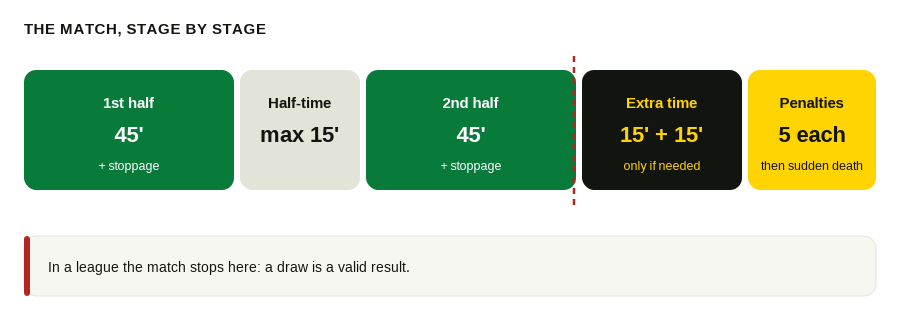
A football match lasts 90 minutes, split into two halves of 45 minutes, plus the stoppage time the referee adds at the end of each half. Between the halves there is a break of no more than 15 minutes. In a league the match ends there, even if the score is level. When a winner is needed, as in the knockout stages of cups, two periods of extra time of 15 minutes are played and, if still level, a penalty shoot-out follows.
In short#
- A match has two halves of 45 minutes and a half-time break of no more than 15 minutes.
- Stoppage time makes up for time lost to substitutions, injuries, VAR, celebrations and time-wasting.
- The fourth official shows the minimum stoppage time: the referee can extend it, never shorten it.
- Extra time is only played if the competition requires a winner.
- Extra time consists of two periods of no more than 15 minutes each, with a short break between them.
- In a shoot-out each team takes five kicks, then one each until one team prevails.
- The golden goal and silver goal no longer exist: both were abolished in 2004.
How long a football match lasts#
The length of a match is set by Law 7 of the Laws of the Game, written by The IFAB for every national association. A match consists of two equal halves of 45 minutes. The length can only be reduced if the referee and both teams agree before kick-off, and if the competition rules allow it. This happens, for example, in youth football.
Between the two halves comes half-time. Players are entitled to a break of no more than 15 minutes, and the exact length is set by the competition rules. Only the referee can allow a change.
The 90 minutes are not, however, the actual playing time. The referee’s watch does not stop when the ball goes out, and a large part of the match passes with the ball dead. Stoppage time exists to give back time lost to unusual causes, not the time taken by normal restarts.
The table sums up what happens when the score is level in the main situations.
| Type of match | If level at full time | Extra time | Penalties |
|---|---|---|---|
| League match | A draw, one point each | No | No |
| Group stage or league phase of a cup | A draw | No | No |
| Single-leg knockout tie | A winner is needed | Usually yes | Yes |
| Two-legged knockout tie | The aggregate score counts | Yes, in the second leg, if the aggregate is level | Yes |
| Cup final | A winner is needed | Usually yes | Yes |
| League play-offs | Depends on the rules | Depends | Not always |
Why stoppage time, extra time and penalties exist#
Every rule on match length comes from a concrete problem. Stoppage time protects playing time; extra time and penalties settle matches that cannot end in a draw.
- Protecting playing time. Without stoppage time, a team in front would have every reason to waste time. Stoppage time takes the value out of that behaviour.
- Producing a winner in knockout matches. A cup must send one team through. A draw, normal in a league, is not enough there.
- Preferring play to chance. Extra time gives another 30 minutes to settle the match on the pitch before turning to penalties.
- Avoiding endless matches. In the past, drawn matches were replayed or decided by the toss of a coin. Penalty shoot-outs, introduced in 1970, put an end to both.
- Fitting a broadcast slot. A match that ends at a predictable time is easier to organise and to televise.
The downside mostly concerns penalties. Many see them as a lottery that rewards nerve more than the quality of play. Stoppage time also divides opinion: since referees began calculating it more precisely, added minutes have grown, and so has the players’ fatigue.
How stoppage time works#
At the end of each half the referee adds the time lost during that half. Law 7 lists the causes to be considered.
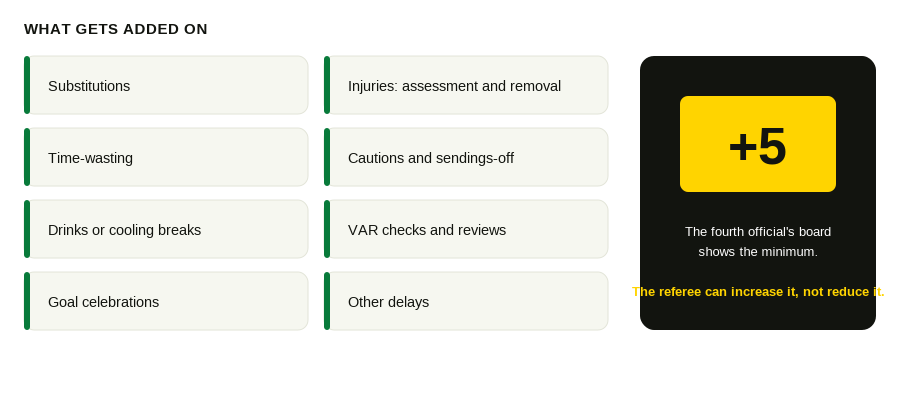
- Substitutions.
- Assessing and removing injured players.
- Time-wasting.
- Disciplinary sanctions, meaning cautions and sendings-off.
- Drinks and cooling breaks, where the rules allow them.
- VAR checks and reviews.
- Goal celebrations.
- Any other stoppage, such as objects thrown onto the pitch or a pitch invasion.
Who decides stoppage time#
The referee decides stoppage time. At the end of the final minute of each half, the fourth official shows the minimum on an electronic board. The referee can increase it if more time is lost during stoppage time, but cannot reduce it.
A timekeeping error in the first half is not corrected by lengthening or shortening the second. The two halves remain independent.
A penalty at the end of a half#
If the referee awards a penalty in the final seconds, the half is extended until the penalty has been taken and completed. If the kick has to be retaken, the half is extended again. The kick is complete when the ball stops, goes out of play or ends up in the net.
The new measures against time-wasting#
In recent years The IFAB has introduced several measures to reduce lost time. A goalkeeper who holds the ball too long concedes a corner. The Laws in force from 1 July 2026 introduced a five-second countdown on throw-ins and goal kicks. A substituted player has ten seconds to leave, and a player treated on the pitch must stay off for one minute. These changes are covered in detail on our blog.
Actual playing time#
The regulation 90 minutes do not match the time the ball is actually in play. Every throw-in, free kick and offside call stops play for a few seconds, and those seconds are not added back. As a result, actual playing time remains well below 90 minutes.
Deliberate time-wasting, on the other hand, is punished. A player who delays the restart can be cautioned, as explained in the guide on cards and suspensions. This is also the root of the debate on “effective time”, which some sports measure by stopping the clock at every break in play.
So far football has chosen another path: keeping a running clock and making stoppage time more precise. This keeps the rule simple at every level, from professionals to amateurs, where there is often not even a scoreboard.
How extra time works#
Extra time is only played when the competition rules require a winner and the match is level. Law 10 provides for two equal periods, each lasting no more than 15 minutes. Between them comes a short drinks break of no more than one minute, without leaving the pitch.
Stoppage time also applies in extra time, under the same rules as normal time. Many competitions allow an additional substitution when a match goes to extra time, to help manage fatigue.
Golden goal and silver goal#
Between the 1990s and 2004 two variations were tried. With the golden goal, the match ended as soon as a team scored in extra time. With the silver goal, it ended after the first period of extra time if a team was in front. Both were abolished: today both periods of extra time are always played in full.
The away goals rule#
The Laws of the Game still allow the away goals rule to decide a two-legged tie. UEFA used it in its competitions for years, but abolished it in 2021. Today in the Champions League, Europa League and Conference League, a level aggregate score leads to extra time and, if needed, penalties.
How a penalty shoot-out works#
The penalty shoot-out is the last tool for deciding a match. It must not be confused with a penalty kick awarded during play for a foul in the box: the shoot-out has its own rules, set out in Law 10.
Before the kicks#
The referee tosses a coin to choose the goal, unless safety or the state of the pitch dictates otherwise. A second toss decides which team chooses whether to kick first or second.
Only players on the pitch at the final whistle may take part, including those temporarily off for a valid reason such as an injury. If one team has more players than the other, it must reduce its numbers to match, telling the referee who is excluded. Each team decides its order of kickers without telling the referee.
During the kicks#
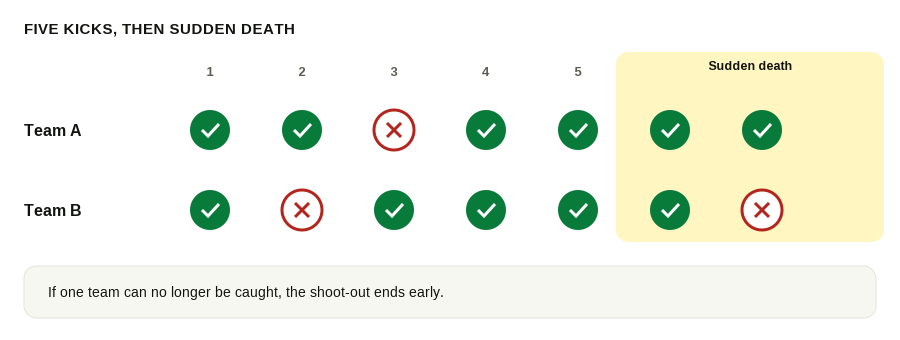
The teams take turns, five kicks each, each by a different player. All other players stay in the centre circle. The goalkeeper of the kicking team waits on the goal line, outside the penalty area.
If the teams are level after five kicks, they continue with one kick each. The shoot-out ends when one team scores and the other misses in the same round. No player may take a second kick until every eligible team-mate has kicked once.
The shoot-out can also end before five kicks. This happens when one team can no longer be caught, even by scoring every kick it has left.
When a kick is complete#
A kick is complete when the ball stops, goes out of play or the referee stops play for an offence. The kicker may not touch the ball a second time. If the ball touches the kicker’s standing foot and goes in, the kick is retaken; if it does not go in, it counts as a miss.
Differences between competitions#
The Laws of the Game set out the tools available. How they are used is up to each competition, and that is where the differences arise.
Leagues#
In Serie A, Serie B, Serie C and in foreign leagues such as the Premier League, La Liga, the Bundesliga and Ligue 1, the match ends after 90 minutes plus stoppage time. A draw is worth one point each, under the points system. There is no extra time and no shoot-out.
The exception is end-of-season deciders. In play-offs and relegation ties the rules vary widely. In some cases the higher-placed team goes through on a draw, without extra time or penalties.
European cups#
In UEFA competitions the league phase is played like a league: a draw is a valid result. In two-legged knockout ties the aggregate score counts, and if it is level extra time and penalties are played at the end of the second leg. The final is a single match, with extra time and penalties if needed. The same applies to the UEFA Super Cup.
Domestic cups#
In domestic cups such as the Coppa Italia and the Italian Super Cup, the organiser decides the format. It varies from cup to cup and sometimes from round to round: in some cases teams go straight to penalties without extra time.
National teams#
At the World Cup, the European Championship and the Copa América, group stages allow draws. From the knockout rounds onwards, extra time and penalties are played. The finals of the Nations League follow the same pattern.
Edge cases and exceptions#
The rules on match length have a few little-known cases that explain situations seen on television.
The goal in the last second#
Many believe the referee must always let the current move finish when time is up. That is not the case: the Law only requires time to be extended so that a penalty can be taken. For a normal move the referee decides when to blow, and usually waits for a neutral moment.
Another common situation is a goal scored from a penalty in the last second. In that case the match ends immediately after the goal, without a new kick-off.
A goalkeeper injured during the shoot-out#
During a shoot-out only the goalkeeper can be replaced, if unable to continue. The replacement can be a player excluded to equalise numbers, or a substitute if the team has substitutions left. Any other injured player cannot be replaced, and the opposing team must remove one kicker.
A sending-off during the shoot-out#
Cautions and sendings-off are still possible during the shoot-out. Cautions received during the match do not carry over into the shoot-out. If a player is sent off, the other team must also reduce its kickers by one.
An abandoned match#
An abandoned match that was not completed is replayed, unless the competition rules or the organiser decide otherwise. If the abandonment is caused by a team reduced to fewer than seven players, that team normally forfeits.
An abandoned trial#
For a time The IFAB trialled a different order of kicks, known as ABBA, to reduce the advantage of the team kicking first. The trial was not adopted: teams still take turns, one kick each.
Terms that get confused#
- Penalty kick and penalty shoot-out. The first is the punishment for a foul in the box during the match. The second is the series that decides a level match.
- Stoppage time and effective time. Stoppage time makes up for time lost to unusual causes. Effective time is the time the ball is actually in play, always well below 90 minutes.
- Extra time and stoppage time. Extra time is two additional periods, played only when a winner is needed. Stoppage time is added to every period, extra time included.
- Golden goal and silver goal. The first ended the match at the first goal in extra time. The second ended it after the first period of extra time. Neither is in use any more.
- Single leg and two legs. A single-leg tie is decided in one match. A two-legged tie adds up the goals of both matches.
- Sudden death. This is the common name for the kicks after the first five. Law 10 does not use the term.
What happens after a shoot-out#
The team that wins the shoot-out goes through or lifts the trophy. In official statistics, however, the match normally remains a draw. Goals scored in the shoot-out do not count towards the result or the scoring charts, so they have no effect on individual awards.
For the teams, the main consequence is physical. A match with extra time means two hours of play, and the team pays for that fatigue in the following days. That is why competitions allow an extra substitution in extra time.
Finally there is the effect on European qualification and the UEFA ranking. A tie won on penalties counts as a win for progressing, while the match counts as a draw for ranking points.
Frequently asked questions#
How long does a football match last in total?#
The regulation length is 90 minutes, split into two halves of 45, plus stoppage time in each half and a break of up to 15 minutes. In practice, more than 100 minutes almost always pass between kick-off and the final whistle.
If extra time and penalties are needed, another 30 minutes of play are added, plus their stoppage time and the shoot-out itself. A match like that can last over two and a half hours.
Who decides how much stoppage time is played?#
The referee decides, keeping track of the time lost. The fourth official shows the minimum on the electronic board at the end of the final minute of each half.
The referee can extend that stoppage time if more time is lost, for example for an injury or a VAR check. It cannot be shortened.
Is there extra time in league matches?#
No. In league matches a draw is a valid result, and each team takes one point. Extra time and penalties are only played when the rules require a winner.
Some end-of-season deciders, such as play-offs and play-outs, are the exception. Even there, many rules favour the higher-placed team instead of going to penalties.
How many penalties are taken in a shoot-out?#
Five per team, each by a different player. If the teams are still level after five kicks, they continue one each until one team scores and the other misses.
The shoot-out can also end before five kicks if one team can no longer be caught. A player cannot kick twice until every team-mate has kicked.
Can the goalkeeper take a penalty in the shoot-out?#
Yes. Every player on the pitch at the final whistle may kick, goalkeeper included. If the shoot-out goes beyond eleven kicks, the goalkeeper must kick before a team-mate kicks for a second time.
During the shoot-out an outfield player can also swap places with the goalkeeper and go in goal. That player must, however, be one of those eligible to take part.
Does the golden goal still exist?#
No. The golden goal, which ended the match at the first goal in extra time, was abolished in 2004 together with the silver goal. Today extra time is always played in full.
It was abolished because teams tended to play too cautiously for fear of conceding the decisive goal. The result was the opposite of what was intended.
Do away goals still count double?#
Not in UEFA competitions: the rule was abolished in 2021. If the aggregate score is level, extra time and, if needed, penalties are played.
The Laws of the Game still allow the away goals rule. Some competitions may therefore use it, but the main ones have dropped it.
Does a match won on penalties count as a win?#
For progressing in the competition, yes: the team that wins the shoot-out goes through. In official statistics, however, the match normally stays a draw, and the shoot-out goals are not part of the result.
For UEFA coefficients the match counts as a draw. The team that goes through still receives the bonuses for qualifying.
Why has stoppage time become longer?#
Because referees began calculating lost time more precisely, including celebrations, substitutions and VAR checks. Before, many stoppages were only roughly estimated.
The measures against time-wasting in force from 1 July 2026 aim to cut stoppages at the source. The goal is to increase actual playing time without making matches even longer.