- 36 Clubs
- 8 Matches each
- 1 Champions place
- Jul-May Season
Regolamento
The Europa League is Europe’s second club competition. It has adopted the same shape as the Champions League: one table of thirty-six clubs in place of groups.
The format
Thirty-six entrants, eight matches each against eight different opponents, four at home and four away. Clubs are split into four pots by coefficient, and each faces two opponents from every pot.
| Position | Consequence | Note |
|---|---|---|
| 1st — 8th | Straight to the round of sixteen | Two matches saved |
| 9th — 24th | Two-legged play-off | Second leg at home for the higher-placed club |
| 25th — 36th | Elimination | There is no drop to the Conference League |
The difference that really counts
The value of the Europa League lies not in its format but in what it awards. The winner enters the Champions League league phase the following season, whatever its domestic finish.
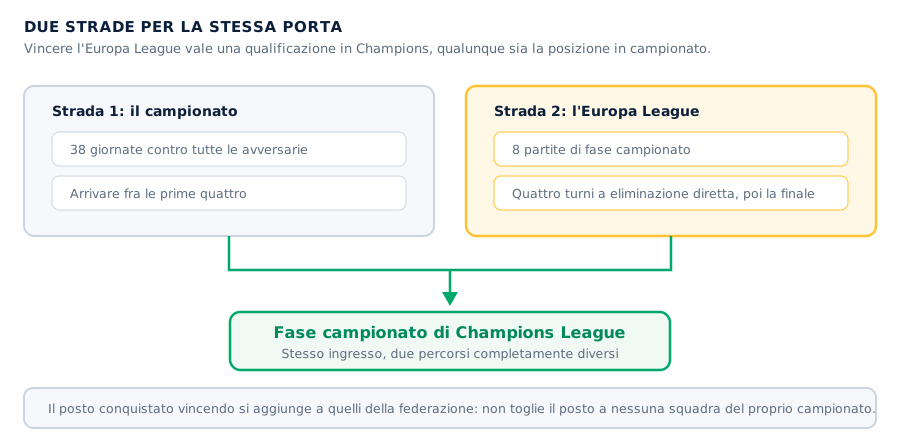
That is why a club that missed the top places at home can still end the season with the most coveted qualification of all. The mechanism is set out in detail in the guide to European qualification.
The calculation worth making
For a mid-table club, winning this competition takes around fifteen extra matches. In return it gains a place that would otherwise cost thirty-eight rounds of sustained league form.
It is not always the better choice. The match load tells on the league, and every year some club pays for its European run with a worse finish at home.
Who takes part
| Route | Who |
|---|---|
| Domestic league | Clubs in the places just below the Champions League positions |
| Domestic cup | The cup winners of the major countries |
| Qualifying rounds | Clubs from smaller countries, after a summer campaign |
| Transfer from Champions qualifying | Clubs knocked out in the late rounds of the larger competition |
The last row explains why some clubs appear here having started elsewhere: losing a Champions League play-off in August does not mean leaving Europe.
The calendar
- July and August Qualifying rounds, with clubs from the smaller countries and those transferred from Champions League qualifying.
- September The league-phase draw and the opening rounds.
- September to January The eight matches, almost always on Thursdays so as not to clash with the Champions League.
- February Play-offs between ninth and twenty-fourth.
- March to April Round of sixteen, quarter-finals and semi-finals over two legs.
- May The final, a single match at a neutral venue, a few days before the Champions League final.
Thursday football
Playing on Thursday is not an administrative detail. It means arriving at the weekend league fixture with two days’ recovery instead of three, for as long as the European run lasts.
It is one reason squads in European competition have to be deeper. The composition rule is the one set out on the Inter and Milan pages: two dependable players per position, not one.
The rules on the pitch
As in the larger competition, the away goals rule does not apply. Level after the second leg means extra time and then penalties.
In the league phase points follow the ordinary criterion described in the guide to the points system. On equal points, overall goal difference decides rather than head-to-head: with eight different opponents, head-to-head results often do not exist.
Posizioni e qualificazioni
| Outcome | Consequence | Note |
|---|---|---|
| Winning the competition | Champions League league phase | The place is additional for the country |
| Winning the competition | Entry to the UEFA Super Cup | Against the Champions League winner |
| Rounds won | Coefficient points | Worth as much as Champions League points in the country calculation |
| Losing the final | No European place | Only the winner qualifies |
If the winner has already qualified
The place is not lost. It passes down the winner’s domestic table, and the effect ripples along the whole chain as far as the Conference League.
It is the same principle governing places awarded by domestic cups, described on the Coppa Italia page.
The weight on the coefficient
In the country coefficient calculation, points earned here count as much as Champions League points. A country with strong clubs in this competition gains future places exactly as one going deep in the larger cup, under the UEFA ranking mechanism.
That detail explains why federations encourage their clubs to take the second competition seriously.
Premi
Europa League payments are lower than Champions League ones, but the comparison has to be made against the budgets of the clubs taking part.
The distribution channels
| Channel | Criterion | Who it favours |
|---|---|---|
| Participation fee | Equal for every qualified club | Clubs with smaller budgets |
| Results | A payment per win and per round reached | Clubs that go deep |
| League-phase position | One step for each place among the thirty-six | Clubs finishing the league phase high |
| Market value and coefficient | Television market and European history | Clubs from the largest countries |
The prize that appears in no table
The real return for the winner is not the prize money but Champions League qualification the following year. The participation fee for that competition alone exceeds the entire payment for winning this one.
Adding the two effects together, lifting the trophy can be worth more than a whole season of domestic broadcasting income for a mid-sized club.
What the run costs
Extra matches bring gate receipts but also costs: travel, player bonuses, wear on the squad. For a small club the balance stays clearly positive, though it is not automatically positive in sporting terms.
Solidarity
As in the larger competition, part of the revenue goes to non-qualified clubs and to the clubs that trained the players involved. The logic is the one described in the guide to the transfer market.
How the three cups compare
| Aspect | Champions | Europa | Conference |
|---|---|---|---|
| League-phase matches | 8 | 8 | 6 |
| What the winner gains | Champions League place | Champions League place | Europa League place |
| Usual matchday | Tuesday and Wednesday | Thursday | Thursday |
The middle row is the telling one. The first two competitions lead to the same destination, which puts the Europa League on a different footing from any other continental cup.
Calciomercato
Taking part in this competition shapes negotiations less than the Champions League does, but it brings the same regulatory constraints.
The list and the eligibility bar
The UEFA list applies, with its ceiling and its places reserved for club-trained and association-trained players. So does the trickier limit: a player who has already appeared in a UEFA competition that season cannot play another for a different club.
Anyone signing in January therefore has to check whether the player has already featured in Europe. The subject is covered in the guide to types of transfer.
When it is decided
European qualification is known in May, but squads are built in summer. Many clubs sign contracts with clauses tied to the outcome: bonuses for reaching the Champions League, reductions for missing Europe altogether.
How those work is explained in the guide to clauses and contracts, and the dates in the guide to transfer windows.
Why some clubs treat it lightly
A club fighting relegation can see the European run as a burden. Fifteen extra matches with a thin squad mean forced rotation in the league, and going down costs more than a good European campaign can bring in.
That choice is visible in the line-ups fielded in the July qualifying rounds, before the domestic season has even started.