- 1899 Founded
- 75,817 Capacity
- 1926 Stadium opened
- Milan Based in
Il club
- Fondazione
- 1899
- Citta
- Milan
- Colori sociali
- Red and black vertical stripes
- Soprannome
- Il Diavolo
Lo stadio
- Impianto
- Stadio Giuseppe Meazza
- Comune
- Milan
- Capienza omologata
- 75,817 seats
- Inaugurazione
- 1926
- Proprieta
- Milan and Inter
La capienza indicata e' quella omologata, non la presenza media: cambia solo dopo lavori o nuove prescrizioni di sicurezza.
Identita
The club was founded in Milan on 16 December 1899 as Milan Foot-Ball and Cricket Club. Most of the founders were English, and that explains a quirk that survives to this day.
Why Milan and not Milano
The club’s name keeps the English spelling of the city. It is not a modern affectation: it was the original name, chosen by the people who set the club up. Over the decades an Italian form was imposed and later dropped, but the English one always returned.
Alongside football, the original rules covered cricket too. That was normal for sports clubs founded by British communities abroad: several disciplines were gathered under one banner.
The colours and the nickname
Red and black were adopted from the start. The nickname, Il Diavolo, comes from what those two colours suggested in popular imagination, and it ended up entering the club’s official imagery.
How this page is arranged
The sections gather what does not age: the ground, the honours, the corporate structure, the constraints governing a squad. You will not find the current players, who change in the sessions described in the guide to how the transfer market works.
Lo stadio
The Stadio Giuseppe Meazza was built in the 1920s on the club’s own initiative, and it was its sole occupant at first. Only later did it become home to both Milanese sides.
One ground, two tenants
The ground also hosts Inter. The two clubs alternate through the league season and must coordinate their fixture lists, since they cannot play at home on the same day.
One effect is visible to the naked eye: the pitch takes roughly twice the matches of a normal ground. Maintenance is therefore more frequent, and more expensive, than elsewhere.
From the city to the two clubs
Built privately, the ground passed early to the City of Milan. For decades the city granted its use to the two clubs against a fee. In November 2025 the clubs took ownership of it, along with the surrounding area.
The change weighs on the accounts. A club playing under concession pays to use the ground and has limited say over works; an owner collects match-day revenue directly and decides what gets done. It is the model Juventus adopted years ago.
Tied to the deal is a project for a new ground on the same site, with near-complete demolition of the existing one. The work is still being defined: timings and final shape should be checked against official sources.
The stated capacity
The number given is the licensed capacity, the authorised maximum. It is not the average attendance, which depends on the opponent and the kick-off time. It changes only after works or new safety requirements.
Andare allo stadio
Anyone visiting San Siro for the first time asks three things: how to get there, where to sit, and what rules apply to away supporters. The answers follow from the structure of the ground, so they stay valid for a long time.
Getting there
The ground is in the western part of the city, served by the metro and by several surface lines. Stops, car parks and match-day traffic restrictions are published on the club’s official site.
It is worth checking which of the two clubs is at home: recommended entry points and signage vary.
Tiers and sections
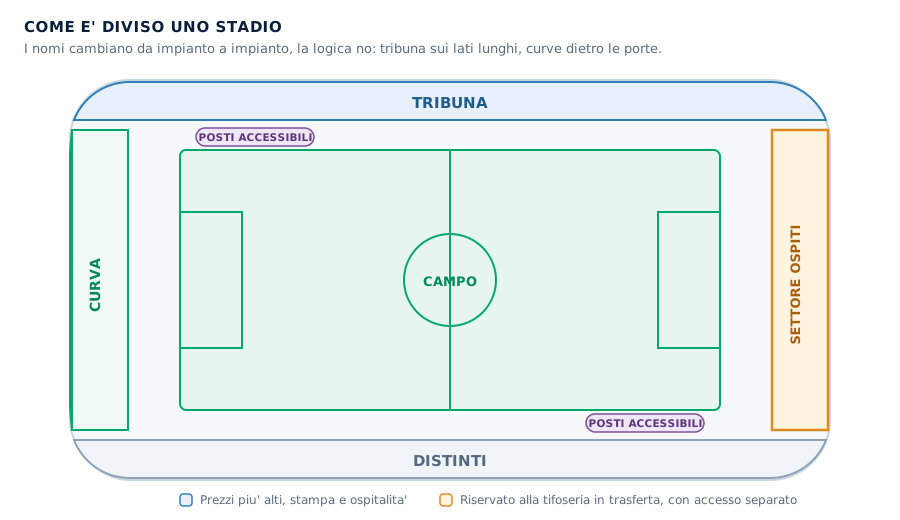
To the standard split between long and short sides, San Siro adds a second variable: the tier. The stands rise over three levels, and the level affects the view more than the section does.
| Choice | Upside | Downside |
|---|---|---|
| First tier, long side | Close to the pitch and the players | Play on the far side is hard to read |
| Second tier | Full view of the pitch | Higher average price |
| Third tier | Lower prices, a sweeping view | Considerable distance and many stairs |
| Away section | Reserved area with its own facilities | Sale limited or banned case by case |
Away supporters
The away section has separate entrances and its own sale rules. The competent authority can reserve tickets to residents of one province, tie them to a supporter card, or ban the sale outright on public order grounds.
Since those decisions come a few days before the match, no prices or procedures appear here: they would already be wrong by the following round.
Accessible places
Providing places for spectators with disabilities is a condition of the ground’s licence. They sit where the view does not depend on the spectators in front, and they carry the right to a companion.
Booking goes through a reserved channel: the places are limited in number and are allocated rather than sold openly.
Albo d'oro
Milan is among the most decorated clubs in European competition. Below are the international trophies with the year of each.
The UEFA competitions
| Competition | Years | Note |
|---|---|---|
| European Cup | 1963, 1969, 1989, 1990, 1994 | The competition’s name before the reform |
| Champions League | 2003, 2007 | The same competition: see the Champions League |
| Cup Winners’ Cup | 1968, 1973 | Competition later discontinued |
| UEFA Super Cup | 1989, 1990, 1994, 2003, 2007 | See the UEFA Super Cup |
Adding the two names together, the club has won Europe’s top competition seven times. Among Italian clubs that is the outright record, and across the continent only one side has bettered it.
A detail that explains the football of the time
The 1989 and 1990 wins came back to back. Repeating was extremely hard even then. Under the current format, described in the guide to European qualification, it has become harder still: there are more matches to win.
The domestic trophies
At home the club has won the Serie A title, the Coppa Italia and the Italian Supercoppa. Totals are not given here because they change with every new success: read them from the official sources listed at the foot of the page.
Le rivalita
Every rivalry has a definite cause, usually historical or geographical. Knowing which one makes it clear why certain matches carry more weight than others.
The Derby della Madonnina
The fixture against Inter takes its name from the statue watching over the city from the cathedral. It is the only derby played by two clubs sharing a ground: neither travels, only the host changes.
Behind it lies a separation in 1908, when a group of members left the club to found another. The two clubs therefore share an ancestor, and the rivalry was born together with the second of them.
The fixtures against Juventus and Napoli
With Juventus the rivalry is sporting in nature. They are two of the most successful clubs in Italy, and for long stretches they fought over the league.
With Napoli the rivalry goes back to the title races of the 1980s, and over time it took on a territorial edge as well.
What they mean in practice
A derby is the season’s best-attended match and the most tightly policed. Restrictions on away tickets are the norm, and the risk classification assigned to the fixture drives the whole security operation.
Organigramma
This section lists the roles of a professional club, not who fills them. People come and go; the structure stays.
The training ground
The first team trains at Milanello, in the province of Varese, a site opened in the early 1960s. It was among the first of its kind in Italy, at a time when most clubs trained in their stadium.
Outside the city there is room for several pitches, accommodation and medical facilities. It is the model almost every leading club later adopted.
How many people it takes
| Area | How many | Responsible for |
|---|---|---|
| Coaching staff | 6 – 10 | Technical direction, fitness work, goalkeepers |
| Medical and research | 10 – 15 | Diagnosis, rehabilitation, injury prevention |
| Scouts | 5 – 15 | Assessing players in Italy and abroad |
| Corporate structure | Several hundred | Accounts, commercial, communications, stadium operations |
The figures are indicative and refer to the top division. Two roles are compulsory under the rules: the safety officer and the officer handling relations with supporters.
Come si compone la rosa
A club in the European competitions works with two different lists of eligible players, and that is the constraint shaping squad building most.
Two rulebooks, two lists
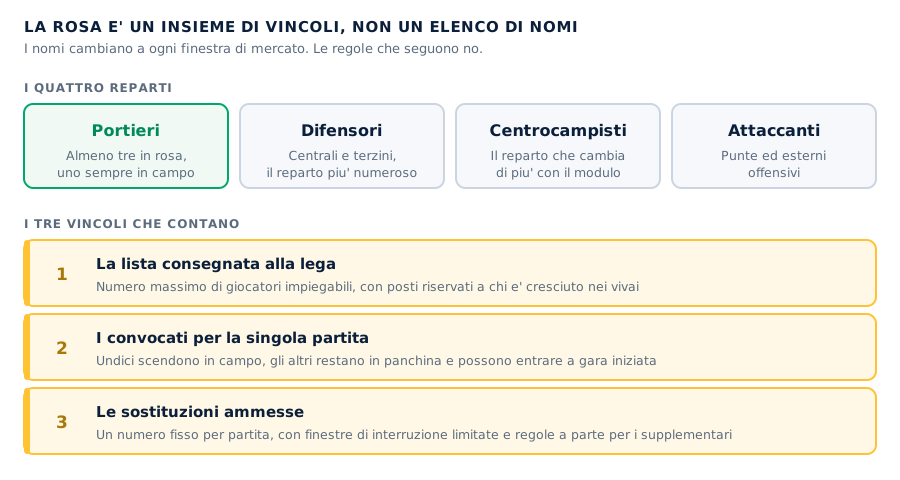
The list filed with the domestic league carries a numerical ceiling and places reserved for players trained in Italian academies. The list filed with UEFA has its own criteria and a different ceiling.
So a player fully eligible in the league may not appear on the European list. The contractual consequences of such exclusions are covered in the guide to clauses and contracts.
Sizing the units
No rule dictates how many defenders or forwards a club registers. The constraint is practical: every position needs a credible replacement, because suspensions and injuries are certain across a season.
The goalkeeper is the exception. One must be on the pitch for the whole match, so every club registers at least three.
Match-day squad, bench and numbers
From the list the coach picks the squad for a given match: eleven start, the others wait. The shirt number is personal and fixed for the season, and it does not follow the position.
Settore giovanile
Youth teams are not optional: entering them is one of the conditions for obtaining the national licence.
Where they are based
The academy has its own site in Milan, separate from the first-team ground. Keeping them apart lets young players develop under age-appropriate workloads instead of professional ones.
The financial logic
Developing a player in-house is worth double. He fills a place reserved for academy-trained players, which would otherwise have to be covered by a signing, and on any sale he produces an almost entirely clean gain.
Even when a young player moves on early, the solidarity mechanism returns to the clubs that trained him a share of the sums paid in later transfers.
The step into the professional game
Two routes remain. The first is a temporary move to a lower-division club, explained in the guide to types of transfer. The second is a team entered in Serie C, an option reserved for leading clubs.