- 18 Clubs
- 34 Rounds
- 2 Relegated
- Aug-May Season
Regolamento
Ligue 1 is the top division of French football. Like the Bundesliga it has eighteen clubs and thirty-four rounds, following a reduction made to ease the calendar.
Why two clubs were removed
Cutting from twenty to eighteen came from two needs. The first was freeing dates for international competitions, which keep growing. The second was concentrating the value of the broadcasting deal over fewer matches.
A side effect is sharper competition to stay up: the same lost places count at the bottom of the table too.
The format
A single group, home and away, three points for a win. The final table awards the title, the European places and the relegations. Only one place is settled by extra matches.
The tie-break criterion
On equal points, overall goal difference comes first, then goals scored. Head-to-head results only come into play afterwards. That is the English and German criterion, not the Italian one described on the Serie A page.
Financial control
This is what makes France a case apart in Europe. An independent body examines every club’s accounts before the season starts and can impose escalating measures, up to relegation.
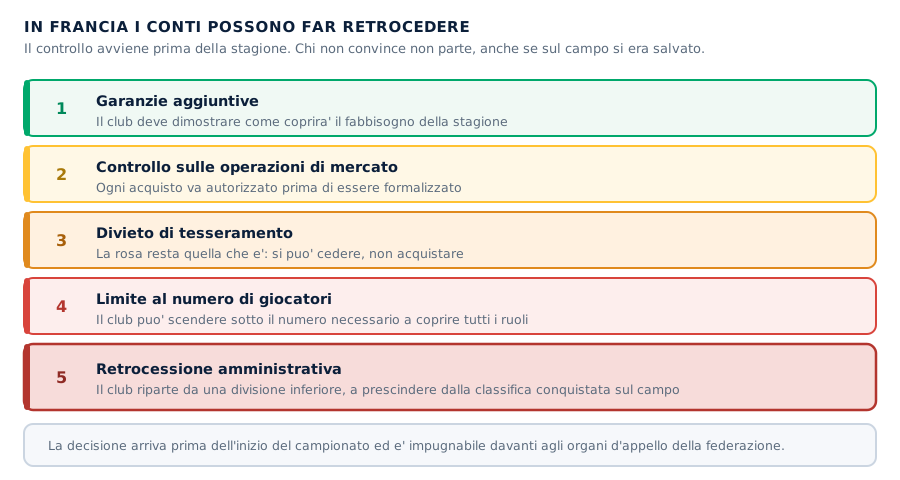
Administrative relegation has been applied to clubs that had stayed up on the pitch. That is a substantial difference from the systems described on the Premier League page, where the sanction lands on accounts already filed.
The decision can be appealed to the federation’s appeal bodies, and each year some clubs are reinstated after producing fresh guarantees.
Comparing the control systems
| Country | When the check happens | Maximum sanction |
|---|---|---|
| France | Before the season | Administrative relegation |
| Spain | Before every registration | Transfer block |
| Italy | At entry and during the season | Refusal of admission |
| England | On accounts already filed | Points deduction |
Developing young players
France has long been the largest exporter of home-trained footballers. The reason is a network of academies recognised by the state, with teaching and boarding standards audited periodically.
A young player’s first contract at a recognised academy has a length and terms fixed by regulation, designed to keep him long enough to repay the investment. The subject is covered in the guide to clauses and contracts.
Squad composition
The list sets a maximum number of professionals and quotas reserved for players trained in France. Second teams are admitted to the lower divisions with no route into Ligue 1.
There are also distinct contract categories for players still in training, with their own protections and limits. A youngster can therefore appear for the first team without yet holding a full professional contract.
The calendar
The season follows the European pattern, August to May, with a winter break longer than Italy’s and shorter than Germany’s.
On top of the thirty-four rounds come the domestic cup, open to amateur clubs as well, and for some clubs the European fixtures. That is why the reduction to eighteen was judged necessary.
Posizioni e qualificazioni
| Position | Consequence | Note |
|---|---|---|
| 1st | French champions | Settled by the table |
| 1st — 3rd | Champions League | Number of places tied to the country coefficient |
| 4th — 5th | Europa League or qualifying | Varies with the domestic cup |
| 6th | Possible Conference League | Depends on who wins the cup |
| 7th — 15th | No consequence | Stay in Ligue 1 |
| 16th | Play-off against a second-division club | Two legs |
| 17th — 18th | Direct relegation | No deciders |
The play-off
The sixteenth-placed club meets the winner of the second-division play-offs over two legs. The winner plays in Ligue 1 the following season.
The mechanism mirrors the German one described on the Bundesliga page, with one difference. In France the opponent is not automatically the third-placed club: it emerges from a mini-tournament, along the lines set out in the guide to how play-offs work.
The European places
How many Champions League places France receives depends on its country coefficient, which sits below those of the four largest leagues. That is why France moves between two and three direct places, while England, Spain, Italy and Germany hold four consistently.
The calculation is explained in the guide to the UEFA ranking, and its practical effects in the guide to European qualification.
How results and future places are linked
A league with fewer places sends fewer clubs to Europe, so it gathers fewer points, so it risks losing further places. It is the loop France has been trying to break for years.
Premi
Ligue 1 earns less from broadcasting than any of the other four major leagues. The reason is a run of failed negotiations, and the consequences show in the clubs’ accounts.
How the rights are shared
| Component | Criterion | Who it favours |
|---|---|---|
| Fixed share | Split equally among clubs in the division | The smaller sides |
| League position | Where a club finishes | Those finishing higher |
| Profile | Following and television appearances | The best-known clubs |
Against the English model described on the Premier League page, the pie being divided is far smaller. The structure of the split is similar; the absolute value is not.
How the gap is made up
French clubs live largely on capital gains. They develop young players, build their value and sell them to richer leagues: the model described in the guide to how the transfer market works.
That is not a weakness in itself. It is a coherent economic model, but it makes keeping the best players beyond two or three seasons very hard.
What the title is worth
The direct prize is modest, as in the other leagues. The real value lies in Champions League entry, which counts proportionally far more for a French club than elsewhere.
The reason is arithmetic: the lower the domestic revenue, the greater the relative weight of European money. The gap between the two sources is the widest in Europe.
What relegation costs
The loss of broadcasting income is immediate and is not cushioned by parachute payments comparable to the English ones. It is one reason relegation in France so often forces a deep rebuild of the squad.
Calciomercato
The French market is among the busiest for outgoing deals and the most cautious for incoming ones. The rules are the international ones, but the economic setting changes how they are used.
The windows and the financial constraint
There are two sessions, with dates in the guide to transfer windows. A club under supervision can be barred from registering anyone: in that case the window effectively does not exist for it.
The ban hits incoming deals only. Departures stay possible, and it is precisely by selling that a club shows it can come back within the limits.
A young player’s first contract
A youngster trained at a recognised academy is bound to sign his first professional contract with the club that developed him, on set terms. It stops years of training ending up free of charge in another league.
When the player does leave, the training clubs are still owed the compensation described in the guide to types of transfer.
How it compares
| Aspect | Ligue 1 | Other major leagues |
|---|---|---|
| Number of clubs | 18 | 20 in Italy, England and Spain |
| Financial control | Can reach relegation | Fines or points deductions |
| Broadcasting revenue | Lowest of the five majors | England far above the rest |
| Economic model | Development and sales | Broadcasting and match-day income |