- 4 Leagues
- 2 Years per cycle
- 1 Trophy
- Sep-Jun Period
Regolamento
The Nations League is UEFA’s national-team competition, created to replace friendlies. It is the only international tournament with promotion and relegation, like a domestic league.
The problem it solves
Before it existed, international dates not used for qualifying filled up with friendlies. Those were matches with nothing at stake, often between sides of very different levels, played in half-empty stadiums.
The answer was to give those dates meaning: competitive matches, between opponents of similar strength, with something to win and something to lose.
The four leagues
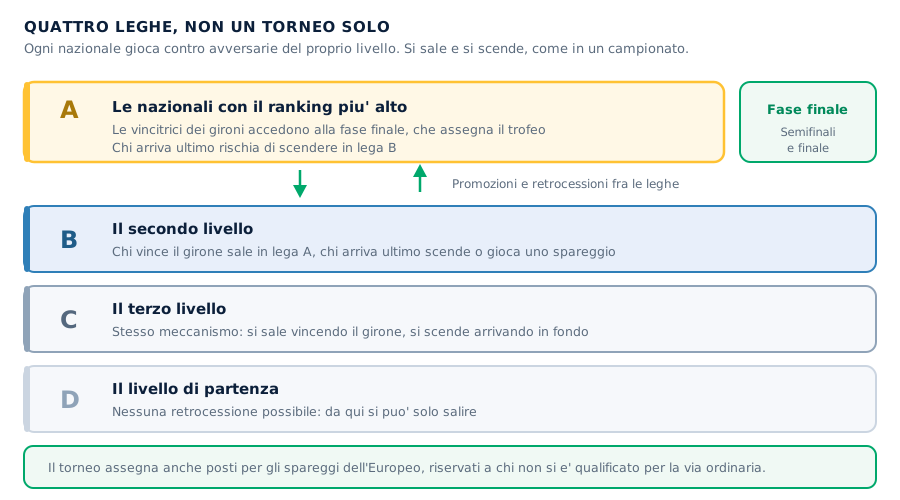
Associations are split into four leagues, A to D, by ranking. Within each league there are groups, and matches are played home and away in the international windows.
| League | Who is in it | What is at stake |
|---|---|---|
| A | The highest-ranked nations | The trophy, through the finals |
| B | The second level | Promotion to League A |
| C | The third level | Promotion to League B |
| D | The entry level | Promotion to League C, with no risk of dropping |
How you go up and down
A group winner is promoted to the league above. The bottom side goes down, or plays a decider against a team from the league below, depending on how that level is structured.
There is no relegation from League D: it is the bottom of the pyramid. It is the same logic as domestic leagues, described in the guide to how relegation works, applied to national teams.
The finals
The League A group winners meet in a short finals tournament, with semi-finals and a final at a neutral venue. The winner is champion of the competition.
The number of rounds is small: a handful of matches over a few days, not a long tournament like the one described on the European Championship page.
The link with the Euros
This is the function that makes the tournament more than an extra trophy. The Nations League awards places in the Euro qualifying play-offs.
Nations that won their group without qualifying by the ordinary route earn a play-off place. If there are not enough of them, the competition’s overall ranking fills the gaps.
The practical effect is considerable. A League C or D nation can earn a play-off place by beating opponents at its own level, instead of measuring itself against the strongest sides in a qualifying group.
The link with the World Cup
The competition’s ranking is also used in World Cup qualifying play-offs, to set pairings or places. The criteria are decided edition by edition, as described on the World Cup page.
The principle stays the same: performance here brings advantages in the larger competitions.
Why not everyone likes it
The recurring criticism is that it adds matches to an already crowded calendar. It affects above all players at clubs competing in the cups described on the Champions League page.
The reply is that those dates existed anyway and were filled with friendlies. The number of matches has not changed: what has changed is what they are.
Posizioni e qualificazioni
| Group position | Consequence | Note |
|---|---|---|
| 1st in League A | The finals tournament | Semi-finals and final at a neutral venue |
| 1st in the other leagues | Promotion to the league above | Plus a possible Euro play-off place |
| Middle positions | No consequence | Stay in the league |
| Last in Leagues A, B and C | Relegation or a decider | Depends on how the level is structured |
| Last in League D | No relegation | There is no level below |
What promotion brings
Going up brings no significant extra money, but it changes the opponents. Playing in League A means facing the strongest nations on the continent, with direct effects on the ranking.
The ranking in turn sets the pots for qualifying draws, under the mechanism described in the guide to the UEFA ranking. Going up a league can therefore be worth more than the trophy.
The downside of promotion
A newly promoted nation faces far stronger opponents, and risks losing ranking points rather than gaining them. It is a documented effect: some associations have seen their position worsen after going up.
What it does not award
The competition qualifies nobody directly for the Euros or the World Cup. It awards only play-off places, which still have to be won on the pitch.
That is a substantial difference from the club cups, where winning one tournament opens the door to another. The comparison is described on the Europa League page.
Premi
The prize fund is smaller than in the major tournaments, but the competition serves a definite financial purpose for smaller associations.
How the money is shared
| Channel | Who receives it | Criterion |
|---|---|---|
| Participation payment | Every association | Differs by league, equal within a league |
| Performance payment | Group winners and finals participants | Added to the base payment |
| Club benefits | Clubs registering the called-up players | For days spent on international duty |
Why it matters to smaller associations
Before, a low-ranked association earned little or nothing from friendlies. It struggled to find opponents, half-filled its stadium and drew no broadcasting interest.
With competitive matches against evenly matched opponents, the crowds return and the broadcasting rights acquire value. For many associations it is the steadiest source of income between major tournaments.
The payment to clubs
Here too, clubs releasing their players receive compensation for the days of absence. It reaches every club, from the largest described on the Juventus page to those in the smaller leagues.
What it does not produce
The trophy carries no place in a club competition, and no financial benefit comparable to a European Championship. Its value is sporting and about ranking, not money.
Calciomercato
The tournament falls during the domestic season, which makes it different from summer tournaments where transfers are concerned.
The international windows
Matches are played on the dates reserved for national teams, which interrupt domestic leagues several times between September and June. Clubs must release called-up players, as international rules require.
The contractual and insurance consequences are the same as those described on the World Cup page.
The effect on clubs
A called-up player can cross the continent twice in a week and return on the eve of a league fixture. It is the main reason clubs criticise the competition.
Squad depth becomes decisive, on the logic set out on the Inter page about competing on two fronts.
The showcase for players
For a footballer from a smaller league, a League C match against a similar nation is worth little in visibility. A League A match against one of the strongest sides is worth a great deal more.
That is an indirect effect of promotion. Going up means playing in front of more scouts, with consequences for the deals described in the guide to how the transfer market works.
The transfer calendar
Window dates do not depend on this tournament, since it is played while the leagues are running. They remain those set by the associations and described in the guide to transfer windows.
Players who come back injured
A player injured on international duty returns to a club that keeps paying his wages. Insurance cover exists for such cases, but it covers the wages and not the sporting damage.
That is why clubs watch international matches closely. The contracts of the most expensive players contain specific clauses, described in the guide to clauses and contracts.
Approfondisci
-
UEFA European Championship
The European championship for national teams: qualifiers, play-offs and finals
-
-
-
-