Transfer windows are the two periods of the year in which clubs may register new players. Outside them the squad is frozen, and no deal is allowed however completely the parties agree. The exact dates are set by each federation, within maximum limits laid down by the international regulations.
In short#
- There are two windows: a longer summer one and a shorter winter one.
- The summer window can last at most twelve weeks.
- The winter window at most four.
- Each federation sets its own dates, and they do not match across countries.
- Outside the windows only players without a contract can be registered.
- Registration before the deadline is required: an agreement alone is not enough.
- A window closed elsewhere may still be open at home.
What transfer windows are#
A transfer window is the period within which a federation accepts the registration of new players in its clubs’ squads. The technical term is registration period, and the word window captures it well: it opens, stays open for a defined time, then shuts.
The point that causes most confusion is that the window governs registration, not negotiation. Two clubs can talk at any time of year, and often do so months in advance. What they cannot do is file the paperwork outside the deadline.
There are two windows per season, of very different lengths.
| Window | When | Maximum length | What it is for |
|---|---|---|---|
| Summer | Between the end and the start of seasons | Twelve weeks | Building the squad for the year |
| Winter | Midway through the season | Four weeks | Correcting injuries and mistakes |
Why they exist#
A permanently open market would look freer, but it would produce consequences that make a league less credible.
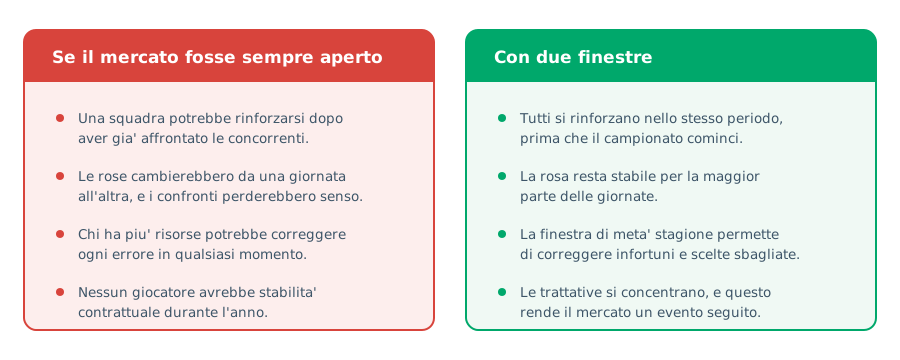
The reasons are three, and worth separating.
- Equal conditions. Everyone strengthens in the same period, before the league starts. A club cannot add a decisive player after already meeting its title rivals.
- Squad stability. For most of the season the team stays the same. Supporters can recognise it, and the coach’s work has meaning.
- Protection of the employment relationship. A contract has a duration, and windows stop it being broken at any moment on a third party’s initiative.
There is also an unplanned but now central effect. By concentrating negotiations into a few weeks, windows have turned the market into an event followed as closely as the matches, with its own television programming.
The calendar of a season#
The summer window#
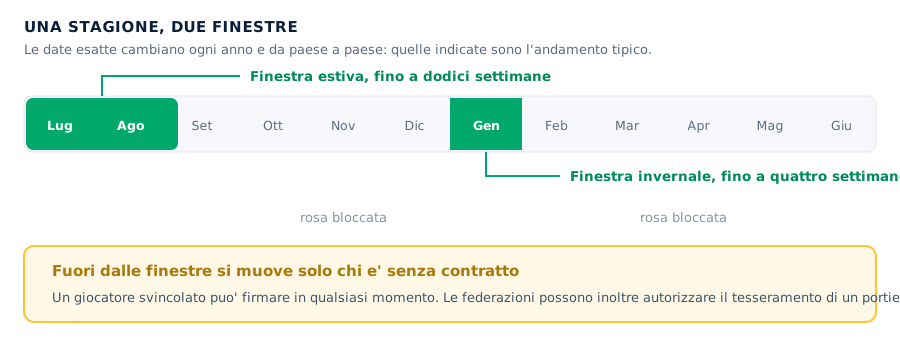
This is the main one. It opens at the end of the previous season and closes in the first days of September, with the league already two or three rounds old. The international regulations cap it at twelve weeks, and each federation chooses how to place them.
The overlap with the opening rounds is deliberate. It lets clubs assess the squad in real conditions before the final moves. It does create the paradox of teams facing an opponent different from the one they will meet two weeks later.
The winter window#
It lasts at most four weeks and falls in January. It exists to correct: long-term injuries, signings that have not worked, positions in the table that have gone wrong.
It is a more expensive window. A club selling mid-season loses a player it was counting on, and a club buying has to persuade somebody to move halfway through the year. Prices tend to be higher for the same player.
For clubs fighting to stay up it is often the last chance, and the link with the race described in how relegation works is direct.
Who can move when the windows are shut#
The freeze is not absolute, and the exceptions are few and well defined.
- Free agents. A player without a contract in force can sign at any time. There is no club to compensate, so there is no deal to authorise.
- Goalkeepers, in emergencies. Many federations allow a goalkeeper to be registered outside the window when those in the squad are unavailable through injury or suspension.
- Amateur-level moves. These follow their own, wider calendars.
The first exception has a notable consequence. A player who terminates his contract during the season becomes free. He can therefore join another club even with the market shut, provided the new club still has room on its list. It is a narrow route but a used one, and its preconditions are described in contract clauses.
Why windows do not all close together#
Each federation sets its own dates within the international limits, and the differences create curious situations.
One league can still be open when another has already closed. An Italian club can therefore sell a player to a club in a country with a longer window. It cannot replace him, however, because its own window has shut in the meantime.
The differences are not confined to Europe. Leagues in the southern hemisphere follow an opposite seasonal calendar, with windows placed in periods that look arbitrary from a European viewpoint.
The same applies between any two leagues. In a negotiation between a club in Serie A and one in the Premier League both federations’ deadlines apply, and the tighter of the two governs.
What changes from league to league#
The international limits are common, but within them each federation decides for itself. Three elements never quite coincide.
- The dates. Serie A, the Premier League, LaLiga, the Bundesliga and Ligue 1 close on different days, even if close together. Anyone dealing abroad has two deadlines to watch.
- Lower division windows. In Italy Serie B and Serie C have their own deadlines, which may not match the top flight’s.
- Opposite calendars. Leagues in the southern hemisphere, and those following the calendar year, place their windows in periods that look arbitrary from Europe.
The most frequent case involves a club selling abroad after its own market has closed. It banks the money but is left with a gap in the squad until January, which also affects clubs competing in the continental competitions described in European qualification.
The youth market#
Far stricter rules apply to players under eighteen, and this is the least known part of the international regulations.
The general principle bars international transfers before eighteen. The exceptions are few and concern cases where the move does not depend on football. A family relocating for work, residence near a border, membership of the same territorial area with guarantees over schooling.
The reason is protection. Without that ban a boy could be moved from country to country on sporting judgements, interrupting his education and family ties. The ban applies to every affiliated federation, from Serie A to the leagues listed under other European leagues, and equally to Serie B and Serie C.
Domestic moves follow national rules instead, with training compensation due to the club that developed the player. The mechanism is described in how the transfer market works.
Deadline day#
The close of a window concentrates a disproportionate number of deals into the final hours, and not out of habit.
- Domino effect. Many deals depend on others: a club buys only once it has sold. The chain unwinds all at once, when there is no time left to wait.
- Pressure on price. The seller knows the buyer will have no other chance until January, and the buyer knows the seller will be left with a player it wanted rid of. Each waits for the other to move.
- Paperwork. Filing must happen by the stated hour. A delay of minutes voids the deal, and the rules set out procedures for filing preliminary agreements and completing them afterwards.
The day after the deadline the squad is final, and the club has to live with it until the next window. It is why planning begins months earlier, often right after the previous window closed.
For clubs in Europe the deadline weighs double. A club in the Champions League has to have its squad ready before the league phase. It cannot rely on January to correct, because the continental lists follow their own deadlines, explained in European qualification.
The free agent market#
Alongside the two windows runs a parallel market that never stops: players without a contract. They fall into three groups.
- Those whose contract has run out. At the natural expiry they become free and choose without anyone’s authorisation. The mechanism is described in contract clauses.
- Those who terminated early. Club and player agree to end the relationship, usually with a severance sum.
- Those never registered. A player left off a squad list, or without a club at the start of the season, stays available all year.
For clubs this is an emergency resource. A serious injury in late January, once the window has shut, leaves a free agent as the only route. The quality available is lower, though, because a player without a contract mid-season usually has a reason.
Windows and squad lists#
Registering a player before the deadline is not enough: there also has to be room on the list. Many leagues set a maximum number of registered players, with quotas reserved for academy graduates.
A signing can therefore force somebody else out of the list. The excluded player stays under contract and trains with the squad, but cannot be selected until the next window.
The European competitions have separate lists. A club may register a different squad for the continental competitions, with its own quotas for home-grown players. Clubs in the Champions League, the Europa League or the Conference League therefore file two distinct lists with different deadlines.
The same applies to the domestic cup, which may have its own entry criteria. A player eligible in the league is not automatically eligible in every other competition the club enters.
What a window means for a squad#
A window is not only a period for signings. It is the moment in which a club decides what it will be for the next six months, and three questions govern every decision.
The first is how many matches lie ahead. A club in three competitions needs cover in every position, while one playing only the league can carry a smaller group. The play-off structure of some divisions adds further fixtures at the end of the season, which has to be planned for in advance.
The second is what the club can afford. Wages committed today constrain the following two or three windows, and a heavy contract signed in a good year becomes a problem in a bad one.
The third is what happens if things go wrong. Squads built for one division rarely fit the one below, which is why relegation clauses exist and why loans are preferred by clubs whose position is uncertain.
Frequently asked questions#
How long do transfer windows last?#
The summer window can last at most twelve weeks, the winter one at most four. Those are the limits set by the international regulations, within which each federation chooses its dates.
The exact dates are announced before the season and do not coincide across countries. It is why one league can still be trading when another has already closed.
Can clubs negotiate when the window is shut?#
Yes. The window limits the registration of players, not the talking. Two clubs can negotiate at any time of year, and the more complex deals are built months in advance.
What cannot happen is filing the paperwork outside the deadline. An agreement reached in November stays on paper until the January window opens.
Who can sign outside the windows?#
Only free agents, that is players without a contract in force. With no club to compensate there is no deal to authorise, and registration is allowed at any time.
Many federations also allow a goalkeeper to be registered outside a window when all those in the squad are unavailable. It is an exception justified by a position that cannot be improvised.
Why is the January window more expensive?#
Because the seller loses a player the season was built around, and the buyer has to persuade somebody to move halfway through the year. Both have a price.
Scarcity adds to it. Struggling clubs look for reinforcements in the same positions at the same moment, with only a few weeks available. Demand concentrates and prices rise for the same player.
Why does everything happen in the final hours?#
Through the domino effect. Many deals are conditional on others: a club buys only after selling, and the chain unwinds together once there is no time left to wait.
There is a negotiating element too. Both sides know there will be no further chance until the next window, so each waits for the other to concede on terms.
What happens if the paperwork arrives late?#
The deal is not completed and the player cannot be selected. The deadline is absolute: a few minutes late has the same effect as no agreement at all.
The rules do allow a preliminary agreement to be filed by the deadline and the documentation completed in the hours that follow. It is a formal procedure with precise requirements, not a general tolerance.
Can a club buy without limit during a window?#
No. Beyond the deadlines there are squad list limits and the cap on loans set by the international regulations. Then come the financial rules, which tie spending to a percentage of revenue.
Many leagues also impose a maximum number of players from outside their area. The full picture is in the guide to how the transfer market works.
Do European squad lists follow the same deadlines?#
No, they are separate. A club competing in Europe files a list distinct from its domestic one, with its own quotas for home-grown players.
The deadlines do not match the close of the national window, and a signing may be eligible in the league but not in Europe until the continental list reopens.