- 20 Clubs
- 38 Rounds
- 3 Relegated
- Aug-May Season
Regolamento
La Liga is the top division of Spanish football. Twenty clubs, a single group, thirty-eight rounds: the structure matches the Italian and English ones. What sets it apart is how it controls club spending.
The format
Home and away against every opponent, three points for a win and one for a draw. No play-offs: the final table awards the title, the European places and the relegations.
The calendar includes a short winter break around the turn of the year, briefer than the German one.
The tie-break criterion
On equal points, head-to-head results come first, then head-to-head goal difference, then overall goal difference. It is the criterion used in Serie A too, and the reverse of the English one.
The method rewards a club that beat its direct rival, even with a worse goal difference across the season as a whole.
The cap on squad cost
This is the feature that makes the league a case of its own. The league calculates for each club a maximum spending limit covering player wages and amortisation, and it differs from club to club.
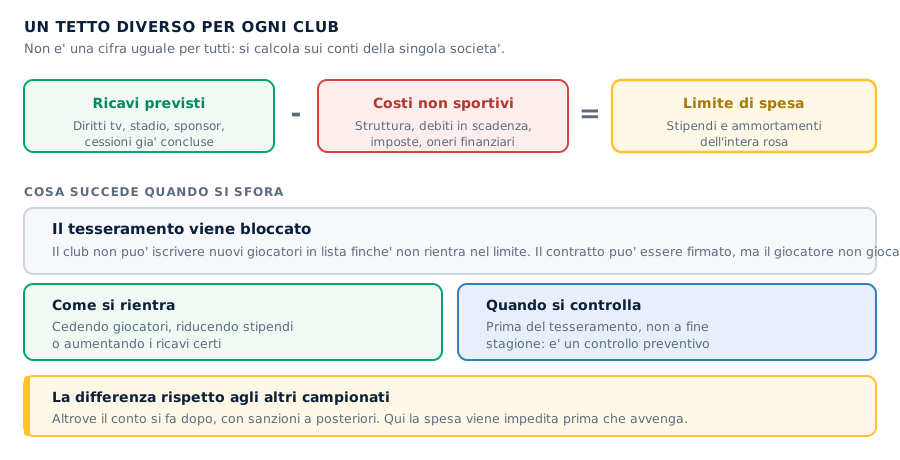
The calculation starts from forecast revenue, subtracts non-sporting costs and maturing debt, and returns the sum the club may devote to its squad. A club above the limit cannot enter new players on its list.
The consequence shows every summer: a club signs a contract, announces the deal, then cannot register the player until it cuts its wage bill. The contract exists, but the player does not play.
Why it differs from other controls
| System | When it acts | What it does |
|---|---|---|
| Spanish cap | Before registration | Prevents the spending |
| English rules | On accounts already filed | Points deduction |
| Italian licence | At entry and during the season | Refusal of entry or points deduction |
| French control | Before the season | Up to administrative relegation |
Entry requirements
Beyond the cap, admission requires corporate and stadium criteria. Many Spanish clubs are sporting public limited companies, a legal form introduced by statute. A few kept their status as members’ associations, owned by the people who join them.
That last arrangement resembles in its effect the German rule described on the Bundesliga page, though it grew out of a different legislative history.
Squad composition
The list sets a maximum number of players and a ceiling on non-EU registrations. Academy and reserve-team players can be used in the first team under set conditions.
Second teams are admitted to the lower divisions, on the condition that they cannot play in the same tier as the first team nor be promoted to the top flight.
Posizioni e qualificazioni
| Position | Consequence | Note |
|---|---|---|
| 1st | Spanish champions | Settled by the table, with no decider |
| 1st — 4th | Champions League league phase | A fifth place is possible on continental merit |
| 5th | Europa League | Can vary depending on the domestic cup |
| 6th | Possible Conference League | Depends on who wins the cup |
| 7th — 17th | No consequence | Stay in the top flight |
| 18th — 20th | Relegation to the second tier | Direct, with no play-out |
The European places
The top four enter the league phase of the Champions League. A fifth can be added when Spain is among the best-performing countries of the season: the mechanism is in the guide to European qualification.
The domestic cup awards a Europa League place. If its winner has already qualified, the place passes down the table instead of being lost.
Relegation and promotion
The bottom three go down directly to the second tier. Two clubs come up automatically, plus a third through the play-offs described in the guide to how play-offs work.
The Spanish second division is among the largest in Europe by number of clubs, which makes the promotion race unusually crowded.
The fixture that can decide the league
The meeting between the two most decorated clubs draws the largest television audience of any club match in the world. Its weight also feeds into the revenue split described in the next section.
European performance and future places
Spain has historically held the highest country coefficient, fed by its clubs’ results in Europe. That coefficient sets how many European places will be available in later years, under the calculation explained in the guide to the UEFA ranking.
It is a self-reinforcing loop: more places mean more clubs competing, and so more chances to gather points. The same applies to Serie A and the other major leagues.
Premi
Until 2015 Spanish clubs negotiated their broadcasting rights individually, and the two largest took an enormous share of the total on their own. A statute imposed collective selling.
How the rights are shared
| Component | Weight | Criterion |
|---|---|---|
| Equal share | Half the total | Split identically among the clubs in the division |
| Sporting results | One quarter | Recent final tables, with decreasing weight |
| Social following | One quarter | Attendance and television audience |
The statute also sets a ceiling on the gap between the highest and lowest earner. It is the brake that stops the previous situation returning.
What flows to the lower divisions
A share of the revenue goes by law to the second division and to the federation. Part of it is set aside for relegated clubs, much like the English parachute payments described on the Premier League page.
One difference matters, though. In England the arrangement rests on an agreement among the clubs themselves, and can be renegotiated. In Spain it is written into a statute, and changing it takes an act of parliament.
What the title is worth
The direct prize for finishing first is modest. The real value lies in Champions League qualification, in the sporting-results component of the split, and in the effect on commercial contracts.
One point tends to be missed: the results component looks at several seasons, so winning the league produces financial effects in later years too.
Calciomercato
The Spanish market follows the international rules explained in the guide to how the transfer market works, but the salary cap shapes every step.
Sell first, then buy
A club close to its limit must free wage room before it can register anyone. That inverts the usual order of business: the sale does not follow the signing, it precedes it.
The result is deals crowded into the closing hours of a window, when departures finally complete and only then are arrivals formalised. The dates are in the guide to transfer windows.
The compulsory release clause
Spanish law requires every professional player’s contract to state a sum for unilateral termination. The player can free himself by paying it, and the club cannot object.
That is why Spanish clauses reach enormous figures: they are not there to be collected, they are there to deter. How they work is described in the guide to clauses and contracts.
Non-EU players
The number of non-EU players who can be fielded is limited. Many South American players obtain a European passport through descent, which takes them out of the count: it is a widespread and entirely lawful practice.
What the second teams change
Because reserve sides play in the professional pyramid, a young Spanish player can face grown men without leaving his club. Elsewhere the same step usually means a temporary move, as described in the guide to types of transfer.
The arrangement also affects the market. A club with a strong reserve side has less need to sign squad players, and can spend its wage room on the first eleven instead.
How it compares
| Aspect | La Liga | Other major leagues |
|---|---|---|
| Spending control | Preventive, blocks registration | After the fact in England |
| Release clause | Required by law | Optional elsewhere |
| Revenue split | Fixed by statute | Agreements among clubs |
| Second teams | Admitted, barred from the top flight | Admitted in Italy and Germany |