- 3 Groups
- 4 Promoted
- 28 In the play-offs
- Aug-Jun Season
Regolamento
Serie C is the third division of Italian football and the last of the professional tiers. It differs from the two divisions above for a structural reason: it is not a single group but three regional sections.
Why three groups
The reason is financial before it is sporting. In a single group clubs would cross the country every week, and travel costs would exceed the means of sides running modest budgets. Splitting by geography shortens the distances.
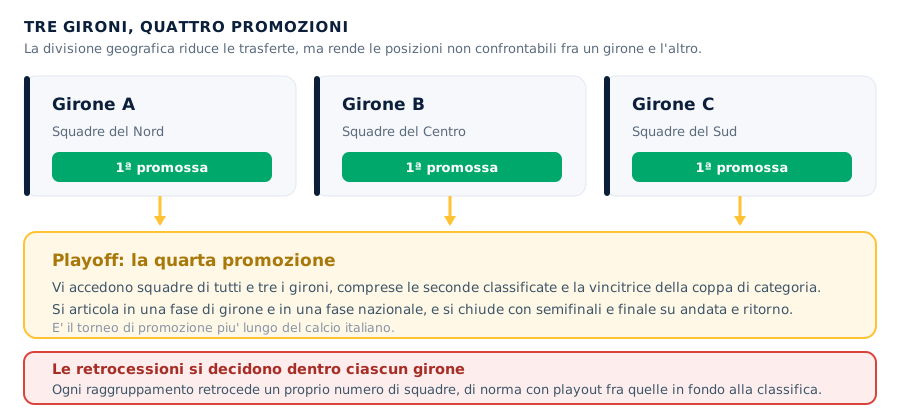
The consequence is that positions cannot be compared. The bottom club of a strong group may have more points than the fourth-bottom of a weaker one, which complicates every comparison across sections.
The format
Each group runs as a league of its own: home and away between the clubs of that section, with a win worth three points and a draw one. The final table of each group determines its promotions, play-offs and play-outs.
The calendar runs deep into June, because knockout stages are added to the league rounds. It is the division with the longest season.
Entry requirements
Serie C also requires the national licence: legal requirements, financial indicators, stadium criteria and youth academy obligations. The thresholds are calibrated to the division, but the check is annual as in the tiers above.
It is the level at which failing those requirements happens most often. A club that does not obtain the licence is not admitted to the following season, even having stayed up on the pitch. The vacant place is reallocated under the rules described in how relegation works.
The application must be accompanied by a bank guarantee and by compliance with the financial indicators. The amounts are lower than in the divisions above but weigh more, because the budgets are smaller. They are revised each year and should be checked against the licensing manual in force.
Deadlines for paying wages and contributions recur through the season. Missing them brings points deductions, and it is the most frequent cause of relegations that do not depend on results.
Squads follow their own constraints, with quotas for young players tighter than in the divisions above. It is a deliberate choice. Serie C is where clubs from Serie A and Serie B send their youngsters on loan, as described in types of transfer.
Posizioni e qualificazioni
| Position | Consequence | Notes |
|---|---|---|
| 1st in each group | Automatic promotion to Serie B | Three promotions, one per section |
| Positions below | Play-offs for the fourth promotion | Twenty-eight clubs from all three groups |
| Mid-table | No consequence | Stay in Serie C |
| Bottom of the table | Play-out | Between clubs of the same group |
| Last in each group | Automatic relegation | Drop to the amateur tiers |
The four promotions
The three group winners go up directly to Serie B. The fourth available place is decided by the play-offs, and this is where Serie C becomes a unique case in European football.
The tournament involves twenty-eight clubs from all three sections, alongside the winner of the divisional cup. It unfolds in two phases. The first is a group phase restricted to clubs of each section. The second is national, and brings in the runners-up, who have rested in the meantime.
It closes with two-legged semi-finals and a final. A club entering at the first round can end up playing around ten matches in little over a month. It is the longest route among those described in the guide to how play-offs work.
Relegation
Relegation is decided within each group, not across groups. Every section sends a set number of clubs down to the amateur tiers, with the bottom club going directly and the other positions settled by play-outs.
The number of relegation places per group, and the gap thresholds that cancel the play-outs, are set by the rules at the start of each season. They change more often than in the divisions above and should be checked against the league’s official release.
Dropping into the amateur tiers is a sharper break than an ordinary relegation: the status of player contracts changes, because the club leaves professional football. The contractual consequences are described in contract clauses.
Reinstatements and exclusions
Serie C is the division where the final table is most often altered by administrative events. When a club fails to obtain its licence or ceases activity, the vacant place is reallocated through reinstatement.
The criterion follows a ranking set out in the rules, weighing final position, club requirements and the geographic balance of the groups. It is why the actual composition of each section is only confirmed in summer, with the season already close.
Premi
Serie C revenue is far below that of the two divisions above. Clubs rely largely on local sponsorship, ticketing and developing young players, rather than on broadcasting rights.
How revenue is shared
The division’s broadcasting rights have a modest overall value, and their distribution among clubs follows criteria set by the division’s own league. The amounts are indicative and should be checked against the official documents listed among the sources.
For many Serie C clubs the most significant item is not current revenue but the capital gain. It is the difference between what a club receives for a homegrown youngster and what he had cost. It is the model that sustains much of the division.
The solidarity mechanism
When a player developed in Serie C is sold years later by a bigger club, a share of the fee returns to the clubs that raised him. It is the solidarity mechanism, described in how the transfer market works.
Alongside it sits the sell-on percentage, which a Serie C club can retain when selling a youngster to a larger side. These are the two channels through which third-division academies are repaid, explained in contract clauses.
What a group winner earns
| Channel | What it involves | Weight |
|---|---|---|
| League prize | A share tied to final position | Very modest |
| Promotion to Serie B | Entry to a higher revenue split | The largest |
| Squad value | Players become sellable at higher fees | Often decisive |
In Serie C the cash prize for winning a group is marginal. The real value lies in the division reached and in the fact that squad players become sellable at higher fees, under the model described above.
What promotion is worth
Going up to Serie B means entering a division with broadcasting revenue an order of magnitude higher. For a provincial club the step changes the scale of the accounts, but it also brings heavier entry requirements and a stadium meeting stricter criteria.
Not every promoted club can sustain that transition, which is why some decline the step or fail to obtain the licence for the division above.
Individual awards
The league names a best player, best goalkeeper, best young player and top scorer for each group. For many players it is the first public recognition of a career, as described in individual awards.
Calciomercato
The Serie C market looks different from the divisions above: few permanent signings, a great many loans and short contracts.
The division of loans
Serie C is the natural destination for young players that Serie A and Serie B clubs want to develop through playing time. The parent club keeps the contract and often contributes to the wages, while the receiving club gains a reinforcement without paying a fee.
The most used formats are the straight loan and the loan with an option to buy, described in types of transfer. The international regulations do cap how many loans each club can make and receive in the same season.
Free agents
In Serie C the market for players without a contract weighs more than elsewhere. Contracts are often one year long, and every summer a high number of players find themselves free and available at any time, even when the windows are shut.
For a club with limited means it is the main route to completing a squad. How the windows and their exceptions work is covered in transfer windows.
The youth requirement
The division’s rules require a minimum number of players within certain age brackets to be fielded, with incentives for clubs that use them. It is how the league pushes clubs to play their own academy graduates rather than relying only on experienced players.
The market consequence is direct. A promising youngster is worth more than his immediate performance, because he helps meet the requirement and opens the possibility of a future sale.