VAR, the video assistant referee, is a match official who reviews footage of the game from a dedicated room. It can only step in on a few decisive situations: goals, penalties, direct red cards and mistaken identity. Under the Laws in force from 1 July 2026, wrongly given second yellow cards and wrongly awarded corners were added. It only intervenes for a clear and obvious error or a serious missed incident. The final decision always belongs to the referee on the pitch.
In short#
- VAR is a match official working in a video room, not a machine that decides on its own.
- It can only review goals, penalties, direct red cards, mistaken identity, second yellows and wrongly awarded corners.
- It only corrects clear and obvious errors, not debatable decisions.
- The referee always decides first, and always decides last.
- Judgement calls are reviewed at the pitchside monitor; objective facts are corrected on the VAR’s information.
- Teams cannot ask for a review: the VAR checks every relevant incident automatically.
- Coach challenges do exist, but in a different system: Football Video Support, on trial in some leagues.
What VAR is#
VAR stands for Video Assistant Referee. The same acronym describes both the person and the system. The person is a qualified referee who watches the match on several screens, with independent access to all available footage. The system is the set of cameras, the video room and the radio links with the pitch.
The VAR does not work alone. The video room, known as the Video Operation Room, also hosts one or more assistants, the AVARs, and the replay operators. The VAR hears everything the officials on the pitch say to each other, but only speaks to the referee by pressing a button.
The rules governing VAR are written by The IFAB, the body that sets the Laws of the Game for every national association. Strictly speaking, VAR is not one of the Laws. It is an attached protocol that each competition may choose to adopt.
The first misconception to clear up is that VAR “referees” the match. It does not. The protocol starts from a precise principle: technology should reduce the most serious errors without taking control of the match away from the referee. That is why the list of situations it can review is short, and everything else is excluded.
| Situation | VAR can intervene | What is checked |
|---|---|---|
| Goal or no goal | Yes | Fouls, handball and offside in the build-up, ball out of play before the goal |
| Penalty or no penalty | Yes | The contact, the place of the foul, any earlier offence |
| Direct red card | Yes | Serious foul play, violent conduct, denying an obvious goal-scoring opportunity |
| Mistaken identity | Yes | A card shown to the wrong player |
| Second yellow card | Yes, only if clearly wrong | The second caution that led to the sending-off |
| Corner kick | Only if the competition uses this option | A wrongly awarded corner, without delaying the restart |
| Ordinary caution | No | Left to the referee’s judgement |
| Midfield foul, throw-in, free kick | No | Outside the protocol |
Why VAR exists#
VAR arrived after years of debate over refereeing errors that decided matches and titles. The IFAB began trials in 2016 and wrote VAR into the Laws of the Game in 2018. That year’s World Cup was the first major tournament with VAR, and Serie A and the Bundesliga had already adopted it the season before.
- Correcting decisive errors. An offside goal or a non-existent penalty can be worth a qualification or survival. VAR exists for those, not for every whistle.
- Protecting the referee. A referee sees an incident once, from a single angle. VAR gives a second chance on the decisions that matter most.
- Catching unseen violence. An elbow or a spit away from the ball often went unpunished. Today VAR can flag it, even after play has restarted.
- Protecting the competition’s credibility. Where television rights and large prizes are at stake, as in the Champions League, an obvious uncorrected error damages the whole product.
- Making decisions consistent. With footage available, similar incidents tend to get similar decisions, even with different referees.
The downside is familiar to anyone who watches football. VAR has moved the arguments rather than ending them. People argue about the line between a “clear” error and a “debatable” call, about waiting times, and about celebrations ruined by a goal disallowed minutes later. Some also argue that slow-motion replays make normal contact at full speed look like a foul.
How VAR works, step by step#
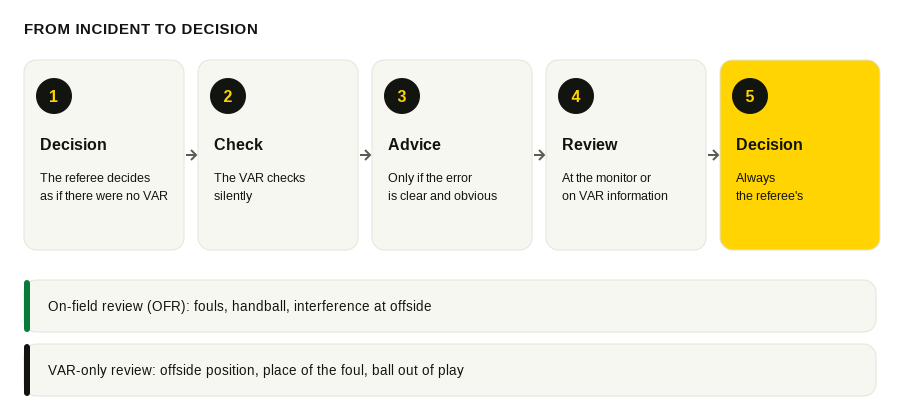
Every VAR intervention follows the same sequence. Knowing it explains why some reviews take a few seconds and others several minutes.
The initial decision#
The referee and assistants must decide as if VAR did not exist. It is an obligation, not advice. The referee cannot leave an incident “pending” and wait for the video room. The decision made on the pitch stands unless the footage shows a clear and obvious error.
The silent check#
The VAR automatically checks every goal, every penalty given or not given, every potential direct red card and every potential case of mistaken identity. Almost always the check is silent: the VAR looks, sees that the decision is correct and says nothing. Viewers do not notice.
When a check takes longer, the referee signals it by holding a finger to the earpiece and extending the other arm. It means the restart is on hold while the video room finishes.
Advice and review#
If the VAR sees a probable clear and obvious error, or a serious incident the referee missed, it says so. Only the referee can start a review: the VAR and the other officials can only recommend one. If play is still going on, the referee stops it as soon as the ball is in a neutral area, without interrupting an attack.
The signal everyone knows is the rectangle drawn with the hands, representing a TV screen. The referee shows it when the review starts and again before announcing the final decision.
On-field review or VAR-only review#
There are two ways of reviewing an incident, and the choice depends on the type of decision.
- On-field review, or OFR. The referee goes to the referee review area by the pitch and watches the footage. It is used for judgement calls: the intensity of a foul, a handball, or interference by a player in an offside position.
- VAR-only review. The referee does not go to the monitor: the VAR describes the footage and the referee decides. It is used for objective facts, such as an offside position, the exact place of a foul or the ball going out of play.
The way footage is watched also changes. Slow motion is for facts: position, point of contact, ball in or out. For the intensity of a challenge or a handball, normal speed is used. Slow motion can make contact look harder than it was at real speed.
The final decision#
The referee shows the TV signal again and announces the decision. Then any disciplinary action is taken and play restarts according to the Laws. The protocol sets no time limit: accuracy matters more than speed. Some competitions ask the referee to explain the decision to the crowd after a review.
The situations it covers#
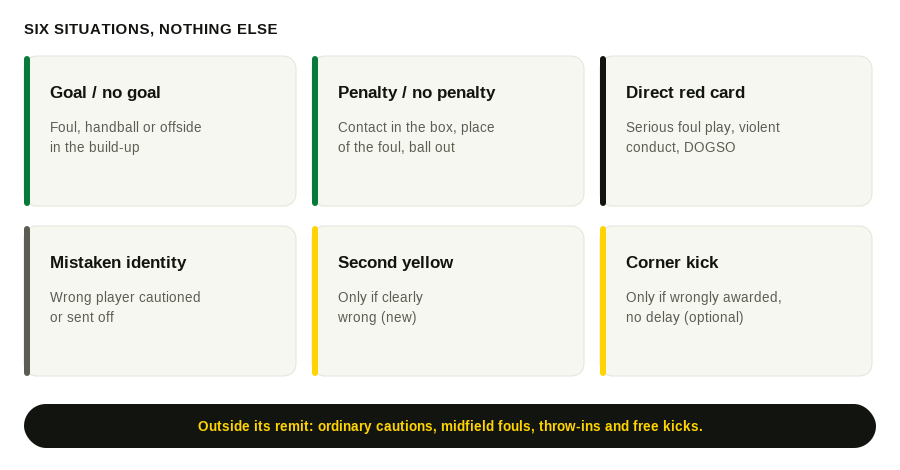
The heart of the protocol is the list of reviewable situations. Outside that list, VAR cannot intervene even for an obvious error.
Goals and penalties#
On a goal, the VAR checks for offences by the attacking team in the move that produced it: fouls, handball, offside. It also checks whether the ball had gone out of play before the goal. On a penalty, it checks the contact, the exact place of the foul, inside or outside the box, and any earlier offences.
The VAR also checks how the penalty is taken. It can intervene if the goalkeeper moves illegally or the kicker commits an offence. It can also intervene if a player enters the area too early and then plays the rebound.
The attacking phase of play#
How far back can a review go? The protocol answers with the idea of the attacking phase. For goals, penalties and denied obvious goal-scoring opportunities, the review can cover the whole move that led to the incident, including how the team won the ball. It cannot reach back to an incident in an earlier phase of play.
Sendings-off and mistaken identity#
VAR intervenes on direct red cards: denying an obvious goal-scoring opportunity, serious foul play, violent conduct, biting, spitting and offensive gestures. If, after the review, the referee decides the offence only deserved a yellow card, the player must be cautioned.
Mistaken identity covers the case in which the referee cautions or sends off the wrong player. VAR can have the card cancelled and shown to the real offender. In this situation only the identity is corrected, not the assessment of the foul.
The new additions: second yellows and corners#
The Laws in force from 1 July 2026 widened the scope. VAR can now intervene on a clearly wrong second yellow card that led to a sending-off. If the review confirms the error, the red card is cancelled. It cannot intervene on a second yellow the referee failed to give.
The second change is optional. Each competition can decide to allow the review of a wrongly awarded corner, but only if the correction is immediate and does not delay the restart. The other changes in the same edition, such as countdowns on throw-ins, are covered on our blog.
The variations: VAR, coach challenges and matches without technology#
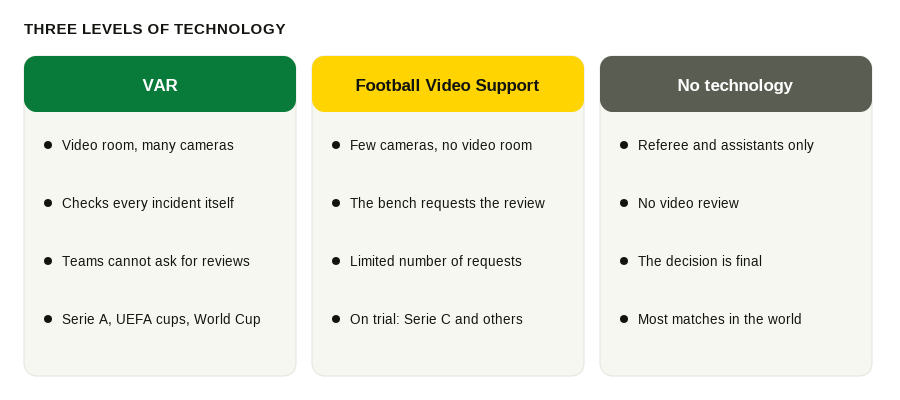
The protocol is the same everywhere, but the level of technology varies a lot from one competition to another. Three situations can be distinguished.
Full VAR#
This is the system used by the major leagues: Serie A, the Premier League, La Liga, the Bundesliga and Ligue 1. It is also used in UEFA competitions such as the Europa League and Conference League, and in national-team tournaments such as the European Championship and the World Cup. There are many cameras, a video room with qualified staff and, often, semi-automated offside technology.
Domestic cups use it too, though not always in every round. In the Coppa Italia and the Italian Super Cup, the set-up depends on the stage and the organiser. The same goes for Serie B, where VAR arrived after the top flight.
Football Video Support#
Football Video Support, or FVS, is what fans call “VAR on request”. It is an experimental FIFA system designed for leagues that cannot afford a video room. It uses only a few cameras and has no VAR: the coach asks for the review, and the referee watches the footage at the side of the pitch.
In Italy, FVS has been on trial in Serie C since 2025. Each team has a limited number of requests per match, and keeps a request if the decision is changed. The reviewable situations are the same as for VAR: goals, penalties, sendings-off and mistaken identity.
Matches without technology#
The vast majority of matches played around the world use no technology at all. In amateur and youth football the officials on the pitch decide, and their decision is final. Reading situations live, without replays, remains the core skill of every referee.
Edge cases and exceptions#
Some parts of the protocol are little known, and they explain many situations that seem inconsistent.
After play has restarted#
Once play has restarted, the referee can no longer go back on a decision. There are two exceptions: mistaken identity, and sendings-off for violent conduct, spitting, biting or seriously offensive gestures. That is why an irregular goal not ruled out before kick-off stands, while an elbow spotted later can still cost a red card.
Likewise, a wrong restart such as a throw-in or a corner cannot be corrected once play has resumed. This also applies to corners in competitions that allow them to be reviewed.
Cards given during a cancelled move#
If a decision is changed, disciplinary action taken in the meantime stands. The exception is a caution or sending-off for stopping a promising attack or an obvious goal-scoring opportunity. If, for example, the goal is disallowed, that card loses its reason and is withdrawn.
The flag that stays down#
Assistants may only delay an offside flag in a very clear attacking situation. They must raise it as soon as the move ends with a goal, a penalty, a free kick, a corner or a throw-in. The aim is to avoid stopping a legitimate move that could then never be restored.
Protests and players’ signals#
Players cannot ask for a review, because the VAR checks everything automatically. Anyone who repeatedly mimes the TV signal is cautioned. During a review, players may not surround the referee or try to influence the decision.
If the system fails#
A technical failure, a wrong VAR decision or a review of a non-reviewable incident does not void the match. The result stands. If no qualified official is available to replace a VAR or a replay operator, the match carries on without VAR.
Terms that get confused#
- VAR and AVAR. The VAR leads the video room. The AVAR is the assistant who follows the live match while the VAR reviews an incident.
- Check and review. The check is the silent look at every relevant incident. The review is the formal process started by the referee.
- On-field review and VAR-only review. In the first, the referee watches the footage at the monitor. In the second, the referee decides on the VAR’s description, and it is reserved for objective facts.
- Clear and obvious error and debatable decision. VAR only corrects the first. A decision that can be argued either way stays as it was given on the pitch.
- VAR and semi-automated offside. Semi-automated offside is a tool that helps the VAR measure position. It does not decide, and it does not exist without a VAR.
- Coach challenge and Football Video Support. In everyday language they are the same thing. FVS, however, is not VAR with challenges: it is a separate system with no video room.
- TV analysis and VAR. Television analysis of incidents has no effect on the result. The VAR is a match official, and its advice changes decisions.
What happens after a review#
The first consequence is on the game itself. If a goal is disallowed, play restarts with a free kick for the offence found. If a penalty is withdrawn, play restarts with a dropped ball or with a free kick for any earlier foul. If a review awards a penalty, play restarts from the spot.
The second is on time. Time spent on reviews is added on at the end of each half, which explains why stoppage time is longer than it used to be. In matches with several interventions, the total can easily exceed ten minutes.
The third is on the table. A disallowed goal or a withdrawn penalty changes the result, and with it the points table. In the decisive stages it affects survival, the play-offs and qualification for European competitions.
Finally there is the effect on suspensions. A sending-off confirmed by VAR leads to a ban under the disciplinary rules of the competition. A sending-off cancelled after a review produces no ban, as if the card had never been shown.
VAR across competitions#
Anyone who follows several competitions notices differences in timing and communication, not in the protocol. In some competitions the referee announces the decision over the stadium speakers, in others not. In Serie A and the Champions League corners can be reviewed; where a competition has not chosen this option, they remain out of scope.
In national-team competitions such as the Nations League and the Copa América, VAR is present at least in the final stages. The UEFA Super Cup uses the same system as UEFA’s club competitions. Across the European competitions the protocol is identical for all three cups.
Frequently asked questions#
Who decides when VAR is used?#
Only the referee can start a review. The VAR checks every relevant incident automatically and, if it sees a clear and obvious error, recommends a review. The final decision always belongs to the referee on the pitch.
Teams cannot ask for anything. The only exception is Football Video Support, on trial in some leagues such as Serie C, where the coach requests the review with a limited number of challenges.
Can VAR overturn a yellow card?#
No, except in two cases. The first is mistaken identity, when the yellow card is shown to the wrong player. The second, under the Laws in force from 1 July 2026, is a clearly wrong second yellow card that led to a sending-off.
A debatable first yellow, or a yellow card not given, remains outside the protocol. The same applies to a second yellow the referee should have given but did not.
Why does VAR sometimes ignore an obvious mistake?#
Because the incident is not one of the reviewable situations, or because play has already restarted. A midfield foul or a wrong throw-in cannot be reviewed, however obvious the error.
The video room may also consider the decision “debatable” rather than “clearly wrong”. In that case the protocol requires the decision made on the pitch to stand, even if many viewers disagree.
How long can a VAR review take?#
The protocol sets no time limit, because accuracy matters more than speed. Most checks are completed in a few seconds, without stopping play.
The longest reviews usually involve manually drawn offside lines or incidents with many camera angles to compare. Time lost is added on at the end of the half, which is one reason stoppage time has grown.
What does clear and obvious error mean?#
It is an error the footage shows without any need for interpretation. The test stops VAR from replacing the referee’s judgement on incidents where two competent people could reasonably disagree.
The test does not apply to objective facts. An offside position, a ball out of play or the place of a foul are corrected even by a few centimetres, because there is nothing to interpret.
Can a goal be disallowed after kick-off?#
No. Once play has restarted, a goal that was allowed can no longer be ruled out, even if the footage shows an irregularity. That is why the referee waits for the check to finish before allowing the kick-off.
After the restart, only mistaken identity and sendings-off for violent conduct, spitting, biting or seriously offensive gestures can be reviewed. The goal, meanwhile, stands.
Why does the referee sometimes go to the monitor and sometimes not?#
It depends on the type of decision. For judgement calls, such as the intensity of a foul or a handball, the referee goes to the monitor and watches the footage. For objective facts, the referee decides on the VAR’s description without moving.
The protocol still allows a monitor review for an objective fact. This happens when the decision matters for managing the match, for example a decisive incident in the final minutes.
Is VAR used in every league?#
No. It is used in the major leagues, such as Serie A and the Premier League, in UEFA competitions and at major national-team tournaments. Lower divisions and amateur football, in most cases, play without it.
Between the two sits Football Video Support, a reduced version with few cameras and reviews on request. It is designed precisely for leagues that cannot meet the cost of a video room.
Can a VAR mistake lead to a replay?#
No. The protocol states that a match is not invalidated by a technology failure, a wrong VAR decision or a review of a non-reviewable incident. The result is the one decided on the pitch.
Errors can have consequences for the officials involved, who are assessed by their refereeing bodies. On the result and the table, however, they change nothing.