- 36 Clubs
- 6 Matches each
- 1 Europa League place
- Jul-May Season
Regolamento
The Conference League is the third and newest European club competition. It exists to answer a specific problem: many countries never saw their clubs survive the summer.
Why it was created
With only two competitions, places concentrated in the countries with the highest coefficients. Clubs from smaller associations entered the July qualifying rounds and were out before their own season had begun.
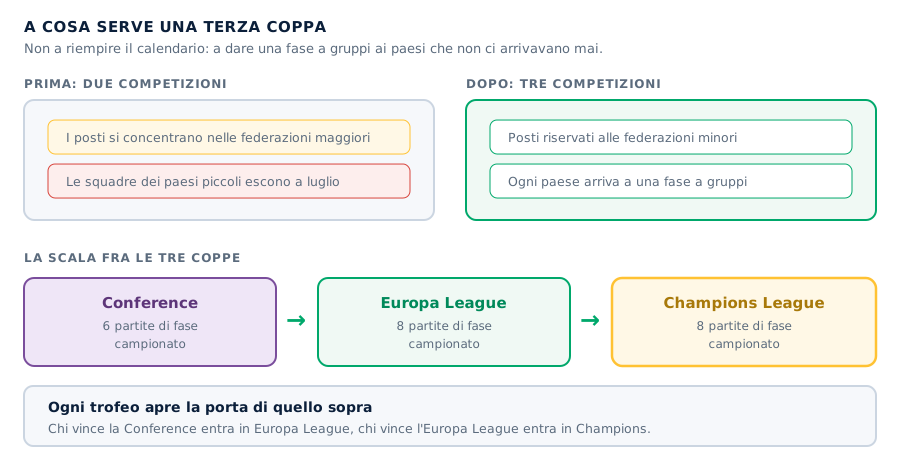
The third cup added places reserved for smaller associations, with the stated aim of giving every affiliated country at least one club in a group stage. That is why it exists, and it should be borne in mind when judging it.
The format
Thirty-six clubs in a single table, as in the other two cups. The difference lies in the number of matches: six instead of eight.
Clubs are split into six pots rather than four, and each faces six different opponents, three at home and three away. There are no two-legged ties in the league phase.
| Position | Consequence | Note |
|---|---|---|
| 1st — 8th | Straight to the round of sixteen | Two matches saved |
| 9th — 24th | Two-legged play-off | Second leg at home for the higher-placed club |
| 25th — 36th | Elimination | The European season ends |
Why six matches and not eight
The choice answers a practical constraint. The clubs taking part have shallower squads and domestic calendars with no room for ten extra European fixtures.
Two fewer matches mean two fewer away trips to fund and two fewer midweek rounds to absorb. For a club from a smaller country the difference is substantial.
How clubs get in
| Route | Who |
|---|---|
| Domestic league | Clubs in the places below the Europa League positions |
| Domestic cup | Cup winners of the lower-ranked countries |
| Qualifying rounds | A long road, largely reserved for smaller associations |
| Transfer from above | Clubs knocked out of Champions or Europa League qualifying |
The chain of places cascading downwards is described in the guide to European qualification. It ends precisely here: when a place falls vacant higher up, the final effect lands on this competition.
The calendar
- July First and second qualifying rounds: this is where clubs from the smallest associations come in.
- August Third round and play-offs, joined by clubs eliminated from the competitions above.
- October to December The six league-phase rounds, on Thursdays.
- February Play-offs between ninth and twenty-fourth.
- March to April Round of sixteen, quarter-finals and semi-finals over two legs.
- May The final, a single match at a neutral venue, before the other two.
The rules on the pitch
The same rules as the other two cups apply. Away goals carry no weight, a level tie goes to extra time and penalties, and the UEFA list reserves places for club-trained players.
In the single table, equal points are separated by overall goal difference. Head-to-head results almost never exist, because each club faces different opponents: the same logic described on the Champions League page.
Posizioni e qualificazioni
| Outcome | Consequence | Note |
|---|---|---|
| Winning the competition | A Europa League place | League phase, not qualifying |
| Rounds won | Coefficient points | Worth less than points from the other two cups |
| Several clubs going deep | Future places for the country | Most visible for mid-sized countries |
| Knocked out in qualifying | European season over in July | The problem the competition set out to reduce |
What the winner takes
The winner enters the Europa League league phase the following season. It is not a Champions League place of the kind described on the Europa League page, but it completes the ladder between the three competitions.
If the winner has already qualified for a European competition, the place is not lost: it passes down its domestic table.
The effect for mid-sized countries
For a country such as Italy, the Conference League matters mainly as a source of coefficient points. A club going deep produces points that add to those of the others, and the total sets future places under the UEFA ranking calculation.
The value per point is lower than in the other two competitions. The number of rounds available is high, though, and a long run counts for more than the name of the cup suggests.
The comparison makes it plain: a country with three clubs going deep across the three cups gains more places than one with a single Champions League semi-finalist.
The recurring criticism
The competition is accused of lengthening already crowded calendars. Those who wanted it reply that the extra matches largely involve clubs that previously played none at all.
Both positions have merit, and the judgement depends on where you stand: at a leading club, or at one that had never made it past July.
It is worth noting that the competition has already brought a European trophy to clubs that had never won one, and to countries that had never seen one. For the other European leagues it is the most concrete change of recent years.
Premi
The payments are the lowest of the three UEFA competitions in absolute terms. Measured against the budgets of those taking part, they are often the most significant.
The distribution channels
| Channel | Criterion | Weight |
|---|---|---|
| Participation fee | Equal for every qualified club | The largest component for smaller clubs |
| Results | A payment per win and per round reached | Grows along the way |
| League-phase position | One step for each place among the thirty-six | Introduced with the new format |
| Coefficient and market | European history and television market | Less significant than in the other cups |
How much it really matters
For a club from a smaller country the participation fee alone can approach its annual budget. That is why qualification is chased with the same intensity a Serie A club chases fourth place.
For a club from one of the major leagues, by contrast, the income is modest against the cost of the run. The difference in perspective explains why the same competition is judged in opposite ways.
Match-day income
Six league-phase matches mean three at home. For clubs used to few high-profile fixtures, the gate receipts from three European nights weigh on the accounts more than the UEFA payment.
Solidarity
This competition also feeds the fund for non-qualified clubs and for the clubs that trained the players involved, on the logic described in the guide to the transfer market.
Calciomercato
For most of the clubs taking part, this is a first European campaign. The rules to know are the same as in the other cups, but the effect on the squad is different.
The squad has to grow
Six league-phase matches plus qualifying and knockout rounds can reach twenty fixtures. For a club that used to play thirty-eight, that is an increase of more than half.
A club qualifying in spring therefore has to build a deeper squad over the summer. The list constraints are those set out on the Napoli page and in the guide to types of transfer.
The UEFA list
The numerical ceiling applies, with places reserved for club-trained and association-trained players. For a club that has never played in Europe this can require adjustments: UEFA’s requirements do not match domestic ones.
The bar on a player appearing in two UEFA competitions in one season for different clubs applies here too.
The shop window
European matches are when players from smaller countries are watched by bigger clubs. Many significant transfers begin with a good performance in this competition.
For clubs living on capital gains, as described on the Ligue 1 page, that exposure is worth as much as the prize money.
Qualifying rounds and the transfer calendar
The July rounds fall before the summer window closes. A club can therefore play them with an incomplete squad, and finish assembling it in August, once the European campaign is already settled.
It is a structural disadvantage for anyone starting in qualifying, and should be read alongside the dates in the guide to transfer windows.