- 44 Clubs
- 1 European place
- Aug-May Season
- 1 Match per round
Regolamento
The Coppa Italia is Italian football’s domestic cup. It is played on a knockout basis and awards a Europa League place to the club that wins it, regardless of where that club finished in the league.
Who takes part
Forty-four clubs enter: the twenty from Serie A, the twenty from Serie B and four from Serie C, nominated by that division’s league.
It is a competition reserved for professional football. Amateur clubs have their own separate national cup.
There is no separate entry application. Participation follows from admission to the league: a club granted the national licence for its division automatically enters the cup as well, with no additional guarantees or requirements. It is a substantial difference from the leagues described in Serie A and Serie B.
The bracket is not drawn
This is what sets the Coppa Italia apart from most European domestic cups. The bracket is set at the start according to the clubs’ sporting ranking, and stays fixed throughout the competition.
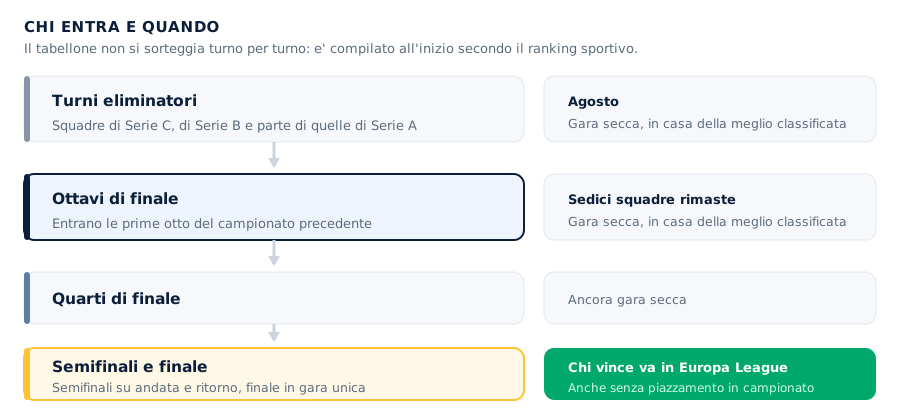
Anyone following the competition therefore knows every club’s full route in advance: which opponent it would meet in the quarter-finals, in the semi-finals, in the final. No draw reshuffles the tie between rounds.
The advantage is predictability, which lets grounds and calendars be planned far ahead. The cost is that the leading clubs start from protected positions and meet only in the closing stages.
The match formats
Up to the quarter-finals ties are single matches, always at the ground of the better-ranked club. If the score is level after ninety minutes the tie goes to extra time and, if needed, penalties.
The semi-finals are played over two legs. The final is a single match at a neutral venue.
| Stage | Format | Venue | If level |
|---|---|---|---|
| Preliminary rounds | Single match | Better-ranked club | Extra time and penalties |
| Last sixteen and quarters | Single match | Better-ranked club | Extra time and penalties |
| Semi-finals | Two legs | Return at the better-ranked club | Extra time and penalties |
| Final | Single match | Neutral venue | Extra time and penalties |
With no group stage, the Coppa Italia has no table and awards no points. All that matters is going through, as explained in the guide to the points system.
Why the calendar matters
The preliminary rounds are played in August, just before or after the league starts. For a Serie B or Serie C club that means facing a decisive match with pre-season barely finished.
The closing stages fall between January and May, and interlock with the European fixtures of clubs competing in the Champions League and the other continental competitions. It is one reason some clubs field alternative line-ups in the early rounds.
Posizioni e qualificazioni
| Outcome | Consequence | Notes |
|---|---|---|
| Winning the cup | A Europa League place | Independent of league position |
| Winning the cup | Entry to the Supercoppa | Alongside the other qualified clubs |
| Losing the final | No European place | Only the winner takes the trophy |
| Elimination | No consequence | Does not affect the league table |
The Europa League place
The Coppa Italia winner earns a place in the Europa League regardless of where it finished in the league. It is the mechanism that makes the competition worth pursuing for clubs not competing for the top positions: winning it is often the only realistic route into Europe.
If the winner has already earned a European place through the league, the cup place is not lost. It passes to the club finishing immediately below the last one already qualified in Serie A, and the effect propagates down the whole chain.
At the end of the chain it is usually the Conference League that receives the surplus place, being the last competition in the sequence. The full picture is in the guide to European qualification.
The Supercoppa
Winning the Coppa Italia also grants entry to the Italian Supercoppa, the trophy contested by the previous season’s leading clubs. That competition’s format has changed several times and should be checked against the rules in force.
What it does not carry
Elimination from the Coppa Italia has no effect on the league. It costs no points and does not touch the table, nor does it bear on the relegations described in how relegation works.
Winning it brings no UEFA coefficient points either. The coefficient records only matches in the continental competitions. The domestic cup therefore counts indirectly: it opens the door to the Europa League, and it is those matches that generate points.
Premi
The financial value of the Coppa Italia lies more in what it opens than in the prize itself.
What the winner earns
| Channel | What it involves | Weight |
|---|---|---|
| Competition prize | A share allocated by the organising league | Modest |
| Europa League entry | Participation payment plus performance bonuses | The largest |
| Gate and broadcasting | Home match receipts and the television share | Varies with the run |
The amounts are indicative and change with every cycle: they should be checked against the league’s official documents, listed among the sources. The proportion between the channels is stable, though, and that is what counts: the cup prize is worth far less than the European place the cup awards.
For a mid-table club the arithmetic is simple. Winning the Coppa Italia means going from no continental revenue to a full European season, with effects visible in the following summer’s transfer market.
The trophy and individual awards
The winning club receives the competition trophy. There are no individual honours comparable to the league’s. The cup’s top scorer does not compete for the European Golden Shoe, which counts only league goals, as explained in individual awards.
Calciomercato
The Coppa Italia affects the transfer market indirectly but concretely, through two channels.
The European place changes the plan
A club that wins the cup finds itself with an extra competition to play the following season. More players of comparable level are needed, because nobody can cover three fronts at once, and the squad has to be widened in the transfer windows that follow.
The opposite applies to whoever loses. A club that had built its budget around a European place has to revise it, and the qualification clauses described in contract clauses do not trigger.
The shop window of the early rounds
For Serie B and Serie C clubs the preliminary rounds matter a great deal. They are one of the few chances to face a higher-division opponent in front of a large audience. A strong performance can change a player’s valuation far more than a league match.
It is one of the moments when scouts from the bigger clubs concentrate their work. How a performance turns into a transfer is covered in how the transfer market works.
Why some clubs do not really play it
In the early rounds line-ups often look very different from the league ones. It is not indifference but a calendar decision.
A club also playing in Europe has a match every three days for months, and the rules allow five substitutions but do not lengthen the squad. Fielding the reserves in the opening rounds is how clubs arrive intact at the matches that weigh more in the table.
The calculation changes from the quarter-finals onwards, when the final is close and the Europa League place becomes concrete. That is when clubs that had rotated go back to their strongest line-up.
Which players are eligible
Only players properly registered and included in the required lists can play. A player signed after the competition has begun may be eligible in the league but not yet in the cup, depending on when the registration took place.
The formats through which those registrations happen, from permanent transfers to loans, are described in types of transfer.