- 20 Clubs
- 38 Rounds
- 3 Promoted
- 4 Relegated
Regolamento
Serie B is the second division of Italian football. Twenty clubs take part in a single group, using the same format as the division above: thirty-eight rounds, home and away.
The format
Each club faces the other nineteen twice, once at home and once away. The regular season therefore closes after thirty-eight rounds, but the campaign does not end there: play-offs and play-outs add further matches for some clubs.
A win is worth three points, a draw one, a defeat none. The criterion is identical across professional football, and its consequences are set out in the guide to the points system.
What sets Serie B apart
The main difference from Serie A is not the format but how many places remain open after the final round. In Serie A every position is settled by the table. In Serie B two of the seven places at stake, one upwards and one downwards, are decided by extra matches.
It is why the Serie B season runs into June, while Serie A closes in May.
How ties are broken
The sequence matches the one Serie A uses for ordinary positions. It applies in this order: head-to-head points, head-to-head goal difference, overall goal difference, goals scored, drawing of lots. The first criterion that separates the clubs decides.
Where the tie affects positions granting access to the play-offs or play-outs, the rules may call for a single decider match. Those rules change from season to season and should be checked against the league’s official release.
Entry requirements and squads
As in Serie A, admission depends on the national licence: legal requirements, financial indicators, stadium criteria and youth academy obligations. The thresholds are calibrated to the division and are lighter than in the top flight, but the logic is the same.
A club failing to obtain the licence is not admitted, even having earned the right on the pitch. It is one of the situations described in how relegation works, and it occurs more often in Serie B because financial margins are tighter.
What entry requires
The application for admission must be filed by a deadline set each year, accompanied by four groups of documents.
| Requirement | What it involves | When it is checked |
|---|---|---|
| Application and documents | Entry by the deadline, articles and accounts | June |
| Bank guarantee | First-demand security, amount set by the manual | June |
| Financial indicators | Liquidity, debt, extended labour cost | Several times a season |
| Wages and contributions | Payment by the deadlines, on pain of points deduction | Recurring deadlines |
The guarantee amount and the indicator thresholds are revised every year in the licensing manual and should be checked against the document in force, listed among the sources. The deadlines for paying wages and contributions recur through the season, and missing them brings points deductions.
Squad composition follows its own rules, with limits on numbers and quotas reserved for players developed in Italian academies. Deals happen within the periods described in transfer windows, which for the lower divisions may have different deadlines from Serie A.
Posizioni e qualificazioni
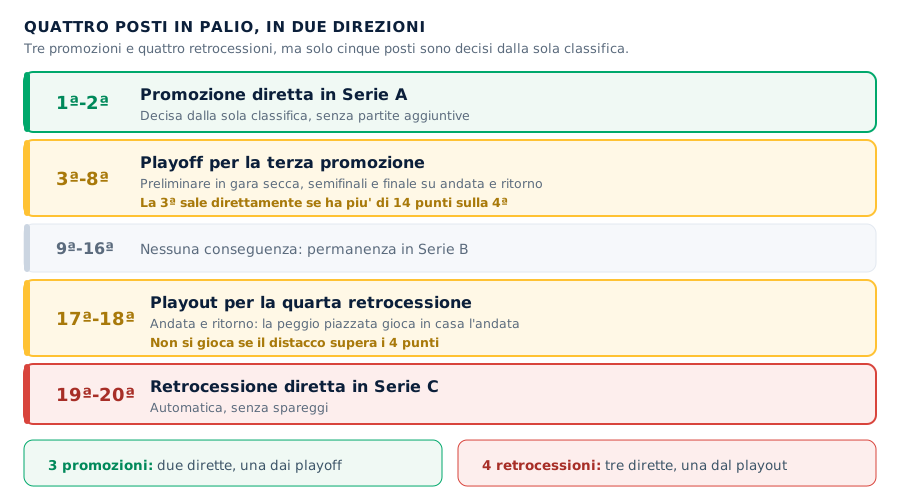
| Position | Consequence | Notes |
|---|---|---|
| 1st — 2nd | Automatic promotion to Serie A | Decided by the table alone |
| 3rd — 8th | Play-offs for the third promotion | 3rd goes up directly with over 14 points on 4th |
| 9th — 16th | No consequence | Stay in Serie B |
| 17th — 18th | Play-out | Not played if the gap exceeds 4 points |
| 19th — 20th | Automatic relegation to Serie C | No deciders |
The three promotions
The top two are promoted directly to Serie A. The third available place is decided by a play-off between the clubs finishing third to eighth.
A threshold can cancel it, however. If the third-placed club finishes with more than fourteen points over fourth, it goes up directly and the play-off is contested only for the remaining positions. The reasoning is fairness: a gap that wide built over thirty-eight rounds should not be overturned in a handful of matches.
The bracket features a single-match preliminary round, then two-legged semi-finals and final. Third and fourth enter at the semi-final stage, and if the aggregate is level the better-placed club goes through. The full mechanism is in the guide to how play-offs work.
The four relegations
The bottom three drop directly to Serie C. The fourth relegation is settled by the play-out between the seventeenth and eighteenth-placed clubs.
A lower threshold applies here too. If the gap between the two exceeds four points, the play-out is not held and the lower-placed club goes down directly. Below that threshold the tie is played over two legs, with the lower-placed club hosting the first.
If the aggregate is level the better-placed club survives: it only needs to avoid defeat. These are the play-off safeguards applied in reverse, as described in how relegation works.
What Serie B does not award
No Serie B position grants a place in the European competitions. Access to Europe runs through the top division and the Coppa Italia, as explained in European qualification.
Serie B clubs do enter the Coppa Italia, joining at the summer preliminary rounds. Winning it would in theory grant a Europa League place, although the bracket makes that outcome very unlikely for a second-division club.
Premi
Serie B revenue is an order of magnitude below the top flight. It is the gap that makes promotion the financial as well as the sporting objective of nearly every club.
How revenue is shared
Broadcasting rights in Serie B are also sold collectively. The split combines a share equal for all, a share tied to results and a share tied to a club’s following. The proportions are set by the division’s own league and do not match those of Serie A.
The amounts are indicative and change with every rights cycle: they should be checked against the official documents listed among the sources.
The parachute payment
Clubs just relegated from Serie A receive a transition payment, also called a parachute, paid by the division above to soften the collapse in revenue. It is the instrument that stops a relegation overwhelming a club’s accounts.
It does create an imbalance inside Serie B: clubs receiving it have resources the long-established ones do not. It is why recently relegated clubs start the promotion race with a financial advantage.
Contract clauses reducing wages on relegation work in the same direction, and are described in contract clauses.
What the champion earns
As in Serie A there is no separate cheque for the divisional title. What counts is promotion, and the two almost always coincide.
| Channel | What it involves | Weight |
|---|---|---|
| Merit share | The largest slice of the results-linked portion | Modest |
| Promotion to Serie A | Entry to the top division’s revenue split | The largest |
| Gate and sponsorship | Season tickets and renegotiated contracts | Varies by club |
The amounts are indicative and should be checked against the official documents. The proportion is clear, though: winning Serie B is worth little in itself and a great deal for where it leads.
What promotion is worth
Going up to Serie A multiplies broadcasting revenue. The share a newly promoted club receives in the top flight exceeds what a Serie B club earns across an entire season. Ticketing and sponsorship are revalued on top of that.
It is the largest financial step in Italian football, and the reason the play-offs described in how play-offs work are followed as closely as the title race.
Individual awards
The league names a best player, best goalkeeper, best young player, best coach and top scorer of the division. They are less visible than the top-flight equivalents but often decisive for careers, as described in individual awards.
Calciomercato
The Serie B market follows the same windows as the top flight, but with very different dynamics.
The weight of loans
Serie B is the main destination for young players sent out to play by Serie A clubs. A loan lets the player accumulate real matches and lets the parent club lighten its wage bill, often by contributing to the salary.
For Serie B clubs the loan is in turn the instrument that allows a competitive squad to be assembled without paying transfer fees. The available formats, including options and obligations to buy, are described in types of transfer.
The division constraint
A Serie B club signs players knowing the division can change in either direction within months. Contracts therefore include clauses tied to promotion or relegation more often than elsewhere, automatically adjusting wages to the tier reached.
The January window is particularly sensitive. Clubs chasing promotion invest, clubs in the play-out zone look for immediate reinforcements, and prices rise for both. The general mechanism is in transfer windows and how the transfer market works.