- 20 Clubs
- 38 Rounds
- 3 Relegated
- Aug-May Season
Regolamento
The Premier League is the top division of English football. Twenty clubs play in a single group, home and away, over thirty-eight rounds.
The format
Each club meets the other nineteen twice, once at home and once away. Three points for a win, one for a draw, none for a defeat: the criterion set out in the guide to the points system.
There are no play-offs. The final table settles everything, at both ends. That differs from the Italian Serie B, where play-offs and play-outs add matches after the last round.
How two clubs on equal points are separated
The first criterion is goal difference, then goals scored. Only if those also match are head-to-head results considered.
It is the reverse of Serie A, where head-to-head comes first. The practical effect is that winning heavily counts in England, while beating your direct rival counts in Italy.
If two clubs finish level at the top, or on a place that decides relegation, the rules provide for a decider at a neutral venue. It is a rare outcome but a foreseen one.
No winter champion, no long break
The Premier League plays through the end-of-year holidays, with a round the day after Christmas. It is a deep-rooted tradition, not a recent scheduling choice.
A winter break does exist, but it is short and staggered: clubs do not all stop on the same weekend. It remains the most densely scheduled of the major European competitions.
Entry requirements
To be admitted, a club must pass checks on three fronts: ownership and directors, financial sustainability, and stadium requirements.
| Requirement | What it involves | When it is checked |
|---|---|---|
| Owners and directors test | Checks on convictions, insolvency and conflicts of interest | On entry and at every change of control |
| Sustainability rules | A ceiling on losses accumulated over three years | Annually, on filed accounts |
| Stadium requirements | Capacity, safety, all-seater status, floodlighting | Before the season starts |
| Wages and obligations | Payments to registered players and to other clubs | Recurring deadlines through the season |
Breaching the sustainability rules brings not a fine but a points deduction. It is a sanction that acts on the pitch, and it has been applied more than once in recent years.
Squad composition
Each club files a list of twenty-five players over twenty-one. A minimum number of them must be homegrown, meaning registered with an English or Welsh club for at least three seasons before turning twenty-one.
Players under twenty-one take up no list places: they can be selected freely. That is why English clubs tend to register young players early, as explained in the guide to types of transfer.
Posizioni e qualificazioni
| Position | Consequence | Note |
|---|---|---|
| 1st | English champions | No decider: the table settles it |
| 1st — 4th | Champions League league phase | A fifth place is possible on continental merit |
| 5th | Europa League | Can shift depending on the domestic cups |
| 6th — 7th | Possible Conference League | Depends on who wins the two domestic cups |
| 8th — 17th | No consequence | Stay in the division |
| 18th — 20th | Relegation to the second tier | Direct, with no play-out |
The European places
The top four enter the league phase of the Champions League. A fifth place can be added when England is among the best-performing countries of the season: the mechanism is explained in the guide to European qualification.
The two domestic cups award further places. If their winners have already qualified through the league, the place is not lost: it passes to the next club in the table.
The three relegations
The bottom three go down directly. There are no survival play-offs, which makes the final round far starker than the arrangements described in the guide to how relegation works.
Three clubs come up from the second tier: the top two directly, the third through a mini-tournament among the sides placed third to sixth. That final is widely considered the most lucrative club match in the world, for the jump in revenue it brings.
The gap promotion creates
Moving between the second tier and the top flight multiplies broadcasting revenue several times over. It is why the English second division is so competitive, and why relegation destabilises even solid clubs.
Comparing with Serie A helps frame the difference. In Italy the drop to Serie B hurts a great deal, but the economic distance between the two divisions stays smaller than in England.
The title and the coefficient
Top positions matter beyond the current season. How English clubs perform in Europe feeds the country coefficient, which in turn sets how many European places will be available in later years. The calculation is explained in the guide to the UEFA ranking.
Premi
The Premier League earns more from broadcasting than any other league in the world. How it shares that money out explains much of its competitiveness.
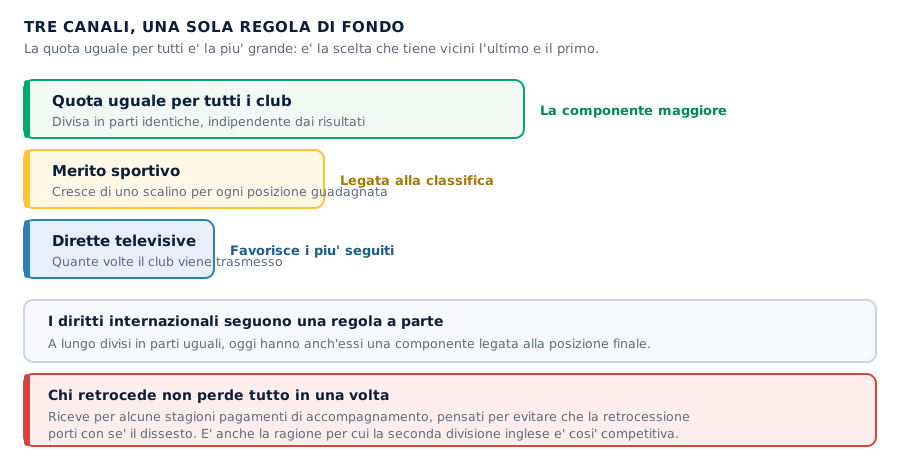
The three channels
| Channel | How it is calculated | Who it favours |
|---|---|---|
| Equal share | Split identically among the twenty clubs | The smaller sides |
| Merit payment | One step for each place in the table | Those finishing higher |
| Facility fees | Number of matches shown live | The best-supported clubs |
The gap between first and last in total receipts stays narrow compared with other leagues. It is the opposite of the old Spanish model, where the two largest clubs negotiated their rights individually.
What relegated clubs receive
A relegated club keeps receiving parachute payments for several seasons, decreasing over time. They exist so that the sudden loss of revenue does not push a club into collapse.
The side effect is that recently relegated clubs start the second tier at an advantage, which fuels a constant debate about the balance of that division.
What the title is worth
The prize money for finishing first is modest against the rest. The real value of winning lies elsewhere: in Champions League entry, in commercial contracts, and in the merit payment, which over time weighs more than the trophy.
Calciomercato
The English market follows the international rules described in the guide to how the transfer market works, with some features of its own.
The windows
There are two sessions, summer and winter, on dates set by the federation within international limits. The detail is in the guide to transfer windows.
The English summer deadline often falls on a different date from the other major leagues. When England closes first, its clubs are exposed: they can receive offers from abroad without being able to replace anyone who leaves.
Young players and the age rule
International rules ban transfers of minors between federations, with narrow exceptions. Since the United Kingdom left the European Union, the exception allowing sixteen-year-olds to move within Europe no longer covers signings from the continent.
The result is heavier investment in domestic academies, and a points-based system governing which foreign players can obtain a work permit.
Training and compensation
When a player changes club, the clubs that developed him are owed a share. The solidarity mechanism and training compensation are described in the guide to clauses and contracts.
How it compares
| Aspect | Premier League | Other major leagues |
|---|---|---|
| Survival play-offs | None | Present in Germany and France |
| Tie-break criterion | Goal difference | Head-to-head in Italy and Spain |
| Financial control | After the fact, with points deductions | Preventive in Spain and France |
| Second teams | Not admitted to the professional pyramid | Admitted in Italy, Spain and Germany |